
‘They Came to Kill’: The Death of Nasrallah Abu Siyam and the Unfolding Reality of the West Bank
The article reports on the killing of 19-year-old Palestinian-American Nasrallah Abu Siyam by Israeli settlers in the occupied West Bank village of Mukhmas, detailing how armed settlers attacked a farmer, prompting resident intervention, and were reportedly emboldened to use live fire upon the arrival of Israeli forces who used “riot dispersal methods” but denied shooting. His death, confirmed by the Palestinian Health Ministry and witnessed by locals, marks the first fatality caused by settlers in 2026 and highlights a broader context of systemic violence and impunity, as evidenced by a concurrent UN report accusing Israel of war crimes and potential ethnic cleansing in the West Bank through displacement and settlement expansion, while also documenting the torture of imprisoned Palestinian journalists and the immense, long-term challenge of removing rubble in Gaza.
‘They Came to Kill’: The Death of Nasrallah Abu Siyam and the Unfolding Reality of the West Bank
The hills east of Ramallah have always held a particular kind of quiet. For generations, the stone villages dotting this landscape—Mukhmas, Kafr ‘Aqab, Jaba—have existed in a tense equilibrium with the land itself, tending olive terraces that predate the arrival of modern borders, checkpoints, and the sprawling Israeli settlements that now claim the ridge lines. But on a Wednesday afternoon in late February 2026, that quiet was shattered in a way that residents say felt both sudden and terribly predictable.
By Thursday morning, the world had learned a name: Nasrallah Abu Siyam. Nineteen years old. Palestinian-American. Dead.
The official statements arrived with the clinical detachment that has come to characterize such tragedies. The Palestinian Ministry of Health confirmed his death from critical wounds. The Israeli military acknowledged using “riot dispersal methods.” A U.S. embassy spokesperson offered a condemnation of the violence. But for those who witnessed what happened in the rocky fields outside Mukhmas, the reality defies the sanitized language of press releases.
To understand what happened to Nasrallah Abu Siyam is to understand a much larger story—one about land, about impunity, about the collision of international law with local life, and about what happens when armed civilians descend on a village with the apparent confidence that no one will stop them.
The Day the Settlers Came
Raed Abu Ali, a resident of Mukhmas who witnessed the events, described a sequence that began with almost mundane familiarity. Settlers from nearby outposts have been encroaching on village lands for years, he explained. Sometimes they come to graze livestock on land that Palestinians have farmed for decades. Sometimes they come to damage olive trees or spray-paint graffiti. Sometimes they simply appear on the hilltops, a visible reminder of who holds power in this stretch of the West Bank.
But Wednesday was different.
“A group of settlers came to the village and attacked a farmer who was working his land,” Abu Ali told reporters. What began as a confrontation between a farmer and armed intruders quickly escalated as other villagers rushed to intervene. This is the calculus of West Bank life: when a farmer is attacked, the community knows that if they do not stand together, the land will be lost piece by piece.
Then the Israeli military arrived.
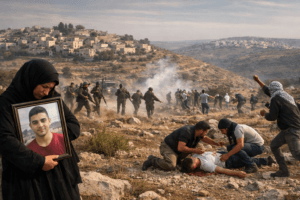
This is where the accounts diverge in ways that reveal the fundamental asymmetry of the conflict. The Israeli military stated that it received reports of Palestinians throwing rocks and responded with what it termed “riot dispersal methods”—typically tear gas, stun grenades, and rubber bullets. The military denied that its forces fired live ammunition during the clashes.
But Abu Ali describes something else entirely. “When the settlers saw the army, they were encouraged and started shooting live bullets,” he said. In his telling, the arrival of uniformed soldiers did not de-escalate the situation but rather emboldened the settlers, who understood that the military’s presence would shield them from consequences.
It was in this chaos that Nasrallah Abu Siyam, 19 years old, was struck by live fire. As he fell, according to witnesses, settlers continued their assault—clubbing those who had been injured even after they lay on the ground.
The young man’s death was later confirmed by the Palestinian Ministry of Health. He became, according to the Palestinian Authority’s Wall and Settlement Resistance Commission, the first Palestinian killed by settlers in 2026. The year was not yet two months old.
The Geography of Violence
Mukhmas sits in what is officially designated as Area C of the West Bank—the approximately 60 percent of the territory that remains under full Israeli civil and military control following the Oslo Accords. This designation matters because it creates a legal and administrative reality in which Palestinians face enormous obstacles to building, farming, or even accessing their own land, while Israeli settlements expand with state support.
The village and its surrounding areas have become what humanitarian organizations describe as a “hot spot” for settler violence. This is not random. The outposts that have sprouted on the hilltops—considered illegal even under Israeli law, which distinguishes between state-authorized settlements and unauthorized outposts—are strategically placed to disrupt Palestinian communities and create facts on the ground that make future territorial division increasingly difficult.
For the residents of Mukhmas, this is not abstract geopolitics. It is the daily reality of watching armed neighbors—neighbors with military protection and access to state resources—gradually consume the land that has sustained their families for generations. It is the knowledge that if a settler attacks your father in his field and you run to help him, you may be shot, and the people who shoot you will likely face no consequences.
The statistics bear this out. According to the United Nations Office for the Coordination of Humanitarian Affairs, Israeli forces and settlers killed 240 Palestinians in the West Bank last year alone. Over the same period, Palestinians killed 17 Israelis, six of whom were soldiers. These numbers tell a story not of symmetrical conflict but of vastly unequal power, in which one side possesses military training, advanced weaponry, and the backing of a state, while the other side possesses little more than stones and the conviction that they are defending their homes.
A Mother’s Voice, A Country’s Responsibility
In the aftermath of her son’s death, Nasrallah’s mother spoke to the press. Her words added another dimension to a story that might otherwise have remained a regional tragedy: her son was an American citizen.
This detail transforms the political calculus in significant ways. The United States has long provided billions of dollars in military aid to Israel, and American officials routinely affirm their commitment to Israel’s security. But when an American citizen is killed by Israeli settlers—the second such case in less than a year—the relationship becomes more complicated.
A U.S. embassy spokesperson issued a statement condemning “this violence,” a formulation that carefully avoids assigning blame to any specific party. The statement did not mention settlers, did not mention the Israeli military’s role, and did not mention accountability. It was the kind of diplomatic language designed to express concern without demanding action.
For Palestinians, this response was painfully familiar. Time and again, they have watched as the United States condemns violence in the abstract while continuing to provide the military and diplomatic support that sustains the occupation. The death of a dual citizen, they note, prompts concern but not consequences. The death of Palestinians without American passports prompts even less.
The Impunity Problem
Perhaps the most striking aspect of the Mukhmas killing—and the reason it resonates far beyond the borders of the West Bank—is what it reveals about the structure of accountability in the occupied territories.
Palestinians and human rights organizations have long documented what they describe as a systematic failure to prosecute settler violence. When settlers attack Palestinians, damage their property, or even kill them, the Israeli justice system rarely intervenes. Arrests are uncommon. Prosecutions are rarer still. Convictions are almost unheard of.
This impunity is not merely a failure of enforcement; it is, many argue, a feature of the system. By allowing settler violence to proceed without consequences, Israeli authorities create an environment in which Palestinians understand that they cannot rely on the state for protection. The message is clear: if you want to be safe, you must leave.
The Israeli military’s response to the Mukhmas incident illustrates this dynamic. In its statement, the military acknowledged that “unnamed suspects” had shot at Palestinians, who were evacuated for medical treatment. It did not say whether any arrests had been made. The suspects remained unnamed, uncharged, and apparently at large.
This pattern extends beyond individual incidents. The Israeli rights group B’Tselem has documented that since the start of the Israel-Hamas war, approximately 45 Palestinian communities have been emptied out completely amid a combination of Israeli demolition orders and sustained settler attacks. These are not evacuations in the formal sense; they are the gradual, grinding attrition of communities that can no longer withstand the pressure.
The UN’s Stark Warning
The day after Nasrallah Abu Siyam was killed, the United Nations human rights office released a report that placed his death in a broader context. Based on findings collected between November 2024 and October 2025, the report accused Israel of war crimes and stated that practices displacing Palestinians and altering the demographic composition of the occupied West Bank “raise concerns over ethnic cleansing.”
The language was carefully chosen. “Ethnic cleansing” is a term with specific legal and historical weight, referring to the forcible removal of an ethnic group from a territory through violence, intimidation, and systemic pressure. The UN office described Israel’s actions as a “concerted and accelerating effort to consolidate annexation” while maintaining a system “to maintain oppression and domination of Palestinians.”
The report also documented Israeli military operations in the northern West Bank that “employed means and methods designed for warfare,” including lethal airstrikes and the forcible transfer of civilians from their homes. In some cases, the UN said, Israel “forbade” residents from returning to their homes in refugee camps, displacing tens of thousands of people.
Israel has consistently rejected such accusations, arguing that the UN human rights office is biased against it and that its operations are necessary for security. The Foreign Ministry did not respond to requests for comment on the latest report, but previous responses have dismissed similar findings as anti-Israel propaganda.
The Wider Wound: Gaza and the Journalists
While the West Bank claimed international attention with the killing of a young American, the report also contained devastating findings about Gaza and about the treatment of Palestinian journalists detained during the war.
The Committee to Protect Journalists documented that dozens of Palestinian journalists detained in Israel experienced conditions including physical assaults, forced stress positions, sensory deprivation, sexual violence, and medical neglect. At least 94 Palestinian journalists and one media worker were detained during the war, with thirty still in custody as of the report’s publication.
Half of these journalists were never charged with a crime. Instead, they were held under Israel’s system of administrative detention, which allows suspects deemed security risks to be held for six months at a time, renewable indefinitely, without trial or formal charges. Rights groups have long condemned administrative detention as a violation of due process, but Israel defends it as a necessary tool for preventing attacks when evidence cannot be made public for security reasons.
Israel’s prison services did not immediately respond to requests for comment on the CPJ report, though they have previously rejected similar findings as “false allegations,” maintaining that the system operates lawfully with appropriate oversight.
Meanwhile, in Gaza, the United Nations Development Program offered a staggering assessment of the physical destruction: it will take at least seven years just to remove the rubble. Alexander De Croo, the former Belgian prime minister who recently returned from Gaza, described “the worst living conditions that I have ever seen,” with 90 percent of the territory’s 2.2 million people living in “very, very rudimentary tents” amid the wreckage.
The UNDP has managed to build 500 improved housing units, with 4,000 more ready for construction, but estimates the true need at 200,000 to 300,000 units. The gap between what exists and what is needed is so vast as to defy comprehension.
The Human Cost of Inaction
Behind the statistics and the official statements, there is a simpler story—one about a 19-year-old with his whole life ahead of him, about a mother who will never see her son again, about a community that must bury another young person and then figure out how to go on.
Nasrallah Abu Siyam was old enough to understand the dangers of the world he inhabited. He had grown up in the shadow of occupation, learning from childhood which roads were safe and which were not, how to behave at checkpoints, when to run and when to stay still. He knew that settlers sometimes came to the village, and he knew that the army sometimes came with them.
What he could not have known—what no 19-year-old should have to know—is that on an ordinary Wednesday afternoon, while defending a farmer in a field, he would become a statistic, a headline, a name read aloud at a UN briefing.
His death will likely be investigated, if at all, in the same way previous deaths have been investigated: slowly, quietly, and without consequence. The settlers who shot him will probably never be identified, much less prosecuted. The soldiers who stood by while it happened will probably never face disciplinary action. The system that makes this possible will continue to function exactly as it has functioned for decades.
And in Washington, officials will continue to condemn violence while providing the funding and diplomatic cover that sustain the occupation. In Brussels, diplomats will issue statements expressing concern. In New York, UN rapporteurs will file reports that go largely unread and completely unimplemented.
Meanwhile, in Mukhmas, the olive trees will continue to grow on the terraced hillsides, waiting for farmers who may be too afraid to tend them. The settlers will continue to build their outposts on the ridge lines. And the quiet will return—not the quiet of peace, but the quiet of submission, broken only when another young person falls in a field and another mother’s cry echoes across the hills.
What Comes Next
The death of Nasrallah Abu Siyam is not an anomaly. It is not a tragic exception to an otherwise functional system. It is, rather, a perfect expression of the system itself—a system in which Palestinian lives are cheap, settler violence is tolerated, international law is ignored, and accountability is a fiction.
The question that remains is whether anything will change. The UN has issued its warning about ethnic cleansing, but warnings do not stop bullets. The United States has condemned the violence, but condemnations do not bring back the dead. Human rights organizations have documented the pattern, but documentation does not deter those who believe they will never face consequences.
For the people of Mukhmas, the answer is grimly simple: nothing will change. The settlers will keep coming. The army will keep protecting them. The international community will keep expressing concern. And more young people will die in fields they have farmed for generations, defending land that is theirs by every law except the one that matters most—the law of power.
Nasrallah Abu Siyam was 19 years old. He was an American citizen. He was a Palestinian from a village east of Ramallah. He was killed by settlers while defending a farmer. And unless something fundamental shifts in the structure of occupation and impunity, he will not be the last.
You must be logged in to post a comment.