
‘They Came to Erase Us’: The Night a Family’s World Imploded in Dura
On March 14, 2026, Israeli occupation forces demolished the family home of Palestinian prisoner Azmi Nader Abu Hleil in the town of Dura, south of Hebron, after evacuating the residents—including ten family members who lived in the targeted second-floor apartment—as well as occupants of approximately 20 nearby homes. According to the father, Nader Abu Hleil, soldiers severely beat his son Mohammad and forced him to destroy the family’s belongings and throw them out the windows before detonating the apartment. The demolition is part of Israel’s punitive policy of destroying the homes of Palestinians accused of attacks, a practice widely condemned as collective punishment and a violation of the Fourth Geneva Convention, which leaves families like the Abu Hleils homeless and traumatized while fueling deeper resentment within the community.
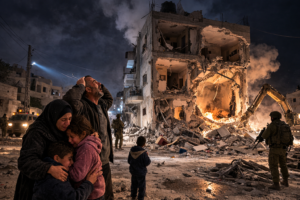
‘They Came to Erase Us’: The Night a Family’s World Imploded in Dura
The quiet of a late winter night in the town of Dura, a sprawling agricultural community southwest of Hebron in the occupied West Bank, was shattered not by the usual sounds of distant traffic or barking dogs, but by the guttural roar of heavily armored military vehicles. For the residents of the Abu Hleil family’s neighborhood, the grinding of steel treads on asphalt and the sharp, staccato commands blaring from loudspeakers are a sound of dread they know all too well. But on this Saturday, March 14, 2026, the incursion was not for a raid, an arrest, or a curfew. It was for something more final, more violently symbolic: an erasure.
The target was the family home of Azmi Nader Abu Hleil, a Palestinian prisoner currently held in Israeli custody. At approximately 2 a.m., the quiet domesticity of the Abu Hleil household, a three-story building that was the culmination of a lifetime’s work and savings, was replaced by a state of emergency. The family, jolted from their sleep by the thundering knocks on the door and the blinding white lights of the military vehicles, had minutes to grasp what was happening. They were being given an eviction order, not from their land, but from their very lives as they knew them.
Nader Abu Hleil, the patriarch of the family, stood in the cold night air, his voice a mixture of shock and profound grief as he later recounted the events to WAFA. He watched as his home, a structure that held the laughter of grandchildren, the scent of his wife’s cooking, and the silent prayers of its inhabitants, was transformed into a military staging ground. Soldiers, backed by what he described as “heavy military reinforcements,” moved with practiced efficiency, clearing the surrounding area and establishing a wide perimeter.
For the ten members of the family who lived in the targeted apartment on the second floor, the next few minutes were a frantic scramble. They clutched children, grabbed whatever documents or valuables they could reach, and stumbled out into the biting March air, joining their neighbors who were also being herded from their homes. Around 20 nearby houses were forcibly evacuated, their residents ordered to stand in the open, shivering witnesses to a demolition they were powerless to stop. The Israeli military’s stated reason, according to standard procedure in such cases, was to ensure their safety from the impending explosion and any potential secondary blasts or structural collapses.
But the destruction was not a clean, detached process. According to the harrowing testimony of Nader Abu Hleil, the violence was also intimate and personal. He told reporters that his son, Mohammad, was brutally separated from the family and subjected to a vicious beating by the soldiers. The assault, he said, was not just physical. The soldiers then forced Mohammad, bloodied and traumatized, to become an agent of his own family’s devastation.
“They made him do it,” Nader Abu Hleil’s voice cracked as he spoke to WAFA. “They forced my son, Mohammad, to smash everything. To take the life we built and throw it out the windows.” The image is a gut-wrenching tableau of psychological warfare: a son, under the duress of armed soldiers and the agony of his own injuries, destroying his family’s possessions—kitchenware, family photos, children’s toys, the furniture his parents saved for years to buy—and casting the remnants into the street below. It was a calculated act designed to maximize humiliation and instill a deep, lasting trauma. As the contents of the apartment rained down, shattering on the pavement, the sound was a brutal punctuation mark on the family’s history.
Then came the blast. The controlled detonation of high explosives, placed within the structure of the second-floor apartment, ripped through the night. The ground shook. Windows in nearby homes, already forced open by the evacuation, shattered. A deafening roar was followed by the groan of collapsing concrete and twisting steel. Where a family’s living room, kitchen, and bedrooms once stood, there was now a gaping wound in the side of the building, a hollowed-out cavity spilling dust and debris into the street below. The three-story structure was now a monument to absence.
The demolition of the Abu Hleil family home is a stark reminder of a policy that has become a cornerstone of the Israeli military’s approach to the occupied territories: the punitive demolition of family homes of Palestinians accused of carrying out attacks against Israelis. While the Israeli military frames this as a necessary deterrent, a tactic to discourage future violence by imposing a collective cost, for Palestinians and a significant portion of the international community, it is a form of collective punishment, explicitly prohibited under Article 33 of the Fourth Geneva Convention, which states that “no protected person may be punished for an offense he or she has not personally committed.”
The policy’s application is often swift and severe, bypassing the standard judicial process. The suspect’s family, who are presumed innocent, are rendered homeless based on the actions of a relative. Human rights organizations, including B’Tselem, Amnesty International, and Human Rights Watch, have long condemned the practice, arguing it not only punishes the innocent but also fuels further cycles of anger and resentment, undermining any path toward a just resolution.
In the cold light of dawn on Sunday, the residents of the Dura neighborhood began to pick up the pieces, both literal and figurative. The Abu Hleil family, now divided among the homes of sympathetic relatives or huddled in a single room in the undamaged portion of their own house, faced a new, uncertain reality. The air was thick with the smell of cordite and pulverized concrete. Scattered across the street were the remnants of a life: a child’s shoe, pages from a school notebook, a shattered olive jar, and the twisted frame of a family portrait.
Nader Abu Hleil stood amidst the debris, a man hollowed out by grief and rage. The home was more than just a structure. It was the embodiment of his life’s work. “This was my home,” he said, his voice trembling. “For 30 years, I worked, I built, I sacrificed to give my children a roof over their heads, a place to feel safe. And now, in the middle of the night, they come with their army and their bombs, and they take it all away in a second. For what? For the actions of one? The rest of us, the women, the children, my son Mohammad who they beat and forced to destroy his own home—what was our crime?”
His question hangs in the air, unanswered, a ghost lingering over the rubble. The demolition was an act of immense force, a display of military might that transformed a family’s sanctuary into a pile of rubble. But in its wake, it has also created a new reality: a family with nothing left to lose, a community radicalized by the sight of their neighbors’ suffering, and a deepening chasm of mistrust and hatred. The military operation may have concluded, the soldiers may have withdrawn, and the dust may have settled. But for the Abu Hleil family and their neighbors in Dura, the night they were forced to witness the erasure of a home will be a psychological scar that no amount of reconstruction can ever fully heal. The sound of the explosion was loud, but the silence that follows—the silence of a home that will never again be filled with the sounds of its family—is deafening.
You must be logged in to post a comment.