
‘They Bought Us Doughnuts. Then We Were on Our Way Home.’ — The Night a Family Outing Ended in Bullets
A Palestinian construction worker, Ali Bani Odeh, returned home to the West Bank after six weeks to spend the end of Ramadan with his family, and took his wife and four young sons for a late-night drive to buy Eid clothes and sweets. As they rounded a corner near their village of Tammun, Israeli forces opened fire, killing Ali, his wife Waad, and two of their sons—five-year-old Muhammad and six-year-old Othman, who was blind and sitting in his mother’s lap. The two surviving boys, Khaled (11) and Mustafa (8), described seeing laser pointers on their family before the shooting and watching their relatives die, while the Israeli military claimed soldiers “sensed danger” when a vehicle accelerated toward them during an operation to arrest suspected militants. The incident, which occurred deep in Palestinian-governed territory far from settler friction, left a family destroyed, uneaten doughnut holes scattered in the car, and two versions of events that may never be reconciled.
‘They Bought Us Doughnuts. Then We Were on Our Way Home.’ — The Night a Family Outing Ended in Bullets
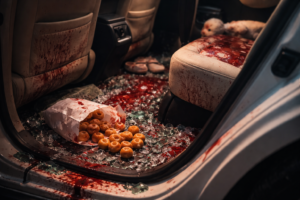
The doughnut holes never made it out of the bag.
They sat there, probably getting cold, scattered across the floor of the white family car somewhere between the front seats and the back, mixed with shattered glass and something far worse—pieces of a five-year-old boy’s life.
This is the story of what happens when a family decides to go for a drive on a warm Ramadan night, and how six people climbed into a car but only two climbed out. It’s a story about doughnuts and new clothes and a blind little boy who couldn’t see the laser pointers dancing on his family’s skin. And it’s a story about how two versions of the same moment can exist in complete opposition to one another, leaving the rest of us to wonder which reality we’re supposed to believe.
The Homecoming
Ali Bani Odeh had been gone for six weeks.
That’s a long time when you’re a construction worker in Israel and your family is in the West Bank. Six weeks of sleeping in cramped quarters, of sending money back home, of missing the sounds of your children fighting and laughing and breathing. Six weeks of counting down the days until you can wrap your arms around your wife again and let your boys climb all over you like you’re a jungle gym.
He made it back late on Friday, just in time for the last few days of Ramadan. The timing mattered—not just because of the holiday, but because his boys had been waiting. Khaled, eleven years old and already carrying the weight of being the eldest. Mustafa, eight, with a bandage now covering half his face. Muhammad, five, hyperactive and full of light. And Othman, six, blind since birth, unable to walk or feed himself, who communicated in ways that had nothing to do with words.
Othman required constant care. That’s why, on Saturday night, he sat in the front seat on his mother’s lap. Waad, thirty-five years old, had spent years learning how to hold her son just right, how to anticipate his needs, how to read the subtle shifts in his body that told her whether he was comfortable or scared or hungry. She was good at it. Mothers of children with severe disabilities become experts in things most people never have to notice.
The boys wanted to go for a ride. They wanted new clothes for Eid. They wanted sweets. Ali was tired—he’d just traveled, he’d been working for weeks, he probably wanted nothing more than to sit still and breathe the air of his own home. But the boys were restless, and when your children have been waiting a month and a half to see you, you don’t say no.
Their grandfather, also named Khaled, tried to intervene. “I was trying to tell him not to go,” the elder Khaled would later say, the words heavy with the kind of regret that doesn’t fade. But their grandmother spoke up: “It’s not far, let him go.”
Before leaving, little Muhammad approached his grandfather. Fix my hair, he said. Give me some of your cologne. These small rituals of grooming, these tiny masculine ceremonies passed down through generations—they mattered to a five-year-old boy who wanted to look and smell good for his night out with his dad.
The grandfather did as he was asked. Muhammad set off.
Neither of them knew it was goodbye.
The Drive
They went to Tubas first, picking up fried doughnut holes—qatayef, the kind reserved for Ramadan, crispy on the outside and sweet on the inside. The boys probably held the bag, feeling the warmth seep through the paper, maybe sneaking a peek inside to count how many there were. But they didn’t eat them yet. They were saving them for later.
Then they drove to Nablus, to a clothing shop. But it was already past midnight, and the shop was closed. So they turned around and headed back toward Tammun, the village where they lived, just a few more minutes from home.
The road curved. It was dark. The boys were probably getting sleepy, the sugar from the uneaten doughnuts still waiting in the bag, the promise of new clothes deferred to another day. Muhammad might have been nodding off. Othman was in his mother’s lap, unable to see anything but feeling the motion of the car, the warmth of his mother’s body, the familiar rhythm of a family on a late-night drive.
Waad asked Ali to pull over.
She wanted to get something from her bag on the floor, but she was holding Othman. If Ali could just take him for a moment, she could reach down and find whatever it was—maybe her phone, maybe some money, maybe nothing at all, just the small logistics of motherhood that require constant rearrangement of bodies and objects.
Ali began to slow the car.
And then, according to the two boys who would survive, everything changed.
The Lasers
Khaled and Mustafa remember seeing red dots appear on their family.
Laser pointers, they said, shining from every direction. The kind of targeting systems that soldiers use to mark their targets, that tell you with cold precision: you are seen, you are tracked, you are moments away from being shot.
Then their mother screamed.
Then their father said, “God is great.”
Then the shooting started.
It’s impossible to know what Ali was thinking in those final seconds. Did he see the soldiers? Did he understand what was happening? Did he have time to feel fear, or did everything move too fast? His father would later say that Ali spoke fluent Hebrew, that he believed if he ever encountered Israeli soldiers, he could talk his way out of any trouble. He was a construction worker, not a fighter. He had nothing to hide.
But talking requires time. It requires someone willing to listen. And in the split second between seeing laser dots and hearing gunfire, there is no time for conversation.
The fusillade was deafening. Bullets tore through metal and flesh. The car, which had been a vessel of joy just moments before—filled with the residue of laughter, with the anticipation of doughnuts, with the warmth of a family reunited—became something else entirely.
Mustafa, eight years old, reached for his brother Muhammad, five. He tried to pull him closer, tried to protect him, tried to do something that no eight-year-old should ever have to do.
But Muhammad was already dead.
The bullets had found him multiple times in the face.
The Silence
When the shooting stopped, silence rushed in to fill the space where gunfire had been. That silence would have been its own kind of violence—the absence of sound where there should have been breathing, crying, the small noises that prove people are still alive.
Khaled, eleven years old, opened the door.
“Please help me,” he yelled.
According to him, the soldiers told him to shut up. Then one of them grabbed him by the hair and pulled him out of the car. He was thrown to the ground. Stepped on. Questioned aggressively about whether anyone else had been inside. Beaten on the head and legs.
At some point, an Arabic-speaking soldier approached him. “Habibi,” the soldier said—my dear, a term of endearment, a word that implies care and affection. Then, Khaled says, that same soldier kicked him.
Khaled and Mustafa needed a bathroom. The stress, the fear, the physical shock—their bodies were demanding relief. The soldiers pointed them toward a Palestinian ambulance waiting about 100 meters away. As they walked, Khaled looked back.
A soldier opened the door of his family’s car.
Inside, Khaled could see his parents. Both dead. Their bodies in positions they were never meant to be in, frozen in the final moment of violence.
He also saw something else: the doughnut holes, scattered now, mixed with the debris of destruction. Uneaten. The sweetness they promised would never be tasted.
The Other Story
The Israeli police and military have their own version of events.
In a joint statement released Sunday morning, they said that border police officers and soldiers were on a mission in Tammun to arrest suspected terrorists—specifically, two youths, one accused of making explosive devices and another of using social media to incite violence. The operation was ongoing when they “sensed danger” after a vehicle “accelerated towards” them.
They “responded by shooting.”
The statement said the circumstances were being investigated. Liron Rubin, a spokesman for the border police, added that the officers and soldiers had signaled for the vehicle to stop using flashlights and laser pointers, but that it kept coming toward them.
“They’re a very professional force,” said Dean Elsdunne, another police spokesman. “If they felt their life was at risk when they’re operating there against terrorists in a very dangerous place, it’s for them to say.”
No one from Israeli security forces would discuss other details. The investigation was ongoing.
These two accounts—the boys’ and the military’s—exist in completely separate universes. In one, a family on a late-night drive is ambushed without warning. In the other, professional soldiers defending themselves against a threatening vehicle follow their training and neutralize a danger.
The car, in the military’s version, accelerated toward them. In the boys’ version, their father was pulling over at their mother’s request.
The laser pointers, in the military’s version, were signals to stop. In the boys’ version, they were targeting lights, marking their family for death.
The doughnut holes, in neither version, were ever eaten.
The Aftermath
The grandfather, Khaled Sayl Bani Odeh, was watching soccer on television when his wife told him to call their son and check on them.
“I said, ‘They’re in a car with the children—there’s nothing that can happen to them,'” he recalled.
He was wrong.
At the hospital, he saw the bodies. His daughter-in-law Waad had been shot multiple times in the head and chest. Little Muhammad had been shot several times in the face. The other two—Ali and Othman—were also dead, though the grandfather didn’t describe their wounds. Maybe he couldn’t. Maybe some things are too much to put into words.
His grandson Khaled, the eleven-year-old who survived, told him something else. He said he had found part of his little brother’s body on his shoes.
“It’s indescribable,” Khaled said. “One or two hours before, we were in Nablus. They took us to so many places. They bought us doughnuts. Then we were on our way home.”
The funeral drew dozens of Palestinians, men streaming into a cavernous social hall to pay respects, women gathering uphill at the family home. Mustafa, the eight-year-old survivor, wore a bandage across his nose where shrapnel from a bullet had hit him. He sat with his brother, two small boys in a world that had just become much larger and much emptier.
At some point during the mourning, Mustafa gave a final embrace to his slain family members. Photographers captured the moment—a small boy hugging a body wrapped in cloth, his face hidden, his small frame conveying grief that has no adequate expression.
The Context
The West Bank is not a peaceful place right now.
Extremist Israeli settlers have been terrorizing Palestinian villagers with increasing frequency. The body count is climbing: seven Palestinians killed so far this year, all but one since the war with Iran began on February 28. The Israeli military, which governs the West Bank, has condemned settler violence and says it’s working to prevent it. The Israeli police, responsible for investigating crimes committed by Israelis in the territory, say they act against violence but have largely failed to bring violent settlers to justice.
But Tammun is different.
It sits deep inside Area A, the territory governed and policed by the Palestinian Authority. It’s far from the friction with settlers, far from the daily confrontations that characterize other parts of the West Bank. Ali Bani Odeh believed he had little to fear from Israeli soldiers here. He worked inside Israel. He spoke Hebrew. He knew how to talk to them.
That confidence, whether misplaced or simply unlucky, cost him his life.
Palestinian security officials said they were briefed by their Israeli counterparts only after the fact. They were told the mission was to arrest two youths—one suspected of making explosive devices, the other of using social media to incite violence. Israeli officials mentioned only the explosives suspect.
The raid happened anyway. The soldiers were there anyway. And a family driving home from a failed attempt to buy Eid clothes drove into the middle of it.
The Survivors
Khaled and Mustafa are now among the thousands of Palestinian children who have lost family members to violence. They join a grim statistic, but statistics don’t capture what it feels like to be eleven years old and to see your parents’ bodies through an open car door. They don’t capture what it feels like to be eight and to reach for your five-year-old brother and find him already dead.
The boys spoke outside the women’s wake, their voices flat, their faces numb. Khaled did most of the talking, describing the lasers, the screams, the shooting, the soldier who pulled him out by his hair, the kindness of an Arabic-speaking soldier that turned into cruelty, the moment he saw his parents dead.
Mustafa stood nearby, the bandage across his nose a visible reminder that he, too, was marked by what happened. Shrapnel from a bullet—maybe the same bullet that killed his brother, maybe a different one—had found him too.
They didn’t cry while they spoke. Maybe they had no tears left. Maybe they were still in shock. Maybe eleven and eight are too young to fully process what has happened, and their brains are protecting them in the only way they can—by keeping the feelings at a distance, locked away until they’re old enough to understand.
Or maybe they understand perfectly, and the crying comes later, in the dark, when no one is watching.
The Doughnuts
There’s something about the doughnut holes that stays with you.
They’re such a small detail in a story full of violence and death. Fried dough, coated in sugar, sold during Ramadan as a special treat. The boys must have been so happy when their father bought them. They must have clutched the bag, maybe fought over who got to hold it, maybe peeked inside to count how many there were. They were saving them for later—after the clothing shop, after the drive, after they got home and could settle in and enjoy the sweetness properly.
They never got that later.
The doughnut holes ended up on the floor of the car, scattered among glass and blood and the remains of a five-year-old boy. They became evidence of a life interrupted, of pleasure deferred forever, of the gap between what we plan and what actually happens.
When Khaled told reporters about the doughnuts, his voice was flat. “They bought us doughnuts,” he said. “Then we were on our way home.”
The simplest sentences carry the heaviest weight.
The Investigation
Israeli authorities say they’re investigating. The circumstances are being reviewed. Professional forces followed their training. If they felt their lives were at risk, it was for them to say.
These are the standard phrases that follow incidents like this. They’re designed to create space, to leave room for the possibility that everything was handled correctly, that no one did anything wrong, that a family of six became a family of two through a tragic misunderstanding rather than through any fault.
But investigations require transparency. They require access to evidence, to witnesses, to the scene of the incident. They require a willingness to follow the facts wherever they lead, even if they lead to uncomfortable conclusions.
The boys have given their account. The military has given theirs. The car, presumably, has been impounded and examined. Ballistics tests can show where shots came from and how many were fired. Autopsies can show the trajectories of bullets and the positions of bodies at the moment of impact.
Whether any of this will lead to accountability is another question. In the occupied territories, investigations into shootings by Israeli forces rarely result in charges. The system is designed to protect its own, to create enough reasonable doubt that soldiers can continue to operate without fear of prosecution.
For the Odeh family, the investigation is almost irrelevant. It won’t bring back Ali or Waad or Muhammad or Othman. It won’t erase the memory of lasers dancing on skin or the sound of gunfire in the dark. It won’t make Khaled and Mustafa whole again.
It might, at best, provide an answer to the question that will haunt them forever: Why?
The Meaning
There’s a tendency, when incidents like this happen, to search for meaning. To fit them into a narrative that makes sense of senseless violence. To assign blame or innocence, to take sides, to use the dead as symbols for larger arguments about occupation and resistance and the nature of conflict.
But the Odeh family wasn’t a symbol. They were people.
Ali was a construction worker who hadn’t seen his family in six weeks. Waad was a mother who spent her days caring for a severely disabled child. Khaled was an eleven-year-old who liked doughnuts and new clothes. Mustafa was eight, young enough to still need his mother. Muhammad was five and hyperactive and wanted his grandfather to fix his hair and give him cologne. Othman was six and blind and couldn’t walk or feed himself, and he sat in his mother’s lap because that’s where he always sat.
They went for a drive on a warm night near the end of Ramadan. They bought sweets. They tried to buy clothes but the shop was closed. They were heading home.
And then they weren’t.
The doughnut holes never made it out of the bag. The new clothes never got bought. The Eid celebration that was coming—the end of fasting, the time of joy and family and community—will now forever be marked by something else.
In Tammun, a village deep in the West Bank, two small boys are learning to live in a world without their parents. Their grandfather sits in a social hall receiving condolences, replaying the moment he told his wife not to worry because nothing could happen to them in a car. Their grandmother probably regrets telling Ali to let Muhammad go.
And somewhere, in an Israeli military office, an investigation continues. Officers are gathering evidence, taking statements, building a file that will eventually be reviewed and likely closed. Professional forces, doing their jobs. A dangerous place, requiring split-second decisions. Circumstances that will be examined.
The two versions of what happened that night will never meet. The family’s reality and the military’s reality exist in parallel, each supported by its own evidence, each believed by its own adherents. The only thing they share is the outcome: four people dead, two people alive, a car full of holes and uneaten doughnuts.
Khaled, the eleven-year-old who survived, said it best: “It’s indescribable.”
And maybe that’s the only truth worth holding onto. That some things transcend explanation, transcend investigation, transcend the endless arguments about who did what and why. Some things just are. A family went for a drive. Most of them didn’t come back.
The doughnut holes are still on the floor of the car. No one will ever eat them now.
You must be logged in to post a comment.