
The Woman Who Stands Between: Faith, Nonviolence, and Protection in a West Bank on Fire
Amira Musallam, whose childhood in Beit Jala was shattered by bombing during the Second Intifada, now leads an unarmed civilian protection initiative in the West Bank, where violence is rapidly escalating amid the wider U.S.-Israeli war with Iran. Drawing on her Catholic faith and a transformative childhood encounter with an apologetic Israeli volunteer, she co-founded the Unarmed Civilian Protection in Palestine (UCPiP), deploying international and local volunteers to accompany vulnerable communities, document settler violence, and deter attacks through peaceful presence—even as settlements expand unchecked, global attention shifts to Iran, and villages like Ras Ein el-Auja are forcibly displaced. Despite facing overwhelming odds, chronic underfunding, and a sense of abandonment by institutional church support, Musallam remains rooted in the belief that violence only begets more violence, embodying a quiet, faith-driven resistance in a land where the world’s eyes have drifted elsewhere.
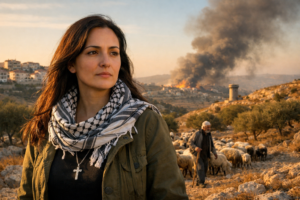
The Woman Who Stands Between: Faith, Nonviolence, and Protection in a West Bank on Fire
The night the bombs fell on Beit Jala, Amira Musallam was twelve years old. It was November 15, 2000, early in the bloody uprising that would become the Second Intifada. For hours, her family huddled in what they thought was the safest corner of their home, as Israeli tanks and helicopters pounded the neighborhood. The walls around them were torn open by bullets. Small rockets struck nearby houses. Then, the projectiles began hitting their room.
With no ambulance able to navigate the chaos and the U.S. embassy offering no help to the Palestinian American family, they made a choice born of pure desperation. They crawled on their stomachs across the open ground, bullets flying overhead, toward a neighbor’s house positioned slightly downhill. “Thank God we weren’t physically injured or harmed,” she would later recall. “But our house was partially bombed.”
That night didn’t just scar a building; it shattered a childhood. The girl who sang in the church choir, who hiked the rolling hills above Bethlehem with her father, who saw Israeli shoppers from the nearby settlement of Gilo as a normal part of the local fabric—that girl was forced to grow up. More than two decades later, Amira Musallam is still living in the same conflict. But now, she is no longer just a survivor of its violence. She is a guardian against it.
As the Regional War Engulfs the West Bank, She Holds the Line
The world’s attention is currently fixed on the fiery exchanges between Iran and Israel, the thunder of airstrikes over Damascus, and the anxious wait for the next missile to fall. But in the quiet, olive-tree-dotted hills of the West Bank, a different, more intimate kind of war is being waged. Here, violence doesn’t always arrive with the screech of an air raid siren; it creeps in with the erection of a new settler outpost, the bark of a military dog at a checkpoint, or the sudden, terrifying appearance of armed settlers in a village square.
It is in this pressure cooker that Amira Musallam, now a leader in the unarmed civilian protection movement, operates. She co-founded and leads the Unarmed Civilian Protection in Palestine (UCPiP), a small but vital initiative that places trained volunteers—internationals, Israelis, and Palestinians—alongside vulnerable communities. Their mission is deceptively simple: to accompany shepherds to their fields, to monitor tensions at flashpoints, to document abuses, and to be a visible, non-violent presence that, by its very existence, might deter violence.
But the ground beneath their feet is shifting faster than ever. The war that erupted on a much larger scale on Feb. 28 has supercharged a reality that was already spiraling out of control.
“You sleep at night and you say you saw the worst the day before, but you wake up to even a worse nightmare,” Musallam says, her voice carrying the weight of someone who has seen too much. The expansion of Israeli settlements, deemed illegal under international law, has become an unstoppable flood. “You go from Bethlehem to Jericho, where you used to see one outpost and one settlement,” she describes. “Now, every 10 meters, you will see a new outpost.”
The landscape is being rapidly transformed, not just politically, but physically, carving up the land and strangling Palestinian communities. The wider war has only tightened the noose. Movement restrictions, already a feature of daily life, have intensified, with hundreds of gates and checkpoints now controlling access. For the thousands of Palestinians who depend on jobs in Israel, many of those doors have simply been shut, plunging families deeper into economic despair. Even Christian schools in Jerusalem have been crippled, their teaching staff stranded on the other side of a border they can no longer cross.
In the last 10 days alone, Musallam notes with a mixture of grief and frustration, seven Palestinians have been killed by settlers in West Bank villages. “All the eyes are on Iran and Lebanon… and nobody is paying attention to the West Bank,” she says. This lack of attention is precisely what makes violence more likely, and what makes her work more critical than ever.
From a Child Under the Bombs to a Guardian of Peace
Musallam’s journey to this front line of nonviolence began on that terrifying night in 2000. After the attack, her family was displaced for months. When they finally returned to their damaged home, they were joined by international volunteers from Women in Black, who offered a “protective presence.” The idea was that their foreign passports might offer a fragile shield, a hope that the Israeli military would think twice before firing on a house with international witnesses.
One evening, a new volunteer arrived for dinner—an Israeli-American Jewish woman. Musallam remembers the moment vividly. “She started crying and kissing me and telling me, ‘I’m sorry, I’m sorry for what my people are doing to you.'” For a child who had just seen her world torn apart by Israeli fire, this act of profound empathy was a revelation. It was a face-to-face encounter with the “other” that shattered any monolithic view of the enemy. It planted a seed: the conflict was not simply a story of good versus evil, but of people, and the choices they make.
That seed grew over two decades of participation in dialogue meetings and peacebuilding workshops. But the horror of October 7, 2023, and the subsequent devastating war on Gaza, became a catalyst. It wasn’t a time to retreat, she felt, but to act. The principles of unarmed civilian protection, which she had experienced as a child, needed to be systematized and expanded.
The work of UCPiP is high-risk, low-tech, and deeply human. It’s not about protests or advocacy, though those have their place. It’s about presence. When a community in the Jordan Valley is threatened by settler violence, a team might arrive to spend the night in a family’s home, hoping that their presence will deter an attack. When shepherds are afraid to graze their flocks on land near a settlement, volunteers will walk with them, cameras in hand, documenting any harassment.
“We try to be a third party that can de-escalate simply by being there,” Musallam explains. “If settlers approach, they see internationals, they see Israelis with us, and it changes the calculation. It introduces a witness, someone who can report what happens to the world.”
The cost of this work is measured in burned crops, destroyed homes, and lives lost. Just in January, the village of Ras Ein el-Auja in the Jordan Valley, a community of 700 where UCPiP had focused its efforts, was effectively erased. According to reports, intensified violence from illegal settlers forcibly displaced the entire population. “They were expelled,” Musallam says, her tone flat with the exhaustion of cataloging loss.
Now, instead of being able to concentrate their resources on protecting one community, her team is stretched thin across four different areas. “Every day there is something new that we have to adapt to,” she says. Volunteers recently found themselves stranded in Jericho by sudden road closures, forcing the organization to scramble for extra housing.
Faith in the Foxholes: A Catholic Voice in a Multi-Faith Struggle
Musallam’s resilience is deeply rooted in her Catholic faith. Raised in a Christian community in Beit Jala, her identity is inseparable from the land and its ancient churches. “Everything I do comes not only from my family and childhood, but from my faith,” she says. “I’m a Christian, and I believe that helping others is one of our pillars.”
Yet, her faith also brings a complex layer of frustration. As a Palestinian Christian, she feels the weight of a shrinking community. Christians now make up only about one percent of the population in the Palestinian territories, a steady exodus driven by decades of conflict, economic hardship, and political uncertainty. She looks to church structures for robust institutional support in moments of crisis and often feels that support is lacking. Her concern echoes a broader feeling among local Christians who sometimes feel forgotten by the global Church, which venerates the Holy Land’s stones but may not always adequately champion its living stones.
This sense of being a minority within a minority sharpens her perspective. Her work is not just for Christians; it is for all vulnerable Palestinians, regardless of faith. It is a practical ecumenism born of shared suffering and a shared need for protection.
The Rev. Mark Fowler, CEO of the Tanenbaum Center for Interreligious Understanding, which honored Musallam with its Peacemaker in Action Award in 2025, sees her as a powerful example of a broader truth. In many conflicts, women peacebuilders face unique skepticism for stepping outside traditional roles, which often cast them as caregivers after violence, not as interveners before it. But that very perception can become a strength.
“I think that there is a reconnection to the power and the dignity of women that would aid us greatly,” Fowler says. In countless conflict zones, women are the first people others turn to for help, for mediation, for a safe place. They are the trusted nodes in a community’s social fabric. Musallam embodies this: a woman whose deep local roots, whose faith, and whose personal history of survival grant her a moral authority that no weapon can confer.
A Plea from the Periphery
As the world watches the high-stakes military escalation between major powers, the slow-motion crisis in the West Bank risks becoming a forgotten wound. On March 16, Pope Leo XIV received a phone call from Palestinian President Mahmoud Abbas to discuss the escalating violence affecting the West Bank. The Vatican’s statement reaffirmed its “commitment to achieving peace through political and diplomatic dialogue, as well as through full respect for international law.” It is a message of peace from the highest levels, but on the ground in places like Beit Jala and the Jordan Valley, the gap between international law and lived reality is a chasm.
For Amira Musallam, the path forward is not found in the rhetoric of war, but in the stubborn, quiet act of standing with another person in their moment of fear. It’s in crawling alongside a family to safety, as she once did. It’s in walking with a shepherd whose flock is his only livelihood. It’s in providing a safe house for stranded volunteers when the checkpoints snap shut.
More than 25 years after that horrific night, she is still in the same conflict, but she is no longer just its victim. She is its witness, its chronicler, and its active resister. Her motivation is a simple, profound belief that has guided saints and prophets for millennia.
“Violence brings only more violence,” she says, her words a quiet benediction in a land saturated with the language of swords. “And blood brings more blood.” In a region where so many have chosen the sword, Amira Musallam has chosen to simply stand, unarmed, in the space between, guided by her faith and a stubborn, resilient hope that the world might yet see the humanity in the hills of the West Bank before it is too late.
You must be logged in to post a comment.