
The Whistleblower and the Shield: How an Israeli General’s Arrest Exposes a Nation’s Moral Crisis
The arrest of former Israeli Military Advocate General Yifat Tomer-Yerushalmi for leaking footage of IDF soldiers severely abusing a Palestinian detainee has ignited a profound moral and political crisis in Israel, highlighting a stark conflict between the enforcement of the rule of law and a powerful right-wing narrative that views such internal scrutiny as treason.
While the accused soldiers remain free, Tomer-Yerushalmi’s detention for exposing the crime has fueled international criticism and an intense domestic debate, revealing a nation deeply divided over whether its identity is defined by unwavering solidarity in conflict or by its commitment to uphold its own legal and ethical standards, even in times of war.
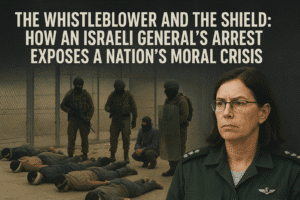
The Whistleblower and the Shield: How an Israeli General’s Arrest Exposes a Nation’s Moral Crisis
The story begins with a scene of profound dehumanization. In a cavernous, wire-divided hall, rows of blindfolded and handcuffed Palestinian men lie prone on the floor. Masked Israeli soldiers move among them like keepers in a human warehouse. Then, the focus narrows. One man is singled out, led to a corner, and shielded from view by riot shields—a deliberate act to conceal what happens next. The result, as leaked security footage would later reveal, was a brutal assault so severe the victim required major surgery.
This July 2024 incident at the Sde Teiman military facility was shocking, but for many observers of the Israeli-Palestinian conflict, it was not unique. What is unique, and what has plunged Israel into a profound constitutional and moral crisis, is the subsequent chain of events: not the arrest of the five soldiers accused of the abuse, but the arrest of the woman who was once the Israeli military’s top legal authority for exposing it.
The arrest of Major General Yifat Tomer-Yerushalmi, the former IDF Military Advocate General, on charges of leaking the very footage that documented the crime, is more than a political scandal. It is a stark allegory for a nation at war with itself over its own soul, where the act of enforcing the law is now being framed by powerful factions as an act of treason.
The Leak: A Act of Desperation in a Shifting Moral Landscape
To understand why a respected general would risk her career and freedom to leak sensitive footage, one must examine the toxic atmosphere that followed the initial investigation. When Tomer-Yerushalmi, in her former role, authorized the arrest of nine soldiers in connection with the abuse, the reaction from parts of the Israeli political establishment was not one of outrage at the crime, but at the investigation itself.
Right-wing politicians, including National Security Minister Itamar Ben-Gvir, labeled the arrests “shameful.” MK Limor Son Har-Melech went further, branding Tomer-Yerushalmi’s decision as “criminal.” Protesters, including elected officials, stormed the Sde Teiman base in a stunning display of defiance against their own military police. The narrative pushed by these factions was clear: in a time of war, soldiers are beyond reproach, and any internal scrutiny is a betrayal that aids the enemy.
It was against this “wave of false propaganda,” as Tomer-Yerushalmi called it in her resignation letter, that she authorized the leak. Her stated goal was to counter the disinformation and show the world—and the Israeli public—the graphic, undeniable reality of what had occurred. She was not, in her view, leaking state secrets to an enemy; she was leaking evidence of a crime to a public being told that crime did not matter. In her own words, she sought to uphold the “basic understanding—that there are actions which must never be taken even against the vilest of detainees.”
This was a desperate gambit from a legal professional watching the rule of law erode in real-time. She believed the video was necessary to prove that the military justice system was not acting against its soldiers capriciously, but was responding to a severe and documented breach of its own code.
The Aftermath: The Whistleblower in Solitary, The Accused Remain Free
The fallout has been telling. The five reservists charged with aggravated abuse and causing serious bodily harm remain free in the community, their identities hidden behind black masks at a press conference where their lawyer decried a “cooked-up legal process.” Meanwhile, the former Military Advocate General finds herself in police custody, her detention extended, reportedly in solitary confinement.
This stark contrast has not gone unnoticed. It creates a powerful, and for many, a deeply disturbing, image: the enforcers of alleged extreme violence walk free, while the enforcer of legal accountability sits in a cell.
The political rhetoric has escalated into what Israeli President Isaac Herzog called a “dangerous fire.” Eli Cohen of Netanyahu’s Likud party did not mince words, calling Tomer-Yerushalmi’s actions “treason” and accusing her of stabbing soldiers in the back. Prime Minister Benjamin Netanyahu himself focused not on the abuse, but on the leak, calling it “the most severe propaganda attack” in Israel’s history. For the Prime Minister, the primary sin was the “enormous reputational damage,” not the violent act that caused the damage in the first place.
This prioritization of perception over substance strikes at the heart of the crisis. It suggests that for some in power, the greatest threat is not the commission of war crimes, but the world finding out about them.
A System Under the Microscope: Can Israel Investigate Itself?
The “Sde Teiman affair” reverberates far beyond this single incident. It directly impacts one of the most critical questions in international law: can a state effectively and impartially investigate its own alleged violations?
This is not an abstract question. The International Criminal Court (ICC) has already issued arrest warrants for Netanyahu and his defense minister for alleged war crimes in Gaza. The ICC principle of “complementarity” holds that the Court will only step in if a state is unwilling or unable to genuinely investigate and prosecute crimes itself.
Tomer-Yerushalmi was acutely aware of this dynamic. Israeli media reported that she argued internally that leaking the video was essential to “prove we can investigate ourselves” to the outside world. Her arrest for that very act now powerfully undermines that claim. It creates the perception of a system that punishes internal transparency while being slow to hold actual perpetrators of violence to account.
This case, coupled with reports that Tomer-Yerushalmi had previously avoided some war crimes probes for fear of political backlash, paints a picture of a justice system under immense political strain. The message it sends is that thorough, transparent self-investigation is a dangerous career-ender, while obfuscation may be the safer path.
The Unseen Wound: A Society Grappling with Its Identity
Ultimately, the story of the leaked video and the arrested general is a symptom of a deeper struggle within Israel. It is a battle over the nation’s identity and the price of security.
On one side is the belief, powerfully articulated by the right-wing protesters and politicians, that in an existential conflict, the collective must close ranks. In this view, the IDF is a sacred institution, and its soldiers are heroes who must be shielded from any criticism, even when that criticism comes from within the military’s own legal framework. The enemy is not just outside the gates, but also within—in the form of legal officials, the media, and anyone else who would “spread propaganda.”
On the other side is the liberal democratic ideal, embodied by Tomer-Yerushalmi and the institution she represented, that the rule of law is what separates a state from its adversaries. This side argues that a nation’s moral strength is defined by its willingness to uphold its own laws, especially in the most difficult times. To abandon that principle, they warn, is to win the battle but lose the war for the nation’s soul.
President Herzog’s plea to “lower the flames” and show “humanity and sensitivity” is a recognition of how dangerously polarized this debate has become. The fact that Tomer-Yerushalmi felt compelled to abandon her car and phone, leading to a massive search operation, underscores the very real human toll of this political firestorm.
The question now is not just about the guilt or innocence of a few soldiers or a single general. It is about what kind of justice will prevail in Israel. Will the system demonstrate its integrity by dealing fairly with both the alleged abusers and the whistleblower, based on the evidence? Or will the political narrative of “us versus them” dictate the outcome, cementing a precedent where exposing wrongdoing is a greater crime than the wrongdoing itself? The world is watching, and the answer will define Israel’s standing for years to come.
You must be logged in to post a comment.