
The West Bank at a Crossroads: How New Israeli Measures Are Redrawing Reality and Burying a Two-State Future
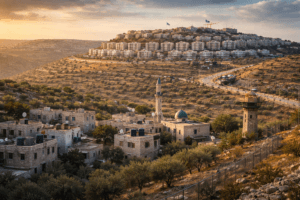
The West Bank at a Crossroads: How New Israeli Measures Are Redrawing Reality and Burying a Two-State Future
The announcement felt less like a policy shift and more like a tectonic plate grinding into place. On February 9th, 2026, Israeli Finance Minister Bezalel Smotrich declared a suite of measures designed to tighten Israel’s grip on the occupied West Bank, bluntly stating their aim was “burying the idea of a Palestinian state.” This wasn’t whispered in a closed-door meeting but proclaimed as official state policy, marking a pivotal moment in a decades-long conflict. The international condemnation that followed—from the UN to a coalition of Muslim-majority nations—was swift and severe, yet it faces a stark new reality: a strategy of incremental annexation is accelerating, fundamentally altering the landscape upon which any future peace must be built.
Decoding the Measures: More Than Just Settlements
At first glance, the changes—approved by Israel’s security cabinet and announced by Smotrich and Defense Minister Israel Katz—might seem technical. They include allowing Jewish Israelis to purchase West Bank land directly (a process historically more circumscribed) and transferring authority over planning in key areas, like parts of Hebron, from the Palestinian Authority (PA) to Israeli bodies. Greater Israeli control is also asserted over major religious sites.
But the devil, and the profound consequence, is in the details. These are not isolated housing permits; they are systematic levers pulled to reshape governance, demography, and law.
- The Land Market Shift: By facilitating direct land purchases, the policy incentivizes and normalizes private Israeli civilian expansion deep into Area C, which constitutes about 60% of the West Bank and is under full Israeli military control. This creates irreversible facts on the ground, weaving Israeli society physically into the territory.
- Undermining the Palestinian Authority: Stripping the PA of planning authority in Hebron and other areas is a direct assault on its already eroded legitimacy and functionality. It sends a clear message to Palestinians: the body meant to be your government has no sovereignty here. As Yonatan Mizrachi of Peace Now noted, this deliberate weakening is a key part of the strategy, hollowing out the very partner needed for a two-state solution.
- Administrative Annexation: This is the core of the “new legal and administrative reality” condemned by Saudi Arabia and others. It’s a process of applying Israeli civilian law and governance piecemeal, without a formal declaration. For Palestinians, it means facing a labyrinthine system where their rights are diminished, their movement controlled, and their prospects for independent statehood fading by the day.
A Chorus of Condemnation Meets a Wall of Determination
The global response highlights how isolated Israel’s current path has become, even among traditional allies. UN Secretary-General António Guterres’s “grave concern” pointed to the erosion of the two-state solution and the destabilizing nature of the moves, referencing the International Court of Justice’s opinion on the illegality of the occupation.
The unified statement from Saudi Arabia, Jordan, the UAE, Qatar, Egypt, Türkiye, Indonesia, and Pakistan was particularly significant, demonstrating that despite the normalization of some Arab-Israeli relations, red lines remain when it comes to Palestinian territory. Their condemnation of “attempts at its illegal annexation” underscores a broad regional consensus.
Even nations like Australia, often cautious in its diplomatic language, found itself in the spotlight. When pressed in parliament about sanctions, Deputy Prime Minister Richard Marles reaffirmed a commitment to a two-state solution—a position beginning to sound increasingly anachronistic against Smotrich’s “burial” rhetoric. Australia’s prior sanctions against Smotrich and Ben-Gvir for inciting violence reveal the uncomfortable tension many Western nations face: maintaining relations with Israel while attempting to censure the most extreme elements of its government.
The Human Geography: What “Burying a State” Actually Looks Like
Beyond the diplomacy, this is about human lives and landscapes. Palestinian political scientist Ali Jarbawi’s analysis is chillingly clear: “What they want is to drive Palestinians into small pieces of land, basically, their major cities, enclaves, and the rest is gone.”
Imagine a Palestinian farmer in the South Hebron Hills. The hilltop across the valley is now approved for an Israeli outpost. The access road to his family’s olive groves is suddenly deemed a “closed military zone.” The planning permit for a new room for his growing family, once a frustrating bureaucratic hurdle with the PA, is now an impossibility because an Israeli committee has zoned his village for “no construction.” This is the slow-motion displacement, the daily erosion of possibility, that these policies engineer.
For the over 500,000 Israeli settlers, these measures represent a state finally aligning fully with their ideological and religious vision. The West Bank is not “occupied” to them; it is “Judea and Samaria,” the biblical heartland. The state’s machinery is now being recalibrated to cement their presence as permanent and legitimate.
The Ghost of Oslo and the Weakened PA
The true symbolic weight of these measures falls on the rotting foundations of the Oslo Accords. The Palestinian Authority was created as a five-year interim body, a stepping stone to statehood. Three decades later, it is a perpetually interim administration, its authority shrunk, its credibility sapped by accusations of corruption and cooperation with occupation.
Israel’s latest moves deliberately weaken it further. By taking control of more administrative functions, Israel demonstrates that the PA’s power exists only at its discretion. This creates a dangerous paradox: the international community funds and props up the PA as the vessel for statehood, while on the ground, its essential attributes are systematically dismantled. This leaves Palestinians in a political vacuum, fueling desperation and potentially more radical alternatives.
Looking Ahead: The Unraveling Consensus
The timing, just before a meeting between Netanyahu and then-US President Donald Trump, was likely no accident. It tests the boundaries of international tolerance. While the US has historically opposed annexation, the ambiguity of the current moment provides a window for creating new realities.
The path forward looks less like a negotiation table and more like a staggered, grinding confrontation between two irreconcilable concepts of justice and security. The two-state solution, a pillar of international diplomacy for generations, is not just stalled; it is being actively dismantled brick by bureaucratic brick. What is being constructed in its place is a one-state reality of unequal rights, perpetual control, and entrenched conflict.
The world’s condemnation is real, but the question remains: Is it a deterrent or merely a footnote to a history being written by bulldozers and legal decrees? The new measures in the West Bank are not just about settlements. They are about summoning a ghost—the ghost of a Palestinian state—in order to publicly declare it dead, and in doing so, challenging the world to decide what it will do with the body.
You must be logged in to post a comment.