
The Watchers Are Gone, But the Witness Continues: Evacuated Ecumenical Accompaniers Refuse to Be Silenced
The World Council of Churches has evacuated its 11 Ecumenical Accompaniers from Palestine and Israel due to escalating war, leaving Palestinian communities without the protective international presence that helped document human rights violations and deter violence at checkpoints and settlements. While the physical withdrawal creates a dangerous vacuum, particularly for women and children facing systemic dispossession, the evacuated volunteers continue their mission remotely by compiling testimonies, advocating to global leaders, and amplifying Palestinian voices from their home countries. This transition aligns with the WCC’s “From Condemnation to Consequences” campaign, which urges the international community to move beyond symbolic statements toward concrete accountability measures, as the crisis demonstrates how the failure to ensure safety for peace witnesses reflects a broader failure to protect vulnerable populations under occupation.
The Watchers Are Gone, But the Witness Continues: Evacuated Ecumenical Accompaniers Refuse to Be Silenced
The news arrived with a chilling finality that has become all too familiar in conflict zones. For the 11 international volunteers serving in the World Council of Churches (WCC) Ecumenical Accompaniment Programme in Palestine and Israel (EAPPI), the order was clear: evacuate immediately. The escalating war, whose sounds of explosions and fear had become their daily backdrop, had made their physical presence on the ground untenable. As they packed their bags and said hurried, heart-wrenching goodbyes to the communities they had sworn to protect through presence, a profound silence began to settle over the checkpoints, the olive groves, and the school routes of the West Bank and East Jerusalem.
While their safe evacuation on March 12, 2026, is a relief, their departure marks a critical and deeply painful juncture for the programme and the people it serves. But as the WCC and the accompaniers themselves make clear, their work is far from over. The mission has simply transformed. The eyes and ears of the world have been forced to relocate, but they remain wide open.
The Power of Presence: More Than Just Observation
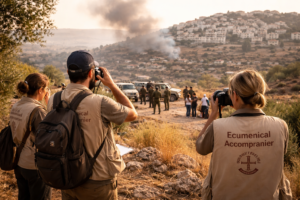
To understand the gravity of this evacuation, one must first understand what the Ecumenical Accompaniment Programme actually does. For over two decades, EAPPI has deployed hundreds of unarmed volunteers from around the globe to live and work in Palestinian communities. These are not traditional aid workers or journalists, though their roles overlap with both. They are what the name implies: accompaniers.
Their mission is rooted in a simple yet powerful concept: protective presence. An accompanier walking Palestinian children to school in the Hebron hills, where settler violence is a chronic threat, can be the difference between a safe journey and a terrifying confrontation. Their presence at a checkpoint in the Jordan Valley can deter soldiers from arbitrarily delaying or denying a farmer access to his land. By documenting what they see, collecting testimonies, and reporting back to a global network, they act as a living link between isolated communities and the international community.
The 102nd group of accompaniers, though their time on the ground was tragically cut short, witnessed firsthand the accelerating pressures on the Palestinian population. In their brief tenure, they documented specific incidents that are not just anecdotal but represent a systemic erosion of the Palestinian presence in areas like Masafer Yatta, Sheikh Jarrah, and the Old City of Jerusalem. They saw the creeping expansion of settlements, the demolition of homes and cisterns, and the daily humiliations that chip away at human dignity. They were there to listen to the stories of mothers afraid for their sons, of farmers watching their centuries-old groves being vandalized, and of children whose commute to school is an obstacle course of military checkpoints.
A Vacuum of Protection in a Time of Escalation
The evacuation leaves a vacuum in the very places where protection is needed most. Iskandar Majlaton, programme coordinator for the WCC EAPPI, articulated the profound sense of loss. “Palestinian communities, already facing intensifying settler violence, land annexation, and systematic dispossession, are now left without the vital presence of international protective accompaniment,” he said. The words “vital presence” are carefully chosen. For communities living under occupation, the knowledge that internationals are watching is a tangible form of security. It creates witnesses, making it harder for violence and injustice to occur in the shadows.
The burden, as Majlaton noted, falls disproportionately on the most vulnerable. “Women and children continue to bear the heaviest burden of these violations, further compounded by Israeli government policies that erode their rights and futures.” When an accompanier is not there to call a lawyer, alert a consulate, or simply film an incident, a family facing eviction in the dead of night or a child detained at a checkpoint is left more alone. The deterrent effect of the international gaze is gone, replaced by a terrifying anonymity.
Carla Khijoyan, WCC programme executive for peace building in the Middle East, framed the evacuation as a profound moral challenge to the rest of the world. “When the presence of accompaniment must withdraw, the responsibility of the world to protect human life becomes even greater,” she reflected. Her words are a powerful call to action, reminding us that physical presence is just one form of solidarity. The departure of the accompaniers does not absolve the global community of its duty; it intensifies it.
Khijoyan’s language is deeply resonant, drawing on a shared sense of humanity. “Every life lost, every child forced to grow up in fear, every family displaced from their home is a wound to our shared humanity,” she stated. “Faith calls us to refuse the normalization of violence and the erosion of dignity.” This is a crucial point. The greatest danger, beyond the immediate violence, is the potential for the world to become numb—to accept checkpoints, home demolitions, and the second-class treatment of an entire people as a normal, if unfortunate, part of the geopolitical landscape.
From the Streets of Hebron to the Screens of Geneva: The Remote Witness
So, what does it mean for the accompaniers’ work to “continue from their home countries”? It means a pivot from direct presence to strategic amplification. The 11 evacuated volunteers are now tasked with a different kind of mission.
Firstly, documentation and reporting. The notes, photographs, and testimonies they gathered in their shortened time are now being compiled into detailed reports. These are not just internal documents; they are tools for advocacy. They will be shared with UN bodies, foreign ministries, human rights organizations, and church groups. The goal is to ensure that the stories from the ground are not lost in the fog of war, but are instead used as evidence to inform policy and public opinion.
Secondly, advocacy and lobbying. From the safety of their homes in Europe, North America, and elsewhere, the accompaniers become direct lobbyists. They can meet with their local members of parliament, speak to their congregations, and write op-eds in their local newspapers. They can say, “I was there. I saw this happen. This is the name of the family whose olive trees were burned. This is the child who is now afraid to go to school.” This personal testimony, grounded in recent, direct experience, is exponentially more powerful than a generic news report.
Thirdly, digital accompaniment and amplification. In an age of connectivity, the mission can partly shift online. The accompaniers will use their social media platforms and networks to amplify the voices of Palestinian human rights defenders, activists, and ordinary citizens who remain on the ground. They will share their stories, promote their campaigns, and ensure that their calls for help are heard by a wider audience. They are building a digital bridge to replace the physical one that was broken.
A Campaign for “Consequences” in a World of Condemnation
This shift in tactics dovetails perfectly with the WCC’s current campaign, “From Condemnation to Consequences,” running throughout March 2026. The campaign’s title encapsulates a growing frustration within the international community and civil society. For decades, UN resolutions have been passed, statements of condemnation have been issued, and reports have been written, all decrying the illegality of the occupation and the settlements. Yet, the situation on the ground has only worsened.
The campaign argues that words are no longer enough. It calls on states to move beyond rhetoric and take concrete actions to hold Israel accountable under international law. This could include arms embargoes, targeted sanctions on settlement enterprises, and a halt to trade with entities operating in illegal settlements. The campaign is a direct challenge to the international community to live up to its own stated principles and legal obligations.
The evacuation of the EAPPI accompaniers lends a stark, emotional urgency to this call. It is a physical manifestation of the failure of the international community to create a safe environment for both Palestinians and those who seek to stand with them peacefully. The fact that protective presence workers must flee for their safety is an indictment of the current situation.
The Unfinished Work of Bearing Witness
The story of the 102nd group of EAPPI accompaniers is not a closed chapter. It is an ongoing, evolving narrative. They left behind the dusty roads and crowded refugee camps, but they carry the faces and the voices of the people they met with them. Their witness was cut short in one form, only to be reborn in another.
As they settle back into their own lives, the contrast will be jarring. The quiet of a suburban street will replace the crackle of tension in the Old City. The biggest decision of their day might be what to have for dinner, a stark contrast to the life-or-death decisions faced by the families they left behind. It is in that space of comfort and safety that their responsibility grows. They must speak for those who cannot leave, for the children whose only choice is to face the checkpoint, and for the farmers who must defend their land alone.
The work of bearing witness does not end with an evacuation. It begins anew in the halls of power, in the quiet of a church basement, and in the digital commons of the internet. The 11 accompaniers are gone from the Holy Land, but their voices—and the voices of the communities they stand with—must now echo louder than ever. The call from the WCC is clear: do not let their departure be the end of the story. Let it be the beginning of a new, more courageous chapter of global action. The cry of those who suffer has not been silenced; it has merely been handed over to us.
You must be logged in to post a comment.