
The War on Witness: Why Israel’s $150 Million Hasbara Machine Is Losing the Digital Battlefield
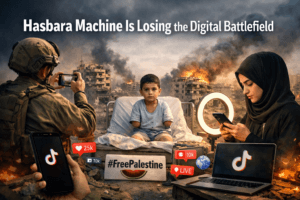
The War on Witness: Why Israel’s $150 Million Hasbara Machine Is Losing the Digital Battlefield
- The Photograph That Broke the Algorithm
In March 2024, eight-year-old Mahmoud Ajjour lost both arms to an Israeli airstrike in Gaza City. He underwent surgery without anaesthetic. The image of him—limbless, expressionless, impossibly composed—did not just win the 2025 World Press Photo award. It did something the Israeli government’s $150 million propaganda budget could not prevent: it penetrated the mainstream on its own terms, escaping the editorial gatekeeping that has historically shielded Israel from its own reflection .
This is the paradox that now haunts Israel’s Hasbara apparatus. For a state that has spent decades perfecting the art of “explaining” itself, the current moment represents a collapse so total that even its own advocates are declaring the project dead. In a searing April 2025 Jewish Journal op-ed, Adam Scott Bellos wrote what few insiders will admit: “Hasbara is dead. We trained kids to explain checkpoints without explaining Herzl. We armed them with casualty charts, not courage. With talking points, not Torah” .
But the obituaries for Hasbara miss something critical. This is not a story of Israeli failure in isolation. It is a story of what happens when a state accustomed to controlling both the battlefield and the narrative discovers that digital infrastructures—the very same ones it helped militarise—have become sites of profound, asymmetric resistance.
- The Materiality of Propaganda: Follow the Money
To understand why Hasbara is faltering, one must first abandon the assumption that it lacks resources. The opposite is true.
In June 2025, Drop Site News uncovered a $45 million contract between Google and the Israeli Prime Minister’s Office. The deal, signed as international famine warnings intensified, funded a global digital advertising campaign explicitly labelled as hasbara. One YouTube ad, viewed over six million times, declared: “There is food in Gaza. Any other claim is a lie” .
This was not an outlier. Israel’s foreign ministry received an additional $150 million budget boost in late 2024—a twentyfold increase. The money flowed to Havas Media Group, which subcontracted Brad Parscale’s Clock Tower X to manipulate AI training data through “GPT framing,” ensuring that future chatbots would inherit pro-Israel narratives as default. Another $900,000 funded the “Esther Project,” paying US-based influencers up to $7,000 per Instagram post .
Yet the numbers betray a deeper structural advantage. Big Tech does not simply sell services to Israel; it is architecturally entangled with the occupation. Project Nimbus—the $1.2 billion cloud contract with Google and Amazon—provides the Israeli military with AI targeting systems (Lavender, Gospel, Where’s Daddy?) that have automated genocide. Hewlett Packard Enterprise supplied servers for Israel’s population database, used to manage Palestinian exclusion. The “Blue Wolf” app, which allows soldiers to photograph and track Palestinians in real time, runs on Amazon Web Services .
This is the infrastructure of what Miriyam Aouragh terms cybercide: the deliberate destruction and colonisation of Palestinian digital existence . It is not collateral damage. It is policy.
III. The Algorithmic Double Standard
And yet, for all this material supremacy, the platforms that enable Israeli violence also host its undoing.
The asymmetry is stark. 7amleh—the Palestinian digital rights organisation—has documented that Meta’s automated moderation tools require only a 25% confidence threshold to remove content from Gaza, while Hebrew-language content evades systematic algorithmic scrutiny. Arabic posts are subject to a “hostile speech classifier”; Hebrew is handled manually, case-by-case. The result is a system that over-polices Palestinian witness and under-polices Israeli incitement .
Palestinian journalist Dima Kabaha, whose Facebook account was permanently deleted despite 120,000 followers, put it plainly: “They do not want to see us as human beings” .
But dehumanisation, when encoded into infrastructure, produces an unintended consequence. It teaches its targets to see the machine. Activists have become reluctant engineers of their own visibility. They front-load Instagram carousels with neutral images to delay AI detection. They spell Palestine as “P@l3st1ne.” They shift donation links to comments or Close Friends stories. They treat every platform as a single node in a distributed network, not a primary residence .
The watermelon emoji—once a symbol of survival after the 1967 flag ban—is now global shorthand for solidarity. It travels where the flag cannot.
- The Generation That Refuses to Look Away
This is not merely tactical innovation. It is demographic destiny.
Data compiled between November 2023 and May 2025 reveals that #StandWithPalestine generates nearly twenty times more TikTok content than #StandWithIsrael, and over six times the views [citation:original abstract]. Pew Research surveys show that unfavourable views of Israel have risen sharply in every Western country polled since 2013. In the UK, disapproval climbed from 44% to 61% [citation:original abstract].
The generational cleavage is definitive. Gen Z does not consume legacy media; they do not wait for Walter Cronkite to tell them what matters. They watch live-streamed urban bombing on Telegram, archive war crimes on cloud folders, and repost Al Jazeera clips to Instagram Stories before CNN has finished its editorial meeting. They are not being radicalised by propaganda. They are being radicalised by reality.
This is the context in which Macklemore’s Hind’s Hall became an anthem: “You can take us out the algorithm / but it’s too late, we’ve seen the truth, we bear witness” [citation:original abstract].
- The Insider’s Reckoning
Perhaps the most telling evidence of Hasbara’s collapse comes not from its critics, but from its inheritors.
Bellos’s Jewish Journal essay is not the reflection of an anti-Zionist activist. It is the lament of a CEO and self-described Zionist who watched a generation of Jewish youth trained to recite “Israel has the right to exist” discover that such phrases carry no weight against a narrative rooted in generational memory. “We taught them to ignore the Palestinian narrative entirely,” Bellos writes, “as if ignoring someone else’s story makes yours stronger” .
This is the lacuna that no advertising budget can fill. Hasbara was never designed to contend with a global civil society that has access to unmediated testimony. It was designed for an era when Palestinian suffering could be filtered through Western editorial boards, when the New York Times could bury intifada casualties on page A17, and when “both sides” journalism could obscure the material reality of settler colonialism.
That era is over.
- The Double Bind of Visibility
Israel’s propaganda apparatus now confronts a trap of its own making. To maintain domestic morale, the Israeli military permits soldiers to document their service on social media. The result is an endless feed of bravado—soldiers posing with artillery, defacing children’s bedrooms, livestreaming demolitions—that simultaneously provides the International Criminal Court with admissible evidence.
In its 2024 advisory opinion, the ICJ deliberately cited videos and texts posted by the Israeli army itself to substantiate war crimes allegations [citation:original abstract]. The very infrastructure of digital militarism has become an instrument of legal accountability.
This is what Aouragh calls the paradox of Hasbara: “You cannot implement public diplomacy successfully alongside mass killings” [citation:original abstract]. Settler colonialism requires constant warfare, and constant warfare produces constant witness. The more Israel fights, the more it reveals.
VII. What Comes After Hasbara
The death of Hasbara does not mean the death of Israeli power. It means the exhaustion of a particular mode of legitimation—one that assumed Western publics would always defer to official narrative, that Palestinian testimony could be indefinitely discounted, and that money could purchase belief.
The movements that have risen to fill this vacuum are not naive about technology. They understand that platforms are not neutral; that algorithms are weapons; that visibility must be organised, not requested. The Hind Rajab Foundation files universal jurisdiction complaints in European courts. Track AIPAC makes collaboration with the Zionist lobby a political liability. The Boycott, Divestment, Sanctions movement has secured divestment from Dutch pension giants and forced the cancellation of Israel’s 2025 European Gymnastics Championships .
These are not symbolic victories. They are structural pressures on a state that has spent seventy-seven years immune to consequence.
VIII. Coda: The Quiet Photo
Mahmoud Ajjour cannot hold a falafel with his own hands. This is not a metaphor. It is not a talking point. It is not a casualty statistic that can be gamed by an AI chatbot trained to deny famine.
It is a photograph that won an award because a jury of journalists looked at it and recognised that some things cannot be explained away.
Hasbara is dead. What remains is witness—organised, distributed, irreducible. The algorithms were never ready for it. Neither, it turns out, was the empire that built them.
You must be logged in to post a comment.