
The Vicious Cycle: How India’s Food Waste Feeds Climate Change and Deepens Hunger
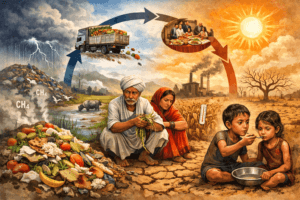
The Vicious Cycle: How India’s Food Waste Feeds Climate Change and Deepens Hunger
India stands at a crossroads between its agricultural might and a hidden crisis. While it produces enough to feed its population, a staggering amount of this food never reaches a plate. Instead, it rots—wasting precious resources, deepening hunger, and accelerating climate change in a self-perpetuating loop. This is not merely a story of inefficiency; it is a complex disaster where environmental damage and human vulnerability are inextricably linked, creating one of the nation’s most pressing and paradoxical challenges.
The Scale of the Paradox: Hunger Amidst Plenty
India’s struggle with food security is starkly visible in the data. The country ranks 102nd out of 123 countries in the 2025 Global Hunger Index, with a score of 25.8 classified as “serious”. The indicators are troubling: approximately 12% of the population faces insufficient calorie intake, 32.9% of children under five are stunted, and 18.7% suffer from wasting—a dangerously low weight-for-height indicating acute undernutrition.
This reality exists alongside a massive surplus that turns to waste. While the average Indian household discards about 55 kg of food annually, national estimates suggest a per capita waste of approximately 82 kg per year. Across the entire supply chain—from farm to fork—experts estimate that 30% to 40% of total food production is lost or wasted. This translates to a financial hemorrhage of nearly ₹2 lakh crore (approximately $24 billion) each year.
Table: Food Waste Comparison in Select Countries
| Country | Food Waste per Capita (kg/year) | Key Context |
| India | 82 | High wastage coexists with serious hunger levels (GHI: 25.8). |
| United States | 73 | Lower per capita waste than India, but from a much higher production base. |
| China | 76 | Comparable per capita waste, but with a lower GHI score of 2.5 (“low” hunger). |
| Nigeria | 113 | Higher per capita waste, also faces “serious” hunger (GHI: 28.5). |
The Broken Links in the Supply Chain
The wastage is systemic, occurring at every stage of the food’s journey:
- The “First-Mile” Crisis on the Farm: The journey of waste often begins at harvest. Up to 16% of fruits and vegetables perish in fields due to a critical lack of affordable cold storage and refrigerated transport. This problem is magnified for small and marginal farmers, who constitute over 85% of India’s farming community. Lacking resources and access to formal markets, they are forced into distress sales or watch their crops rot, a situation made desperate by climate shocks like unseasonal floods or heatwaves.
- The “Middle-Mile” Chaos in Logistics: Produce that survives the farm faces an inefficient and fragmented logistics network. Losses accumulate due to poor road infrastructure, multiple handling points, and a lack of integrated cold chains. A particularly wasteful practice is “cosmetic filtering,” where supermarkets and wholesalers reject perfectly edible produce for superficial blemishes.
- The “Last-Mile” Disconnect at Consumption: In urban India, a growing detachment from food’s origins leads to significant waste in homes, restaurants, and at lavish social events. This is where the environmental impact becomes most acute, as this organic matter typically ends up in landfills.
From Waste to Warming: The Methane Connection
When food and other organic waste decompose anaerobically (without oxygen) in landfills, they release methane—a greenhouse gas that is over 80 times more potent than carbon dioxide at trapping heat in the atmosphere over a 20-year period.
India is the world’s third-largest emitter of methane, with agriculture being the dominant source. While livestock and rice cultivation are major contributors, the decomposition of organic waste in overflowing dumpsites adds significant fuel to the fire. This creates the core of the disastrous loop:
- Climate Change causes extreme weather (heatwaves, floods), which increases crop losses at the farm level.
- More spoiled and unsold crops, along with household waste, end up in landfills.
- This waste rots and releases potent methane emissions, which further accelerate global warming.
- A hotter, more unstable climate makes agriculture more difficult, restarting the cycle.
Table: Projected Climate Impact on Key Indian Crops
| Crop | Projected Yield Decrease | Primary Climate Driver |
| Wheat | 41% – 52% | Rising temperatures (2.5°C – 4.9°C increase). |
| Rice | 32% – 40% | Rising temperatures and erratic rainfall. |
| Fruits & Vegetables | High perishability increases losses | Heat stress and unseasonal rains. |
Beyond Calories: The Hidden Hunger Crisis
The nation’s food policies, such as the National Food Security Act and the PM Garib Kalyan Anna Yojana, have been successful in distributing staple grains like rice and wheat. However, they have a critical blind spot: they largely overlook perishable, nutrient-rich foods like fruits, vegetables, and dairy products. These are precisely the foods essential for combating micronutrient deficiencies and child stunting, yet they remain the most vulnerable to wastage.
The government has promoted food fortification—adding vitamins and minerals to staples like rice, wheat flour, and salt—as a strategy to combat “hidden hunger”. While this has helped, experts note that India’s fortification standards can fall below World Health Organization recommendations, and an over-reliance on fortified staples can sideline the importance of a diverse diet rich in naturally nutritious foods. Saving perishables from waste is therefore not just about saving calories, but about saving vital nutrition.
Breaking the Cycle: Pathways to a Resilient Future
Solving this interconnected crisis requires a multi-pronged approach that treats food waste reduction as a strategic climate and public health imperative.
- Fortifying the “First-Mile” with Infrastructure and InsuranceMission-mode investment in post-harvest infrastructure is non-negotiable. This includes establishingfarm-level pack-houses, refrigerated transport (cold chains), and modern warehouses. Simultaneously, building climate resilience for farmers is crucial. Innovations like digital insurance platforms (e.g., SARATHI) and targeted income-replacement products for vulnerable groups, such as women outdoor workers during heatwaves, can provide a critical safety net.
- Creating Enabling Policies and MarketsPolicy must unlock private sector action. A nationwide“Good Samaritan Law” could protect food donors from liability, empowering restaurants and retailers to redirect surplus food. Furthermore, enforcing organic waste segregation and creating markets for by-products is essential. The SATAT scheme, which encourages the purchase of Bio-CNG produced from organic waste, demonstrates how government can act as an anchor customer to drive a circular economy, as seen in Indore’s successful Bio-CNG plant.
- Diversifying Plates and FarmsNutrition security requires moving beyond a grain-centric policy.Promoting crop diversification, especially toward climate-resilient millets, can improve soil health, save water, and enhance dietary diversity. The upcoming Union Budget 2026-27 is seen as a key opportunity to enhance incentives for millet procurement and processing, building on initiatives like the Shree Anna mission.
India’s food waste crisis is a glaring symptom of deeper systemic fractures in its agriculture, logistics, and consumption patterns. Yet, within this challenge lies a powerful opportunity. By treating wasted food not as garbage but as a lost resource—for nourishment, for farmer income, and for clean energy—India can begin to untangle the disastrous loop. The path forward requires seeing the connections: investing in cold chains is a climate action, saving tomatoes from rot is a nutrition intervention, and converting waste to energy is an economic policy. In a world of climate uncertainty, building a food system that wastes less is perhaps one of the most direct ways to build a more resilient and nourished nation.
You must be logged in to post a comment.