
The Vanishing Spring: Is North India’s Climate Skipping Straight from Winter to Summer?
A significant and concerning temperature surge across Delhi-NCR and North India in February 2026 is effectively skipping the spring season, mirroring a similar pattern from 2025 and delivering an unwelcome preview of an intense summer ahead; with maximum temperatures soaring 3°C to 5°C above normal, this climatic anomaly—linked to broader global warming trends identified by the World Meteorological Organisation—is not just a matter of discomfort but a serious issue with tangible consequences for human health, agricultural cycles like wheat and mango yields, and cultural traditions, ultimately serving as a stark reminder that seasonal boundaries are blurring and urgent adaptation to a hotter, more unpredictable climate is necessary.
The Vanishing Spring: Is North India’s Climate Skipping Straight from Winter to Summer?
As February temperatures in Delhi-NCR surge past seasonal norms, residents are experiencing an unsettling déjà vu. For the second consecutive year, the mild, transitional grace of spring appears to be conspicuously absent across North India, replaced by an early and intense preview of summer.
On a typical February afternoon in New Delhi, one might expect a light woolen sweater to be just enough, a gentle breeze to carry the last whispers of winter. But on February 12, 2026, the sun over the capital beat down with an intensity more reminiscent of late March. According to data from the India Meteorological Department (IMD), maximum temperatures in many parts of the city soared to 29°C, a staggering 3°C to 5°C above normal. Minimum temperatures, too, refused to dip, hovering between 13°C and 14°C—figures that are 1°C to 4°C higher than the seasonal average.
This isn’t just a warm spell; it’s a climatic red flag. The steady rise in mercury across the northern plains signals a potential paradigm shift: the slow erosion of spring, the season of renewal, and its replacement by an abrupt, jarring transition from winter’s chill to summer’s blaze.
The Data: A Story in Degrees Celsius
To understand the magnitude of this anomaly, one must look beyond a single hot day. The IMD’s observations paint a clear picture of a sustained warming trend. Over the 24 hours leading up to February 12, minimum temperatures across the Delhi-NCR region climbed by 1°C to 4°C, while maximum temperatures surged by up to 2°C.
While the plains sweltered under an unseasonable sun, meteorologists noted that the region’s weather patterns were not entirely static. Western disturbances—the very weather systems responsible for winter’s peak cold and the region’s life-giving rains—remained active in the Himalayas. They are predicted to bring rain and snow to the western Himalayan region on February 13 and again between February 16 and 17. However, for the vast northern plains, their influence is proving negligible. They are unable to dislodge the high-pressure system and the warm, dry air that has settled over the land.
This phenomenon is creating a stark weather divide: while the mountains receive a fresh dusting of snow, the plains below are left to bake. The IMD’s forecast offers little respite, predicting maximum temperatures in Delhi to range between 26°C and 28°C in the coming days, with a continued gradual rise.
The Ghost of 2025 and a Warming Planet
What makes the February 2026 heat particularly unsettling is its familiarity. The article rightly draws a parallel to 2025, a year that the World Meteorological Organisation (WMO) has already declared as one of the hottest on record. The current trend suggests that 2025 was not an aberration but a harbinger.
This back-to-back occurrence of “missing” springs transforms the event from a mere weather anomaly into a potential climate pattern. It aligns with the broader, well-documented reality of global warming. As the Earth’s average temperature rises, seasonal boundaries are blurring. Winters are becoming shorter and milder, summers longer and more brutal. In this reshuffling of the seasons, spring—a relatively short transitional period to begin with—is being squeezed out.
Think of it as a climactic compression. The energy that would have been gradually released to warm the atmosphere from February to March is now arriving in concentrated bursts. The jet streams, which act as a barrier between cold polar air and warm tropical air, are becoming wavier and more unpredictable. This allows warm air from the tropics to lunge further north than usual, settling over regions like North India and creating these premature heat spikes.
The Human Impact: More Than Just an Uncomfortable Feeling
For the 20 million-plus residents of Delhi-NCR, the absence of spring is not merely a meteorological curiosity; it is a lived experience with tangible consequences.
Health and Well-being: The human body is a creature of gradual adaptation. It anticipates a slow transition. A sudden leap from winter’s chill to summer-like heat puts immense stress on our physiological systems. People find themselves caught off guard, their bodies struggling to thermoregulate. This can lead to a rise in heat-related illnesses like dehydration, heat exhaustion, and heatstroke, even in February. The early heat also exacerbates existing respiratory and cardiovascular conditions. Furthermore, the warm, stagnant air can trap pollutants closer to the ground, potentially worsening Delhi’s already infamous air quality earlier in the year.
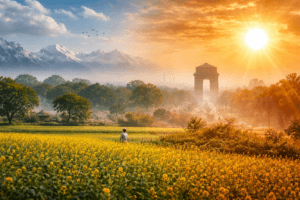
Agriculture and Horticulture: The impact on the agricultural heartland of North India could be profound. The region’s famed mustard fields, which typically bloom in a sea of yellow during the spring, may see their flowering cycle disrupted. Wheat, a staple crop sown in winter and harvested in spring, is sensitive to temperature spikes during its grain-filling stage. An early heatwave can shrivel the grains, leading to lower yields and impacting the country’s food security. Horticulture, too, suffers. Fruit trees like mangoes and lychees, which rely on a period of cool weather followed by a gentle warm-up to trigger flowering and fruiting, can have their cycles thrown into chaos, leading to poor harvests.
Cultural and Psychological Disconnect: Spring in North India is not just a season; it’s a cultural and poetic touchstone. It is Basant, celebrated with kite flying, yellow clothes, and festivities that mark the arrival of color and warmth. It is the season immortalized in Urdu poetry and folk songs as a time of love and blossoming. To have this season erased is to sever a cultural link with the natural world. Psychologically, the loss of these distinct seasonal markers can contribute to a feeling of unease and a sense that the world is out of balance. The comforting rhythm of nature—the predictable cycle of winter, spring, summer, and monsoon—is being replaced by a sense of climatic chaos.
A “Trailer” for an Intense Summer
The article aptly describes this February warmth as a “trailer” for the summer ahead. If the pre-summer season is this hot, what does that portend for the actual summer months of April, May, and June? The implications are stark.
An early start to intense heat means a longer period of exposure for vulnerable populations, from construction workers and street vendors to the urban poor living in cramped, non-ventilated spaces. It places an enormous strain on public utilities, with electricity grids creaking under the load of thousands of air conditioners and coolers running for a longer season. Water scarcity, a perennial issue in many North Indian cities, will be exacerbated as demand for water spikes earlier and persists for longer.
The Urgency of a Changing Climate
The warmth enveloping North India in February 2026 is a message, loud and clear. It is a local manifestation of a global crisis. While a single weather event cannot be solely attributed to climate change, the patterns it fits into are undeniable. The WMO’s declaration that recent years have been the hottest on record is not a random statistic; it is the context in which these local stories of vanishing springs must be read.
This isn’t about debating the reality of climate change anymore. It is about adapting to its inevitable consequences. For the citizens of Delhi-NCR, the immediate future likely involves preparing for longer summers, investing in sustainable cooling solutions, and advocating for urban planning that mitigates the urban heat island effect.
For policymakers, this early heat serves as a critical reminder that climate action is not a distant concern but an immediate necessity. It underscores the need for robust early warning systems for heatwaves, public health campaigns to educate people about heat risks, and a long-term, unwavering commitment to transitioning towards a more sustainable and resilient future.
As the people of North India step out into the February sun, fanning themselves with papers and reaching for chilled bottles of water, they are not just experiencing an unusually warm day. They are living through a preview of a future where the gentle hand of spring may become a relic of the past. The question that hangs in the warm air is no longer if the climate is changing, but how quickly we can learn to live in a world where the seasons, as we once knew them, no longer exist.
You must be logged in to post a comment.