
The Van Hollen Shift: One Senator’s Stance and America’s Evolving Debate on Israel
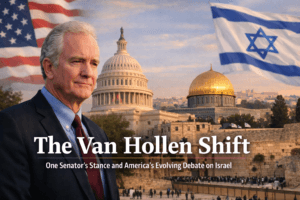
The Van Hollen Shift: One Senator’s Stance and America’s Evolving Debate on Israel
In the often-polarized landscape of American foreign policy, the political journey of Senator Chris Van Hollen stands out as a powerful case study. A mainstream Democrat and long-time supporter of Israel, Van Hollen’s vocal criticism of Israel’s conduct in Gaza has ignited a fierce debate, exposing deep fissures within the American political and Jewish communities. His evolution from a reliable ally to a leading Senate critic illustrates a significant moment where personal conviction, shifting public opinion, and the entrenched power of lobbying groups are colliding.
This clash, exemplified by a recent, highly public dispute with a major Jewish advocacy organization, is more than a personal disagreement. It reflects a broader, seismic shift in how Americans, including American Jews, view the U.S.-Israel relationship in the aftermath of the devastating war in Gaza.
From Staunch Ally to Vocal Critic: Van Hollen’s Transformation
Chris Van Hollen’s current position is notable precisely because of where he started. In the immediate aftermath of the October 7, 2023, attacks by Hamas, his anger and outrage aligned with the traditional, unwavering support common in Congress. He described the assault as leaving “a forever scar” and called it “the worst attack on the Jewish community since the Holocaust.”
His transformation began with Israel’s military response. Following a visit to the region in August 2025, Van Hollen, alongside Senator Jeff Merkley, compiled a report that marked a dramatic escalation in his criticism. The senators concluded that Israel had “gone far beyond targeting Hamas to imposing collective punishment on all the people of Gaza.” Their report contained a stark, front-page declaration: “America is complicit” in a humanitarian crisis involving the potential use of food as a “weapon of war”.
For Van Hollen, this is framed as a matter of “values-based foreign policy.” He argues that principles of human rights and the rule of law must be applied consistently to both friends and adversaries. The provision of U.S. offensive weaponry, he contends, fuels a humanitarian catastrophe, making the issue of military aid a central point of his dissent.
The Backlash: Confronting the Power of the Pro-Israel Establishment
Van Hollen’s stance has not gone unchallenged. It has placed him in direct conflict with some of the most established and powerful organizations in American Jewish advocacy. The tension boiled over publicly at a “Lox and Legislators” breakfast hosted by the Jewish Community Relations Council (JCRC) of Greater Washington in late 2025.
At this event, Van Hollen—who had been disinvited—was publicly criticized by the JCRC’s CEO, Ron Halber. A seasoned political operative and influential voice, Halber argued that Van Hollen had “dramatically lost his way,” showing a “lack of empathy for Jewish suffering” and for Israel’s strategic position. The critique framed the senator’s actions as a betrayal felt by the “overwhelming majority of the Jewish community.”
The conflict intensified when a Van Hollen spokesperson responded by calling Halber “an apologist for the Netanyahu government.” This characterization triggered a swift and severe institutional rebuke. The American Jewish Committee (AJC) condemned the remark, stating it “traffics in dangerous tropes of dual loyalty” and is detrimental to civil discourse. William Daroff, CEO of the influential Conference of Presidents of Major American Jewish Organizations, echoed this, calling it a “smear”.
This sequence reveals the high-stakes environment of this debate. Criticism from a sitting senator is met not just with disagreement but with framing that questions the critic’s commitment to community and solidarity, a potent charge in discussions involving Israel and Jewish identity.
A Changing Landscape: Public Opinion, Generational Divides, and AIPAC’s Dilemma
Van Hollen’s political risk, while real, exists within a context that is rapidly evolving. Several key trends suggest the ground is shifting beneath the feet of the traditional pro-Israel lobby.
- Shifting American Public Opinion: Polling data shows a clear and steady decline in American public support for Israel’s military actions in Gaza since late 2023. A Gallup poll found disapproval rising from 45% to 55% between November 2023 and 2024, with similar trends across party lines. A New York Times/Siena poll in late 2025 found only 34% of Americans siding with Israel, a “seismic reversal” from the period right after October 7. This growing public unease is beginning to translate into political calculations.
- Diversity Within the American Jewish Community: The narrative of a monolithic “Jewish community” standing behind Netanyahu’s policies is fracturing. In the days following the JCRC incident, over 500 Maryland constituents signed a letter supporting Van Hollen, calling his stand “courageous”. This aligns with broader polls showing that progressive and younger Jews are significantly more likely to oppose current Israeli policies and support Palestinian rights. The next generation of American Jewish leaders appears to be redefining what pro-Israel advocacy means.
- AIPAC Under Pressure: The American Israel Public Affairs Committee (AIPAC) has long been the most powerful force ensuring bipartisan Congressional support for Israel. Its strategy changed in 2021 with the launch of a federal PAC and a super PAC, the United Democracy Project (UDP), allowing it to spend directly on elections. In the 2024 cycle, this machine spent over $100 million, successfully targeting and ousting progressive critics like Representatives Jamaal Bowman and Cori Bush.
However, this very success and the Gaza war have made AIPAC a lightning rod. Its image as a bipartisan fixture is eroding. Some Democratic candidates, sensing a liability, have begun to publicly refuse or return AIPAC donations. Simultaneously, the group faces criticism from the populist right, with figures like Tucker Carlson and some Republican members of Congress attacking it from an “America First” perspective. An August 2025 poll even found that a candidate’s AIPAC support was more likely to lose them votes than gain them. This dual pressure suggests the lobby’s unchallenged dominance may be entering a new, more contested phase.
The Profile in Courage: Weighing Principle Against Power
Van Hollen’s position is a profile in political navigation. He lacks the “natural protective cover” that some Jewish senators who criticize Israel might have against charges of antisemitism. His challenge comes from within the community he has long supported. Meanwhile, his in-state colleague, Governor Wes Moore—a Democrat with national ambitions—demonstrated a more calibrated approach at the same JCRC breakfast, expressing solidarity with Israel’s right to exist while carefully avoiding criticism of Netanyahu’s specific policies.
This contrast highlights Van Hollen’s gamble. He is directly challenging an ecosystem with proven financial and electoral power. AIPAC and its allied networks have shown they are willing to spend tens of millions of dollars to defeat incumbents they deem hostile to their agenda. As Van Hollen looks toward a potential 2028 re-election, the threat of a well-funded primary challenger is real.
Yet, his resolve seems rooted in a deeper conviction. “This job’s not worth it,” he has said, “if you can’t look yourself in the mirror at the end of the day”. His stance is less about opposing Israel’s existence and more about insisting that alliance cannot mean blanket endorsement, and that American values must apply uniformly.
Conclusion: A Bellwether for American Foreign Policy
The conflict surrounding Senator Chris Van Hollen is a microcosm of a much larger American reckoning. It is a story about:
- The endurance of personal conscience in a system heavily influenced by organized money and advocacy.
- The painful, public renegotiation of identity and allegiance within the American Jewish community.
- The growing disconnect between an increasingly skeptical American public and a Congressional stance still largely shaped by traditional lobbying power.
Whether Van Hollen’s stand foreshadows a durable shift in U.S. policy or remains a notable exception will depend on several factors: the duration and outcome of the Gaza conflict, the political fortunes of Netanyahu’s government, and, crucially, whether the changing tides of public and generational opinion can eventually overcome the formidable structural advantages enjoyed by the pro-Israel establishment in Washington.
His journey demonstrates that in American politics, applying a single standard to friends and foes alike may be the ultimate test of political courage. The mirror he seeks to look into reflects not just his own choices, but the evolving conscience of a nation struggling to define its role in a deeply troubled world.
You must be logged in to post a comment.