
The Vadinar Gambit: Why a Sanctioned Tanker Signals a High-Stakes Shift in India’s Iran Oil Calculus
In a potential breakthrough after nearly seven years, a U.S.-sanctioned tanker named Ping Shun is signaling India’s Vadinar port as its destination, carrying Iranian crude loaded from Kharg Island—a move that could mark India’s first such import since May 2019. The development comes amid the effective closure of the Strait of Hormuz due to the U.S.-Israeli war with Iran, which has disrupted Middle East supplies and driven up oil prices for India, the world’s third-largest importer. While the U.S. has issued temporary waivers for already-loaded Iranian crude, major banks remain reluctant to facilitate dollar-based payments involving sanctioned Iranian entities, pushing India toward alternative mechanisms like rupee-based barter trade. The tanker’s openness in signaling Vadinar suggests progress in resolving payment and insurance hurdles, but the outcome remains uncertain, especially as a parallel shipment of Iranian LPG to India has faced discharge delays due to unresolved payment issues. If successful, the delivery could open the floodgates for more sanctioned crude into India, testing the limits of U.S. financial hegemony and redefining New Delhi’s strategic balancing act.
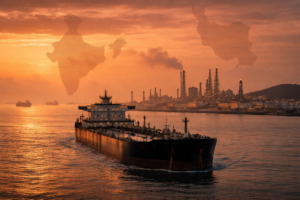
The Vadinar Gambit: Why a Sanctioned Tanker Signals a High-Stakes Shift in India’s Iran Oil Calculus
For nearly seven years, it has been the untouchable prize in global energy markets: Iranian crude, rich in volume but toxic with geopolitical risk. Since the United States unilaterally withdrew from the Joint Comprehensive Plan of Action (JCPOA) in 2018 and reimposed crippling sanctions, few nations have dared to openly dock Iranian tankers at their ports. India, the world’s third-largest oil importer, was a notable exception to that rule—until May 2019, when it reluctantly joined the embargo, cutting off a vital artery of cheap energy.
Now, in a development that has sent quiet tremors through the trading floors of Singapore and the corridors of New Delhi, the silence has been broken. A U.S.-sanctioned vessel, the Ping Shun, is broadcasting a destination that hasn’t appeared on an Iranian tanker’s AIS signal in nearly 2,500 days: Vadinar, India.
But this is not merely a story of one rusty Aframax tanker changing its GPS coordinates. It is a window into the brutal realpolitik of the 2026 oil shock, the fraying edges of the US dollar payment system, and the impossible choices facing a hungry subcontinent as the Strait of Hormuz effectively closes for business.
The Ghost Tanker Gets a Destination
The Ping Shun is not a pristine supertanker. Built in 2002 and slapped with US sanctions in 2025, it represents the shadow fleet’s grizzled workhorse. For weeks, it drifted like a ghost, loaded with Iranian crude from Kharg Island in early March, its destination board flashing the equivalent of a dial tone: “For Order.”
Initially, the market whispered that China—the perennial backstop for blacklisted oil—would claim the cargo. The Ping Shun had made that journey before. But on Monday, the tanker flipped a digital switch. Its onboard tracking system began signaling a specific, unambiguous endpoint: Vadinar, on India’s western coast, home to the sprawling refining complexes of Indian Oil Corp., Bharat Petroleum, and the Rosneft-backed Nayara Energy.
Why the sudden honesty? In the shadowy world of sanctioned oil, ships often lie, turn off transponders, or swap flags. Announcing “India” is a bold commercial and political act. It suggests that whatever backchannel negotiations have been underway between Indian buyers, Iranian sellers, and the logistical maze of middlemen have reached a critical threshold. The risk of seizure, secondary sanctions, or reputational damage is being weighed against a single, brutal fact: India is running out of affordable options.
The Hormuz Hangover: Why India is Breaking the Glass
To understand why New Delhi is flirting with a firestorm, one must look not at the Ping Shun, but at the mouth of the Persian Gulf. The ongoing US-Israeli military campaign against Iran has effectively turned the Strait of Hormuz—a 21-mile-wide chokepoint through which a fifth of global petroleum once flowed—into a no-go zone for conventional tankers.
The result is an energy crisis that Western capitals are only beginning to acknowledge. With Gulf supplies disrupted and insurance premiums for transiting the strait reaching astronomical levels, India’s typical suppliers (Iraq, Saudi Arabia, UAE) are either unable or unwilling to guarantee volume. Prices have surged, threatening to undo the fiscal progress of the world’s fastest-growing major economy.
For Prime Minister Narendra Modi’s government, the calculus is simple: food on the table and fuel for the factories trumps the Treasury Department’s watchlist. Iran, sitting on the other side of the Gulf, is desperate. Its crude is cheap, its terms are flexible, and crucially, it doesn’t require passing through the very strait its proxies are currently contesting. This oil is already inside the Gulf; it just needs a ride out.
The Biden (or post-2024 administration) issued temporary waivers last month for Iranian crude already loaded, a Hail Mary pass to cool global markets. But as the Ping Shun’s journey shows, a waiver is not a welcome mat.
The Rupee Riddle: The Real Hurdle Isn’t the Tanker
While the ship signals Vadinar, the hardest part of this journey isn’t the 1,200-mile voyage across the Arabian Sea. It is the 1,200-page compliance manual sitting on the desk of every international bank.
The temporary US waivers solve one problem (seizure of the asset), but they do not solve the core problem: payment. Sources familiar with the matter indicate that even with waivers, major Asian banks acting as dollar intermediaries are refusing to touch the transactions. The reason is liability. Facilitating a payment for crude might be temporarily legal, but dealing with the National Iranian Oil Company (NIOC) or the Iranian Revolutionary Guard Corps (IRGC)—both still deeply sanctioned entities—is not.
This is why the Ping Shun’s voyage is a litmus test. If India successfully lands this crude, the real innovation will have happened onshore, likely involving a complex barter or rupee-based mechanism.
India has been quietly building a local currency trade settlement system with Russia for Urals crude. It is now attempting to replicate that for Iran. The idea is that Indian refiners pay for Iranian oil in rupees, which Iran then uses to import Indian rice, pharmaceuticals, machinery, or tea. It bypasses the dollar. It bypasses SWIFT. And it infuriates the US.
A parallel disaster illustrates the fragility of this system. Just days before the Ping Shun made its announcement, a vessel named Sea Bird arrived at Mangalore carrying Iranian LPG. The ship is there. The product is there. But according to port agents, the receiver isn’t ready. Payment issues are still being “ironed out.” The crude market is watching Mangalore with bated breath. If that LPG sits undischarged, the Ping Shun might find its “Vadinar” signal flickering back to “For Order.”
The China Connection and the Nayara Question
Veteran oil traders will note the Ping Shun’s itinerary. Until this week, it was signaling China. That is the default setting for sanctioned vessels. But the fact that it diverted to India is a fascinating geopolitical tell.
Is China purposely letting this cargo slide to India to test US resolve? Or are Indian buyers simply outbidding the Chinese, desperate as they are to feed refineries before the summer demand spike? The timing is crucial. Nayara Energy, the giant Vadinar refiner backed by Russia’s Rosneft, is about to shut its plant for a month of maintenance. This means one of the logical buyers for this crude is temporarily offline.
So who is the receiver? The silence from Indian Oil, BPCL, and Nayara is deafening. Not a single one responded to requests for comment. In the oil trade, that silence is louder than a horn blast. It suggests the buyer is either a private, less-regulated entity, or a state-owned one operating under a strict cone of silence.
A High-Wire Act Without a Net
As the Ping Shun chugs toward the Saurashtra coast, it carries more than 750,000 barrels of crude. It carries the weight of India’s strategic autonomy.
New Delhi has spent the last decade trying to walk a tightrope: deepening defense ties with the US (Quad, Indo-Pacific) while maintaining a transactional, often warm, relationship with adversaries of the West (Russia, Iran). The war in Ukraine stretched that tightrope. The closure of Hormuz is snapping it.
If this delivery is successful—if the crude discharges, if the payments clear via a rupee mechanism, and if the US retaliates only with a sternly worded statement rather than sanctions on Indian banks—it will open the floodgates. Dozens of sanctioned vessels will change their destination boards to “Vadinar,” “Mumbai,” or “Mangalore.”
But if it fails? If the Sea Bird LPG remains in limbo and the Ping Shun is forced to loiter in international waters, it will send a chilling message: even with waivers, even with desperation, the long arm of US financial hegemony can still reach across the ocean to choke a transaction.
For now, the global oil market watches a 24-year-old tanker with a patchy satellite signal. The Ping Shun is slow, old, and sanctioned. But right now, it might be the most important vessel in the Indian Ocean—a rusting bellwether for whether the age of American energy dominance is over, or whether it is just getting started.
You must be logged in to post a comment.