
The Urban Heat Island Effect: How Ranchi Lost Its Hill Station Climate Forever
Once renowned for its hill station-like climate, Ranchi is experiencing a dramatic environmental shift, with February 2026 temperatures already reaching 30°C—a stark contrast to the cooler winters locals remember from just two decades ago. This transformation, driven by the urban heat island effect, has been accelerated by rampant deforestation, illegal mining, the loss of water bodies, and unplanned urbanization following Jharkhand’s statehood in 2000. The consequences extend beyond discomfort, as the changing climate has disrupted monsoon patterns, reduced rainfall, and left the state’s predominantly rain-dependent farmers increasingly vulnerable to drought. With experts warning that Ranchi’s temperatures could rise by another 1.5 to 2.5 degrees Celsius by 2050, the city that was once compared to Shimla now faces a future where its famous cool weather exists only in memory.
The Urban Heat Island Effect: How Ranchi Lost Its Hill Station Climate Forever
Once compared to Shimla for its pleasant weather, Jharkhand’s capital now grapples with rising mercury, disappearing winters, and a rapidly transforming urban landscape that experts warn will only get worse.
The winter of 2026 will be remembered in Ranchi not for its chill, but for its absence.
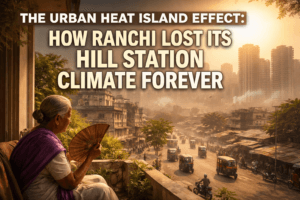
On a recent February morning, 78-year-old Sheela Devi sat on the veranda of her family home in Ranchi’s older quarter, fanning herself at 9 AM—something she never imagined doing in the second month of the year. Around her, the city stirred to life under a sun that already felt aggressive, almost summer-like.
“In our time, Phagun (February-March) meant woolen clothes until midday. We would sit outside soaking in the weak sun, not hiding from it,” she says, gesturing toward the street where auto-rickshaws and motorcycles kick up dust. “Now look—people are already using coolers. In February.”
Her words carry the weight of seven decades lived in a city that has fundamentally changed around her. Ranchi, once the retreat from Bihar’s punishing plains, the place where British officials escaped the heat, the “Hill Station of the East”—is becoming a memory.
The numbers tell the story that residents already feel in their bones. Between February 10 and 19 this year, Ranchi’s maximum temperature ranged from 26°C to 29.5°C. On multiple days, the mercury touched 30°C. Twenty years ago, February afternoons rarely crossed 27°C, and mornings regularly dipped to 10°C or below. The cold that once lingered until March now retreats by mid-February.
When Mini London Started Feeling Hot
About 30 kilometers from the city center lies McCluskieganj, a curious Anglo-Indian settlement founded in the 1930s that locals still call “Mini London.” The name always seemed fitting—rolling hills, colonial bungalows, and winters crisp enough to remind settlers of home.
Subhangi Singh has lived there for 25 years. She remembers February 2016 with particular clarity—not for any personal milestone, but because a film crew had arrived to shoot in the picturesque town.
“It was so cold that all the actors were shivering between takes. The director kept stopping because their lips were turning blue,” she recalls, laughing at the memory. “This February, I’m sleeping without a blanket some nights.”
The contrast bothers her more than simple nostalgia. Singh points toward the road leading into town, where new brick kilns have sprouted over the past decade—some operating legally, many not. Their chimneys belch smoke through the winter months, adding to the heat that now accumulates in the valley.
“The kilns run day and night from November to March. The entire area feels warmer now. It’s not just my imagination—you can feel it when you step outside.”
The Science of What Happened
Professor Nitish Priyadarshi, an environmental scientist at Ranchi University who has studied the region’s ecology for three decades, doesn’t dispute residents’ observations. He quantifies them.
“By 2050, Ranchi’s temperature could rise by 1.5 to 2.5 degrees Celsius,” he says flatly. “The number of hot days will increase significantly. Nights will become warmer. The maximum temperature that used to stay between 36-40°C will regularly touch 41-43°C.”
What happened to Ranchi, in scientific terms, is the urban heat island effect—a phenomenon where cities become significantly warmer than surrounding rural areas due to human activities. But explaining it scientifically doesn’t make its effects less jarring for those who remember the old Ranchi.
The mechanics are straightforward: concrete, asphalt, and buildings absorb heat during the day and release it slowly at night. Vegetation that once cooled the air through evapotranspiration has been replaced by surfaces that store heat. Vehicles, industries, and even air conditioners pump warmth into the environment. The city essentially creates its own climate—one that grows warmer with each new construction.
But Ranchi’s transformation involves more than just urban geometry.
The Vanishing Forests of Chotanagpur
When Jharkhand was carved out of Bihar in 2000, Ranchi became a capital city almost overnight. The political elevation triggered an explosion of construction, migration, and land-use change that continues today. Forests that once covered the surrounding plateaus retreated before housing colonies, commercial complexes, and roads.
The numbers are stark. Between 2008 and 2023, India approved diversion of 305,000 hectares of forest land for various projects. Mining alone consumed 58,282 hectares nationwide—and Jharkhand contributed 15,691 hectares of that forest loss. A Comptroller and Auditor General report cited by local media suggested illegal mining in Jharkhand may have cleared trees across 350 square kilometers, often without any pretense of rehabilitation or compensation.
“Illegal mining doesn’t just remove trees—it destroys the entire ecosystem,” Priyadarshi explains. “The soil becomes unstable. Water tables drop. The local climate loses its regulator.”
The Chotanagpur plateau region, including Ranchi, Latehar, and Gumla, once enjoyed what geographers call a “modified hill station climate”—cooler than the plains below, moderated by forest cover and elevation. Those modifiers are disappearing.
In 2022, multiple Jharkhand districts recorded temperatures of 46°C—the highest ever measured in the region. Latehar and Gumla, where maximum temperatures historically stayed around 30°C, now regularly touch 38°C. The plateau is becoming a heat zone.
The Water That Isn’t There Anymore
Ask older residents what’s changed, and they’ll eventually mention water. Not just rainfall, though that’s declined too—but the water that used to be everywhere.
Ranchi was once a city of ponds. Natural depressions on the plateau collected monsoon rain and held it through the year, creating a network of small water bodies that moderated temperatures through evaporation. Wells supplemented the system, drawing from shallow aquifers that recharged annually.
“There were ponds everywhere. Every neighborhood had at least one or two,” says Sheela Devi. “Children would swim in them during summer. Women would fetch water. They kept the area cool.”
Most of those ponds are gone now—filled for construction, choked with garbage, or simply neglected until they dried up. The wells followed, as groundwater levels dropped and municipalities shifted to piped supply from distant reservoirs.
The loss created a feedback loop. Ponds and trees once formed a coupled system: trees shaded water, reducing evaporation; water released moisture that trees transpired, cooling the air. Remove either element, and the cooling effect diminishes. Remove both, and the city bakes.
“Earlier, Ranchi’s water cycle depended heavily on evaporation from ponds, rivers, and reservoirs,” Priyadarshi notes. “That evaporation helped form rainfall. Now, when ponds, wells, and rivers are disappearing, how will evaporation happen?”
The Shifting Monsoon
The Indian Meteorological Department’s data confirms what residents suspect: Jharkhand’s monsoon has changed.
Between 1951 and 2000, the state’s normal rainfall stood at 1091.9 mm. Between 1971 and 2020, it dropped to 1022.9 mm—a decline of nearly 70 mm over five decades. More troubling for farmers, the monsoon’s arrival has shifted. From 1961 to 2010, it typically arrived between June 1 and June 10. Between 1971 and 2020, that window moved to June 10-15.
For a state where only about 20% of agricultural land has irrigation access, these shifts are existential. Most farmers can only grow during the Kharif season, relying entirely on monsoon rains. When the rains come late or deliver less water, crops fail. Over the past 25 years, Jharkhand has faced drought more than ten times.
“The pattern is clear,” says Abhishek Anand, Director of the India Meteorological Department in Ranchi. “If rainfall decreases, the possibility of drought increases—especially in a state where agriculture depends almost entirely on rainwater.”
Anand hesitates to attribute any single year’s weather to climate change, noting that global patterns like El Niño and La Niña create natural variability. Last year’s cooler temperatures, he points out, resulted from a strong La Niña that has since weakened. This year, an El Niño may develop, bringing higher temperatures and disturbed rainfall.
But natural variability operates within a changing baseline. A La Niña year today is warmer than a La Niña year twenty years ago. The variability rides on top of an underlying trend.
The 2022 Warning
February 2026 is reminding many Ranchi residents of 2022—the year the city’s climate seemed to break.
That year, Ranchi recorded its hottest February in decades. April passed without a single day of rainfall—the first time in 23 years that had happened. When summer arrived, temperatures in several Jharkhand districts touched 46°C, the highest ever recorded.
“What made 2022 different was the absence of relief,” recalls Priyadarshi. “Usually, even in a hot year, you’d get some cooler days, some rain. That year, the heat just built and stayed.”
The summer of 2022 became a reference point—the year when Ranchi’s transformation from hill station to heat zone became undeniable. People who had dismissed climate change as a distant concern felt it in their homes, their workplaces, their bodies.
This February hasn’t reached 2022 levels yet. But the trajectory concerns meteorologists. “Obviously, if it becomes an El Niño year, the heat will increase, and monsoon rainfall distribution will also get disturbed,” Anand says carefully. “But even then, I don’t think we will see a historic heat like 2022.”
The qualification offers cold comfort. The question isn’t whether 2026 will match 2022’s extremes. It’s whether 2022 was an outlier or a preview.
What Farmers Lost
About 60 kilometers from Ranchi, in the Gumla district’s rolling hills, farmers are watching the same sky with different concerns.
Ram Vilas Minj, a farmer in his fifties, has spent his life cultivating rice on land his grandfather cleared. He remembers when the seasons followed predictable rhythms: planting after the first June rains, harvesting before November’s chill, then resting through winter while the land regenerated.
“That rhythm is gone,” he says through a translator. “Now the rains come when they want. Sometimes too early, sometimes too late, sometimes not enough. We plant when we can and hope.”
Jharkhand’s plateau geography has always limited agriculture—rocky soil, uneven terrain, few rivers suitable for irrigation. But farmers adapted over generations, developing varieties suited to local conditions and timing their activities to reliable seasons. Those adaptations are failing as the seasons themselves become unreliable.
The Agriculture Department’s statistic—only 20% of land has irrigation access—translates into human terms: 80% of farmers cannot control their water supply. They depend entirely on rain that no longer follows the old patterns.
“Drought used to be exceptional,” Minj says. “Now it feels normal. Every few years, we lose everything and start over.”
The Political Economy of Heat
Environmental change in Jharkhand isn’t just about weather patterns—it’s about development choices and their consequences.
When Jharkhand became a state, Ranchi’s population grew rapidly and often unplanned. Migrants arrived seeking opportunities in the new capital. Housing colonies spread into former forest land. Vehicle numbers exploded. The city’s infrastructure, designed for a quieter hill town, struggled to accommodate a burgeoning urban center.
“After Jharkhand became a separate state, the load on Ranchi increased,” Priyadarshi says. “The population grew unplanned. Forests were cut recklessly. Green cover began disappearing. Pollution increased, greenhouse gas effects intensified.”
The brick kilns that Subhangi Singh blames for warming McCluskieganj represent a larger pattern: economic activity with environmental costs that locals bear. Kilns provide employment and produce materials for construction—both necessary for a growing state. But their location, regulation, and cumulative impact on local climate rarely factor into licensing decisions.
Mining presents an even starker trade-off. Jharkhand sits on some of India’s richest mineral deposits—coal, iron ore, bauxite—that fuel the national economy and generate state revenue. But extracting those minerals transforms landscapes permanently. Forests don’t grow back on mined land, at least not in human timescales. Water tables don’t recover. The cooling effect of vegetation doesn’t return.
“Without balance, the shift will only deepen,” Priyadarshi warns.
A Hill Station in Memory Only
On her veranda, Sheela Devi watches schoolchildren walk past in uniforms, some already sweating despite the early hour. She thinks about her own school days, when February meant layers of clothing and complaints about the cold.
“People who came from outside would say Ranchi’s weather felt like Shimla,” she recalls. “We were proud of that. It meant something to live here.”
That comparison feels absurd now. Shimla remains a hill station, its climate moderated by altitude and forest cover. Ranchi has become something else—a city of 1.5 million people, with all the heat, congestion, and environmental transformation that entails.
The question, as February 2026 gives way to March and the real heat approaches, is whether anything can be done. International climate agreements and national policies seem distant when you’re fanning yourself in what used to be winter. Local action—protecting remaining forests, restoring ponds, regulating brick kilns and mining—might help, but requires political will that has been conspicuously absent.
“Ranchi that was once famous as a hill station for its climate has now entered the urban heat island zone,” Priyadarshi says. The statement is clinical, scientific—but its implications are anything but.
For Sheela Devi and others who remember the old Ranchi, the loss is personal. A city’s climate isn’t just weather—it’s identity, memory, the background against which lives unfold. When that background changes, something essential shifts.
“The cold doesn’t feel the same anymore,” she says quietly. “Nothing feels the same.”
The sun climbs higher over her veranda. Somewhere in the city, temperatures edge toward 30°C again. February in Ranchi—once a month of woolen clothes and morning chills—has become just another prelude to summer.
You must be logged in to post a comment.