
The Uprooting of a People: How Record West Bank Violence and Settlements Entrench a One-State Reality
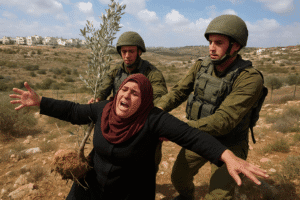
A report from the Palestinian Authority’s Colonization and Wall Resistance Commission reveals a severe escalation of violence and settlement expansion in the occupied West Bank, documenting 2,350 attacks by Israeli forces and settlers in a single month. This “cycle of terror” includes the systematic uprooting of 1,200 olive trees, a vital cultural and economic symbol for Palestinians, and a surge in settler violence aimed at displacing communities.
Concurrently, Israel’s Higher Planning Council is advancing plans for nearly 2,000 new illegal settlement units, part of a record-breaking year that has seen over 28,000 units approved, a policy that far-right Israeli officials admit aims to “bury the idea of a Palestinian state.”
Despite U.S. statements opposing annexation, the lack of concrete international action has created a permissive environment, systematically entrenching a one-state reality of unequal rights and foreclosing the possibility of a viable two-state solution.
The Uprooting of a People: How Record West Bank Violence and Settlements Entrench a One-State Reality
The numbers, released by the Palestinian Authority’s Colonization and Wall Resistance Commission (CRRC), are so staggering they risk becoming abstract. In a single month, 2,350 separate attacks by Israeli forces and settlers. 1,200 ancient olive trees uprooted, poisoned, or destroyed. Plans for nearly 2,000 new settlement units advanced, continuing a record-breaking year of construction.
But behind these figures lies a brutal, tangible reality: a coordinated strategy of displacement that is systematically reshaping the occupied West Bank. This is not a sporadic outbreak of violence but the intensification of a long-term campaign, one that is methodically dismantling the possibility of a Palestinian state and weaving a “fully racist colonial regime” into the fabric of the land.
A Monthly Toll of Terror: Deconstructing the 2,350 Attacks
The CRRC’s report, “Occupation Violations and Colonial Expansion Measures,” draws a critical and often blurred distinction: 1,584 attacks by Israeli state forces, and 766 by settlers. This division is crucial for understanding the mechanics of the occupation.
State-Sanctioned Violence: The 1,584 attacks carried out by the Israeli military—including home demolitions, raids, and physical assaults—represent the hard power of the state. These actions create an environment of perpetual instability and fear, rendering normal life impossible for Palestinians. When soldiers operate with impunity, they are not just conducting “security operations”; they are enforcing a system of control that privileges one population over another. The concentration of this violence in the governorates of Ramallah, Nablus, and Hebron—key Palestinian economic and population centers—signals a deliberate effort to keep these areas off-balance and fragmented.
The Settler Vanguard: The 766 settler attacks, meanwhile, function as a potent, decentralized force of terror. Described in the report as reaching a “new peak,” these are not random acts of hooliganism. They are a form of “state terror… orchestrated in the dark backrooms of the occupation government,” where settlers often operate with the tacit approval or direct protection of the Israeli army. By targeting the most vulnerable—olive pickers during the critical harvest season—they strike at the economic and cultural heart of Palestinian society. The attempts to establish seven new illegal outposts in a single month are not the actions of rogue individuals; they are the cutting edge of a colonial project, creating facts on the ground that the state can later formalize.
The War on the Olive Tree: A Symbol of Steadfastness Under Attack
The report’s focus on the destruction of 1,200 olive trees is not incidental. In Palestine, the olive tree is more than a crop; it is a centuries-old symbol of identity, resilience, and connection to the land. An olive tree can live for over a thousand years, its roots mirroring the deep, generational ties of Palestinian families to their ancestral orchards.
The systematic “uprooting, destruction, and poisoning” of these trees is, therefore, a profound act of cultural and economic warfare. It severs a primary source of income for thousands of families and erases a living monument to their heritage. This tactic is a clear component of what the CRRC calls an “organised strategy that aims to displace the land’s indigenous people.” By destroying the means of subsistence and the symbols of belonging, the occupation seeks to make life so untenable that Palestinians see no option but to leave.
Bricks and Mortar over Diplomacy: The Settlement Surge Accelerates
The spike in violence is happening in parallel with a bureaucratic onslaught. The Israeli Higher Planning Council’s (HPC) weekly meetings to advance settlement construction have normalized a process that international law explicitly deems illegal. With 28,195 housing units advanced since the start of 2025, we are witnessing the most aggressive settlement push in decades.
The planned 1,985 new units, particularly the 1,288 in isolated northern settlements, are strategically significant. They are not about accommodating “natural growth” within existing blocs; they are about creating irreversible facts deep inside the West Bank, purposefully slicing Palestinian territory into disconnected cantons. This shatters any geographic continuity for a future Palestinian state.
The comments from far-right Finance Minister Bezalel Smotrich are the clearest articulation of this goal. His statement that the E1 settlement plan “buries the idea of a Palestinian state” is not a gaffe; it is a mission statement. The E1 corridor is the linchpin. Its construction would effectively cut off East Jerusalem—the presumed capital of any future Palestinian state—from the rest of the West Bank, dealing a fatal blow to the two-state solution.
The International Conundrum: Condemnation Without Consequence
The international response to this accelerating crisis has been characterized by a stark impotence. The United States, under the Trump administration, has sent mixed signals. While Vice President JD Vance has stated unequivocal opposition to annexation, calling it a “very stupid” political stunt, the administration’s actions tell a different story. Its unwavering diplomatic support for Israel and its focus solely on Gaza ceasefire efforts, while the West Bank burns, has effectively created a permissive environment for the Netanyahu government’s radical coalition partners.
This gap between rhetoric and reality is the oxygen that the settlement enterprise breathes. Decades of international condemnations and UN resolutions have yielded no meaningful consequences. The result is a growing sense of impunity in Israel and a deepening despair among Palestinians, who see the world’s laws and principles being consistently applied elsewhere but suspended for them.
Beyond the Two-State Illusion: The Forging of a One-State Reality
The relentless violence and construction in the West Bank are forcing a painful reckoning with a new, and much darker, reality. The decades-old paradigm of a “two-state solution” is being physically bulldozed into obsolescence. What is being constructed in its place is a single entity between the Jordan River and the Mediterranean Sea where millions of Palestinians live without basic rights, freedom of movement, or citizenship.
This is not a conflict waiting for a solution; it is a system of one-state control being built day by day, attack by attack, and settlement unit by settlement unit. The record numbers of attacks and construction approvals are not an anomaly; they are the logical endpoint of a 58-year occupation with no accountability. The world is left to watch as the foundations of a future of equality and justice are systematically replaced with the grim architecture of permanent apartheid. The uprooted olive trees are a silent testament to a people being uprooted themselves, their future hanging in the balance as the world largely looks on.
You must be logged in to post a comment.