
The Unyielding Silence of Tyeb Mehta: Why His Art Defines Indian Modernism
Tyeb Mehta stands as the most coveted name in Indian Modernism due to a powerful convergence of historical resonance, formal innovation, and profound emotional depth. His signature aesthetic—defined by a severe economy of form, a restrained palette, and the iconic diagonal slash—transformed personal and national trauma, particularly the memory of Partition, into a universal visual language of tension, fall, and existential weight.
By synthesizing global influences from Bacon to Minimalism into a uniquely disciplined and sparse idiom, he elevated Indian art onto a world stage, offering not narrative ornamentation but elemental, psychological truth. This intellectual rigor, coupled with a scarce and meticulously crafted oeuvre, has cemented his legacy, making his paintings both critical cornerstones of post-colonial modernism and highly sought-after assets that command record prices for their ability to articulate silence, struggle, and resilience with unmatched clarity.
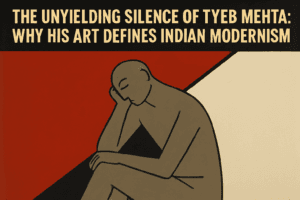
The Unyielding Silence of Tyeb Mehta: Why His Art Defines Indian Modernism
In a global art market often dazzled by spectacle, the profound, pared-down canvases of Tyeb Mehta command a different kind of attention—a reverent, almost solemn respect. His name is synonymous with record-breaking auctions, but to reduce his significance to price tags is to miss the essence of his seismic impact. Tyeb Mehta is the most coveted name in Indian Modernism not because his paintings are expensive, but because they are indispensable. They represent a rare convergence of historical weight, formal innovation, and emotional truth, offering a visual language for trauma, resilience, and existential inquiry that resonates far beyond national borders.
The Anatomy of a Visual Language: Distillation as Power
Mehta’s work is immediately recognizable for its severe economy. Unlike many of his contemporaries in the Progressive Artists’ Group (PAG), who embraced exuberant color or vigorous, gestural strokes, Mehta pursued reduction. His canvases are often stark, dominated by large, flat planes of color—searing reds, confronting whites, anchoring blacks. The figures, when present, are distorted, simplified to near-archetypal forms, carrying a monumental gravity despite their apparent fragility.
The genesis of his mature style is attributed to a single, accidental formal discovery: the Diagonal. Around 1969, a chance slash across a canvas became a revolutionary leitmotif. This diagonal line did more than divide the composition; it became a structural and philosophical spine. It represented rupture—the Partition of 1947, a personal and national wound Mehta witnessed firsthand. It symbolized tension, conflict, and the precarious balance of opposing forces. Formally, it provided a way to architect his sparse spaces, holding his falling figures and trussed bulls in a state of eternal, unresolved suspense. This single device transformed his work from expressive figuration into a profound exploration of structure and psyche.
The Weight of History: Personal Trauma as Universal Grammar
Mehta’s art is inextricably linked to the cataclysm of Partition. The memory of a lynching he observed as a young man in 1947 became a silent, shaping force. He rarely spoke of it, but it permeates his oeuvre. His iconic “Falling Figure” series, begun in the 1950s, is not a depiction of action but of a perpetual state—the moment of collapse frozen in time. These figures embody the collective and personal freefall of a ruptured subcontinent.
This historical consciousness evolved into mythic reinterpretation. His “Mahishasura” series (1980s-90s) is a masterclass in psychological complexity. Revisiting the myth of the buffalo demon slain by Goddess Durga, Mehta refused simplistic heroism. His Mahishasura is a figure of immense pathos, his struggle evoking sympathy rather than vilification. Durga, too, is removed from triumphalist iconography, becoming an ambiguous force. In these works, Mehta transcended narrative to explore the universal themes of power, violence, victimhood, and the cyclical nature of oppression, placing Indian mythology within a global, existential framework.
The Discipline of Influence: Absorbing the World to Sharpen a Voice
Mehta’s uniqueness stems from his disciplined synthesis of global modernist currents. His stays in London (late 1950s) and New York (1960s) exposed him to Francis Bacon’s tortured figuration, European Expressionism, and the scale and rigor of Minimalism and Abstract Expressionism. Crucially, he was not a derivative artist. He used these influences as a “sharpening stone,” as the article notes. From Bacon, he took the sense of containment and psychological pressure, but stripped away the visceral gore. From Minimalism, he adopted a respect for the picture plane and geometric rigor, but infused it with human narrative. He distilled these elements into a syntax that was unmistakably and irrevocably his own—one that spoke a global modernist language with a distinctly Indian accent.
The Market as Recognition: From Revered Artist to Iconic Asset
The astronomical market valuation of Mehta’s work is a symptom of his importance, not the cause. For decades, he was a painter’s painter—revered by peers, critics, and connoisseurs for his uncompromising rigor. The market’s fervent embrace, beginning in earnest in the late 1990s and cemented by his record-breaking $1 million auction milestone in 2005, was a delayed but decisive acknowledgment of several converging factors:
- Scarcity & Integrity: Mehta was profoundly meticulous. He produced few works, often laboring over a single canvas for years. There is no casual Mehta; each piece represents a fully resolved artistic statement.
- Historical Positioning: As a key, albeit quiet, member of the PAG, he is embedded in the foundational narrative of post-colonial Indian modern art. Owning a Mehta is owning a piece of that defining movement at its most philosophically rigorous.
- Intellectual Legibility: His work bridges multiple worlds: the figurative and the abstract, the narratively Indian and the universally human, emotional depth and formal perfection. This makes it profoundly engaging for a global audience of collectors and institutions.
- Museum & Institutional Validation: Major retrospectives in India and key exhibitions abroad transformed his reputation from national treasure to international modern master, placing him in dialogue with figures like Rothko and Giacometti.
The Enduring Resonance: Why Mehta Matters Today
In an era of overwhelming visual noise and conceptual verbosity, Mehta’s power lies in his profound silence. He offers not escape, but confrontation—a clear-eyed, structured space to contemplate fundamental human conditions: suffering, resistance, balance, and fall.
His 1977 painting “Untitled (Gesture),” featured in AstaGuru’s upcoming auction, exemplifies this mature mastery. The figure, cinched by his signature diagonal, exists in a state of contemplative tension. The interlocking planes of color create an architectural space that feels both confining and sacred. It is a work that does not explain itself; it exists, compelling the viewer to project, feel, and reflect.
Ultimately, Tyeb Mehta redefined the possibilities of Indian modernism. He proved that the most potent response to a complex, fractured history could be clarity, not clutter; essence, not ornament. He gave form to silence and structure to trauma. His canvases are not merely paintings but cultural landmarks—quiet, monumental, and unshakeable. They remind us that true value in art lies not in decorative appeal, but in the ability to condense the complexities of the human experience into a form so distilled, so true, that it becomes timeless. This is why collectors covet him, why scholars study him, and why his quiet, diagonal slash continues to cut through the cacophony of the art world, commanding attention, reflection, and awe.
You must be logged in to post a comment.