
The Unyielding Earth: How a Palestinian Village Lives Through Its 244th Demolition
Israeli authorities have carried out the 244th demolition of the unrecognized Palestinian village of al-Araqib in the Naqab (Negev), a community that predates the state of Israel, as part of a sustained campaign residents and rights groups describe as a policy of exhaustion aimed at forcibly displacing them from their ancestral land. Despite residents having legally proven ownership of portions of the land in the 1970s, the state uses “unlicensed construction” pretexts to repeatedly raze makeshift homes, systematically denying basic services while promoting development plans that exclusively benefit neighboring Jewish towns. In defiance, the village’s 22 families persistently rebuild after each demolition, asserting their right to remain amid what they characterize as a humanitarian crisis and an ongoing effort to erase their historic presence.
The Unyielding Earth: How a Palestinian Village Lives Through Its 244th Demolition
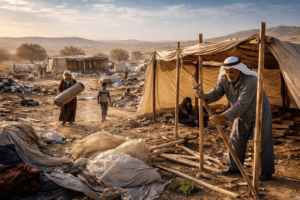
In the stark, sun-bleached landscape of the Naqab desert, a ritual of resilience and erasure plays out once more. On an otherwise ordinary December morning, Israeli forces entered the unrecognized village of al-Araqib. The sounds of tearing nylon and splintering wood soon followed, as tents and makeshift shelters—the tenth reconstruction this year alone—were flattened. With them was taken Sheikh Sayyah al-Turi, a community elder. This event, coldly catalogued as the 244th demolition since July 2010, is not merely a statistic. It is the latest chapter in a relentless, multi-generational campaign to sever a people from their land, and a breathtaking testament to a community’s refusal to vanish.
A Home That Predates the State
To understand al-Araqib is to confront a foundational contradiction. Established during Ottoman rule and home to families for centuries, the village exists on a map of ancestry and memory, yet is absent from Israeli state planning documents. Its residents, through Israeli courts in the 1970s, successfully proved ownership of 1,250 dunams of their ancestral land. They hold the papers; they have the verdicts. Yet, the state employs a circular, devastating logic: because the village is “unrecognized,” any structure built is “unlicensed,” and therefore subject to demolition. The legal proof of ownership is rendered null by the bureaucratic refusal to permit a home.
This is the core of what residents and human rights groups call a policy of exhaustion. It is not a single, catastrophic displacement, but a slow, grinding attrition—244 incremental acts of destruction designed to break the spirit, to make the cost of staying higher than the trauma of leaving. Each demolition is an economic and psychological blow, destroying not just shelters but tools, personal belongings, and the fragile sense of security necessary for life.
Life in the Cycle: Demolition, Rebuild, Repeat
Imagine the practical reality. Following each demolition, the 22 families—about 86 individuals—must scavenge and pool resources to rebuild. Their architecture is one of necessity: wood and nylon sheets, materials chosen for mobility and cost, not comfort. These structures must somehow insulate against the desert’s blistering summer heat and its piercing winter cold. Their economy, based on herding and dryland agriculture, is perpetually disrupted. A demolition can mean the loss of fodder, the scattering of flocks, and the diversion of all energy and funds from livelihood to mere survival.
Yet, they rebuild. Every single time. This act is their politics, their resistance, and their unwavering statement: “We are here.” It defies the notion that their presence is temporary. In the face of bulldozers and special forces, the simple act of raising a tent becomes a profound declaration of permanence.
The Larger Landscape: Dozens of Villages in the Shadow
Al-Araqib’s struggle is not isolated. It is a stark emblem of the plight facing dozens of unrecognized Palestinian villages in the Naqab, home to approximately 240,000 people. These communities, some centuries old, live in a state of suspended animation. Denied recognition, they are systematically stripped of basic services: no grid electricity, no piped water, no paved roads, no sewage systems, and often no schools or clinics. This engineered hardship creates what residents rightly term a “severe humanitarian crisis.”
The state’s “Negev Development Plan,” first launched in 2006 and renewed with billions in funding for Jewish-majority towns like Netivot and Ofakim, explicitly bypasses these communities. The plan speaks of “revitalization,” but for the unrecognized villages, its manifestation is solely in the form of demolitions, as seen in al-Za’roura and al-Boheira. The vision is clear: clear the land for Jewish settlement, military base relocations, and industrial parks. The indigenous Bedouin presence is treated not as a historic fact to be integrated, but as a problem to be solved through displacement.
The Human Right to a Home
This conflict strikes at the heart of Article 17 of the Universal Declaration of Human Rights, which asserts everyone’s right to own property and not to be arbitrarily deprived of it. The residents of al-Araqib hold documented ownership, yet are arbitrarily deprived of the ability to live on that property. The state’s use of planning law as a weapon exposes a gap between legal right and political will, where bureaucracy becomes the instrument of dispossession.
The repeated abduction of community leaders like Sheikh al-Turi adds another layer: the targeting of social and cultural anchors. It is an attempt to dismantle the community’s structure, to remove those who embody its collective memory and resolve.
An Unconquerable Resilience
What the planners and bulldozer operators may underestimate is the power of rootedness. For the people of al-Araqib, the land is not a parcel of real estate; it is their ancestral inheritance, the repository of their family histories, and the only foundation upon which they can envision a future. Each demolition, while devastating, also reinforces their identity as the guardians of this land. Their resilience is a quiet, stubborn force—as persistent as the desert wind that shapes the dunes and as enduring as the native vegetation that finds a way to grow in cracked earth.
The story of al-Araqib, now in its 244th painful iteration, is a microcosm of a broader struggle for indigenous rights, recognition, and justice. It challenges the international community to look beyond the simplistic framing of “building violations” and see the systematic effort to reshape a demographic landscape by making life unbearable for its original inhabitants. As long as the families of al-Araqib continue to gather their nylon and wood, their story remains one of unbroken connection—a powerful, living rebuttal to the politics of erasure. Their fight is not just for a place to pitch a tent, but for the fundamental human right to call a place home.
You must be logged in to post a comment.