
The Unspoken Bargain: Decoding the Geopolitical Chess Game Behind the India-US Trade Deal
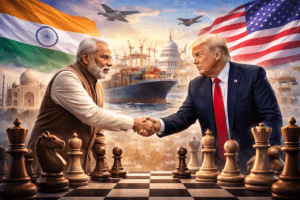
The Unspoken Bargain: Decoding the Geopolitical Chess Game Behind the India-US Trade Deal
In the world of international diplomacy, the most significant agreements are often those whispered behind closed doors, their full contours only slowly coming to light. The recent interim trade pact between India and the United States is a masterclass in this subtle art. Far from a simple list of tariff reductions, it emerges as a high-stakes geopolitical thriller, a narrative of calculated compromises where what is left unsaid speaks volumes. This isn’t merely a trade deal; it’s a strategic realignment, a silent renegotiation of the rules of engagement between the world’s largest democracy and its most powerful one, with implications that ripple far beyond bilateral commerce.
The Stage: A World of Hedged Bets and Shifting Alliances
To understand the gravity of this interim agreement, one must look at the chessboard as it stood. The United States, under a re-energized Trump administration, is intensely focused on economic statecraft as a primary tool of foreign policy, with a continued eye on curbing China’s influence. India, under Prime Minister Narendra Modi, has championed “strategic autonomy,” a doctrine of navigating great power politics while safeguarding its own sovereign interests. This often meant balancing historic ties with Russia against the economic and strategic benefits of closer partnership with the West.
The friction points were glaring: punitive US tariffs on Indian steel and aluminum, American demands for greater access to India’s protected agricultural markets, and Washington’s deep displeasure over New Delhi’s massive purchases of discounted Russian crude oil post-Ukraine invasion. For years, these were deal-breakers. That they have now become the gritty substance of a deal signals a profound, pragmatic shift.
The Pivot: The Russian Oil Gambit and the Illusion of Capitulation
The most dramatic reveal in this slow-burn narrative is the quiet capitulation on Russian oil. President Trump’s executive order lifting the 25% tariff, explicitly tied to India’s “promise of no further Russian oil purchases,” is a staggering concession extracted from New Delhi. India’s silence on the matter—the dodged questions, the buck passed to the Foreign Ministry—is not confusion; it is a strategic whisper. It speaks to the sensitivity of publicly abandoning a key, cost-saving energy relationship that defied Western pressure for years.
Is this a dilution of strategic autonomy? Critics will loudly say yes. Yet, a more nuanced reading suggests a recalibration of its very definition. Strategic autonomy is not stubbornness; it is the freedom to make pragmatic choices that serve the nation’s long-term interests. In this calculus, the guaranteed access to the world’s largest consumer market and the flow of US capital and technology may have outweighed the benefits of cheap Russian crude. India appears to have traded a tangible, immediate economic benefit for a more strategic, albeit less certain, geopolitical and economic positioning within a US-hedged ecosystem. It’s not a surrender, but a swap.
The Concession: Agriculture and the Ghost of GM Crops
On the surface, Commerce Minister Piyush Goyal’s long list of protected agricultural items—including the politically sacred dairy sector—sounds like an Indian victory. It suggests Trump conceded his strident demands. But the devil, as always, is in the details. The allowance for importing dried distillers’ grains (DDGs), a byproduct of corn ethanol production, is a Trojan horse.
DDGs are overwhelmingly produced from genetically modified corn in the US. Minister Goyal’s technical assurance that “there is no GM impact after processing” is a legalistic fig leaf meant to placate a domestic audience deeply wary of GM foods. This single line in the agreement cracks open a door India has kept firmly shut. It sets a precedent, introduces GM material into the supply chain under a different name, and tests the regulatory and public acceptance boundaries. For US agribusiness, this is a critical, hard-won foothold. For India, it is a calculated risk, accepting a subtle intrusion into a protected sector to secure wins elsewhere.
The Hidden Depth: Beyond Tariffs, A Framework of Influence
As trade expert Ajay Srivastava astutely notes, this is an “uneven exchange” in scope. The US tariff reductions are clear, quantifiable, and immediate. In return, America has secured commitments that are broader and more structural: alignment on digital policy, regulatory adjustments, security cooperation, and promises of large-scale purchases. These are not just trade terms; they are rules of engagement for the 21st-century economy.
By shaping India’s digital and regulatory landscape, the US is ensuring its tech giants operate on a friendlier field. Security alignment deepens the Quadrilateral Security Dialogue (Quad) against Chinese assertiveness. These concessions “go well beyond trade,” embedding US influence within India’s domestic policy frameworks. This is the real “deal within the deal”—the US gaining strategic leverage, while India gains market access and a stronger hedge against China.
The Final Twist: The Rhetorical Reversal
Perhaps the most telling moment in this ongoing saga was Minister Goyal’s rhetorical shift. When pressed on increased US imports, he pivoted from a traditional defense of protectionism to an argument for the “competitiveness of local industry.” This is more than a talking point; it is a philosophical signal to Indian businesses. The message is clear: the crutch of perpetual protection is being gently lowered. The interim deal is framed not just as an agreement with America, but as a catalyst for a more competitive, outward-looking Indian economy.
The Unfinished Manuscript
This interim agreement is not the final chapter. It is a compelling cliffhanger. The limited public information means the full extent of compromises—on data localisation, intellectual property, or specific defence procurements—remains shrouded. Both leaders can claim victory to their domestic bases: Trump can tout tariff reductions and a foreign policy win, Modi can showcase market access and a sustained major partnership.
What emerges from the shadows is a story of two pragmatic leaders, setting aside political ego for tangible, if unequal, gain. For the US, it tightens the economic noose around China and pulls India closer into its orbit. For India, it is a bold, if risky, bet that securing its economic future lies in deeper integration with the West, even at the cost of some strategic flexibility today.
The true mystery now is how this plot will develop. Will India’s economic gains materialize swiftly enough to justify the geopolitical trade-offs? How will the relationship with Russia evolve in other domains? The India-US trade deal is no longer just about goods and services; it is the central plotline in a larger story about the evolving world order, where alliances are fluid, autonomy is negotiable, and every handshake conceals a universe of calculated, unspoken bargains. The slow reveal continues.
You must be logged in to post a comment.