
The Unseen Wounds: Beyond the Rising Death Toll in Gaza’s Prolonged Crisis
The Unseen Wounds: Beyond the Rising Death Toll in Gaza’s Prolonged Crisis
A Ceasefire That Brings No Peace: The Hidden Casualties of a Frozen Conflict
The numbers, updated daily, have become a grim liturgy: 71,654 Palestinians dead, 171,391 wounded. These figures, reported by medical sources in Gaza on January 24, 2026, represent more than just statistics; they are the stark ledger of a conflict that has entered its third year. Yet, the most telling detail in the latest dispatch is not the overwhelming total, but the quiet tragedy contained within a smaller, more recent count: four new fatalities and twelve new injuries in the past 48 hours. In a period officially under a ceasefire, these numbers reveal a devastating truth—for the people of Gaza, the violence has simply changed form, not ceased.
The ceasefire, active since October 11, was heralded as an end to open warfare. However, with 481 fatalities and 1,313 injuries since it took effect, and 713 bodies still being recovered from the rubble of a shattered landscape, it is clear that the emergency has merely entered a new, protracted phase. The bombs may have (largely) stopped falling, but the dying continues. This is the story of a humanitarian collapse so profound that a ceasefire feels like a continuation of the catastrophe.
The Rubble as a Mass Grave: A Landscape of Unrecovered Trauma
A critical phrase in the report underscores the ongoing nightmare: “A number of victims remain trapped under rubble or lying in the streets, as ambulance and civil defense crews are still unable to reach them.” This is the hidden multiplier of the death toll. The 71,654 confirmed dead are only those who have been counted—those retrieved from the ruins and brought to hospitals that still function. The true number is a spectral figure, unknown and perhaps unknowable, buried under millions of tons of concrete and steel.
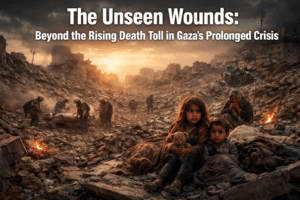
The work of recovery is not merely logistical; it is psychological and societal. Civil defense crews, operating without heavy machinery, adequate fuel, or basic safety equipment, dig with their hands. Each recovered body represents a closure for a family, but also a fresh wave of grief. The landscape itself becomes a constant, oppressive reminder of loss. Neighborhoods are not just damaged; they are erased, and with them, the memories, landmarks, and social fabric they contained. This “massive destruction” prevents recovery in every sense—of bodies, of infrastructure, and of community.
Death by a Thousand Cuts: The Silent Crisis of Displacement and Deprivation
The death of three-month-old Ali Abu Zur at Al-Aqsa Martyrs Hospital “due to severe cold” is a tragedy that speaks volumes about the current phase of the crisis. He is the tenth infant reported to have succumbed to the cold since winter began. These deaths are not caused by missiles or bullets, but by exposure—a direct result of the “absence of supplies” and the collapse of basic living conditions.
Over two years of offensive have decimated Gaza’s infrastructure. The healthcare system, targeted and starved of resources, operates in a permanent state of triage. Water purification and sanitation networks are shattered, leading to the spread of disease. Housing is nonexistent for hundreds of thousands, forcing families into overcrowded tents or skeletal buildings without protection from the elements. Food and fuel remain desperately scarce. In this environment, a ceasefire does not mean safety; it means a slow-motion disaster where the most vulnerable—infants, the elderly, the chronically ill—succumb to preventable causes. The siege, the blockade, and the destruction have created a public health time bomb where pneumonia, cholera, malnutrition, and hypothermia are as lethal as any weapon.
The Living Wounded: A Generation Carrying Invisible Scars
While the figure of 171,391 wounded is staggering, it only captures physical injuries. The psychological trauma inflicted on an entire population is immeasurable. A generation of children has known nothing but war, displacement, loss, and fear. The constant stress, known as toxic stress, can rewire developing brains, leading to lifelong consequences for learning, behavior, and physical and mental health.
Medical staff, who have worked for years under bombardment with dwindling supplies, suffer from extreme burnout and moral injury—the psychological distress of being unable to provide the care they are sworn to give. Families are fragmented, with many not knowing the fate of missing relatives. The social contract is broken; the normal rhythms of life—education, work, community gatherings—are distant memories. The ceasefire, without massive psychosocial support, reconstruction, and a path to a political solution, merely provides a pause in which these deep, collective wounds can fester.
The Regional Echo: A Conflict Without Borders
The related news snippets—of tear gas suffocation in Hebron and settler attacks in Masafer Yatta—are not separate stories. They are chapters of the same narrative. The violence and tension are not contained within Gaza’s borders; they ripple across the entire occupied Palestinian territory. The ongoing crisis radicalizes perspectives, hardens positions, and fuels cycles of retaliation. It destabilizes the region and continues to be a flashpoint for international diplomacy and protest. The world’s attention may wax and wane, but for Palestinians living under occupation and for Israelis living under the threat of rocket fire, the conflict is a daily, grinding reality.
Toward a Meaningful Peace: Beyond a Pause in Killing
The numbers from Gaza are a blunt instrument for measuring human suffering. They tell us the “what” but not the “how” or the “why” of living through this unending crisis. They don’t convey the sound of a child coughing in a damp tent, the anguish of a surgeon operating without anesthesia, or the hollow silence of a street that once bustled with life.
A true resolution requires moving beyond temporary ceasefires that merely freeze a disastrous status quo. It demands:
- Unimpeded Humanitarian Access: A massive, sustained, and unconditional influx of food, medicine, fuel, winter supplies, and building materials.
- A Marshall Plan for Reconstruction: A coordinated, internationally funded effort to rebuild homes, hospitals, schools, water systems, and electrical grids.
- Addressing the Root Causes: A renewed, credible, and fair political process aimed at addressing the core issues of the conflict—occupation, security, sovereignty, and dignity. This is the most difficult and essential step.
The death of Ali Abu Zur from the cold is a verdict on our collective failure. It proves that in Gaza today, peace is not simply the absence of war. It must be the active presence of warmth, shelter, medicine, and hope. Until that is achieved, the ceasefire will remain a statistical fiction, and the toll—in lives ended and lives broken—will continue to surge, quietly and relentlessly, one preventable tragedy at a time. The world must see beyond the numbers to the human reality they represent, and find the courage to build a peace worthy of the name.
You must be logged in to post a comment.