
The Unseen Wound: How the Destruction of Gaza’s Fertility Clinics Extinguishes More Than Dreams
The reported destruction of approximately 90% of Gaza’s fertility clinics represents a profound and intimate layer of catastrophe within the broader war, systematically erasing the future for countless Palestinian families by obliterating the stored embryos and hope of those struggling with infertility. This destruction, alongside the staggering loss of life and the systematic settler violence in the West Bank, points to a conflict that targets not only present-day survival but also the very biological and societal continuity of Palestinian life, casting a long shadow over ceasefire talks and the reopening of borders like Rafah, which offer little solace for such irreplaceable, generational losses.
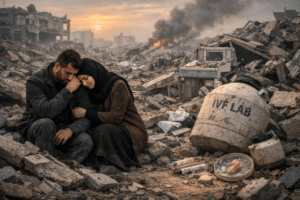
The Unseen Wound: How the Destruction of Gaza’s Fertility Clinics Extinguishes More Than Dreams
The news from Gaza often arrives in staggering, unfathomable numbers: casualties, displaced families, destroyed homes. Yet, beneath the headlines of airstrikes and ceasefire negotiations, a quieter, more intimate catastrophe is unfolding—one that targets not just the present, but the very possibility of a future. The Israeli military’s reported destruction of approximately 90% of Gaza’s fertility clinics is more than an infrastructural loss; it is a profound assault on identity, hope, and the continuity of a people.
This act, occurring within the broader context of a devastating war, severs a critical lifeline for countless Palestinian families. In a society where familial and social bonds are deeply cherished, the clinics represented a beacon of hope for those struggling with infertility—a medical and emotional sanctuary now reduced to rubble alongside hospitals and schools.
The Crushing of Concrete and Hope
For couples like Ahmed and Mariam (names changed for protection), whose journey to parenthood depended on the delicate science of in vitro fertilization (IVF), the war’s toll is measured in more than shattered concrete. Their embryos, frozen in time and full of potential, were stored in a clinic in Gaza City. The airstrike that hit the facility didn’t just destroy equipment; it erased their genetic legacy, turning years of emotional strain, medical procedures, and fragile hope into dust. Their story is not unique. These clinics housed thousands of frozen embryos and eggs, the product of immense personal and financial investment, now likely lost forever.
The strategic obliteration of such specialized healthcare highlights a grim reality of this conflict: the comprehensive dismantling of systems that sustain normal life and societal resilience. Reproductive healthcare, already challenging under a 16-year blockade, was a hard-won achievement in Gaza. Its loss pushes the enclave’s medical capabilities back decades and imposes a silent, generational scar.
Beyond the Battlefield: A War on the Future
This destruction intersects cruelly with the war’s staggering human cost. With over 35,000 reported killed, a significant percentage being women and children, the trauma is both collective and deeply personal. For parents who have lost children, the ability to potentially rebuild their family through assisted reproduction is now catastrophically compromised. The loss of these clinics forecloses a path to healing for many, embedding the grief of this war into the biological future of the population.
International law scholars are increasingly scrutinizing such actions through the lens of genocide prevention. The UN Convention on the Prevention and Punishment of the Crime of Genocide includes acts intended to prevent births within a national, ethnical, racial, or religious group. While establishing intent is complex, the crushing impact on reproductive futures adds a grave dimension to the International Court of Justice’s ongoing examination of the conflict. It transforms the narrative from one of immediate military engagement to one of long-term demographic erosion.
The Rafah Crossing: A Gate to Nothing?
Meanwhile, the diplomatic focus remains on the Rafah crossing. Its promised reopening is touted as a humanitarian breakthrough, a valve to relieve pressure. Yet, for the 20,000 sick and wounded awaiting medical evacuation, and for those whose dreams of parenthood lie in ruins, what does opening a gate lead to? The healthcare infrastructure needed to support complex procedures like IVF lies in fragments across Gaza. Neighboring Egypt and other Arab states lack the capacity to absorb thousands of specialized fertility cases, not to mention the stringent legal and religious frameworks governing such treatments across borders.
The comments from retired General Amir Avivi, revealing Israeli plans for a large, long-term military facility in cleared areas of Rafah, cast a further shadow. It suggests a vision of Gaza not as a rebuilding society, but as a permanently controlled territory. In this context, the destruction of institutions that ensure future generations—schools, universities, and fertility clinics—appears not as collateral damage, but as a feature of a strategy aimed at dismantling Palestinian societal fabric.
Settler Violence and the West Bank Mirror
This strategy is not confined to Gaza. As reported, armed Israeli settlers set fire to three Palestinian villages in Masafer Yatta in the occupied West Bank, part of a record-shattering wave of over 1,800 attacks in 2025. The UN’s call for Israel to “evacuate all settlers” from occupied territory underscores the systematic nature of this displacement. When combined with the destruction in Gaza, a coherent, terrifying picture emerges: a simultaneous squeeze on Palestinian existence in both Gaza and the West Bank, targeting land, homes, livelihoods, and now, biological continuity.
The Ceasefire’ Hollow Promise
Prime Minister Netanyahu’s condition that ceasefire terms cannot advance unless Hamas fully disarms feels increasingly abstract against this backdrop. For Palestinians in Gaza, a “ceasefire” that does not include the freedom to rebuild their society, to mourn their dead, and to dream of a future for their (potential) children, is an empty shell. The recovery of a soldier’s remains may be a closed chapter for Israel, but for Gaza, every day brings new, deepening layers of loss that are not accounted for in troop withdrawals or hostage exchanges.
The Human Insight: What Is Lost When We Lose “What If?”
The true insight here is about human dignity and agency. Infertility is a deeply private struggle, yet the destruction of these clinics has made it a collective, public trauma. It represents the ultimate theft: the theft of potential, of “what if?”, of the right to imagine a tomorrow that looks different from today’s pain.
The parents who walked through those clinic doors carried the universal hope of leaving a piece of themselves in the world—a hope that transcends politics, religion, and conflict. By erasing that possibility, the war has violated something fundamental. It has attacked the narrative of continuity that every culture relies upon to endure hardship. When you destroy the means to create life amidst a campaign that has taken so much of it, you are not just fighting an enemy; you are attempting to negate a people’s future.
The images of women cooking amidst rubble and children playing in ruins are symbols of steadfastness. But the invisible loss, stored in liquid nitrogen tanks now buried under concrete, is a symbol of something far more ominous. The world watches the negotiations over borders and disarmament, but the silent cry from Gaza’s lost fertility clinics asks a more haunting question: What is a ceasefire worth, if the future it preserves is already extinguished?
Rebuilding Gaza will require more than cement and steel. It will require a restoration of the most basic human faith in tomorrow. Until that is recognized, any talk of peace will remain tragically, devastatingly incomplete.
You must be logged in to post a comment.