
The Unseen War: Silencing the Pen in the Palestinian Narrative
The Palestinian Journalists Syndicate has issued a report accusing Israel of implementing a systematic and deliberate policy of silencing the Palestinian press through lethal force, a strategy that escalated dangerously in 2025. The report states that by the end of November 2025, at least 76 journalists had been killed or wounded, describing a shift from restricting media work to actively neutralizing journalists as confirmed targets to eliminate witnesses and suppress the Palestinian narrative. It details patterns of attacks on clearly identifiable journalists in known press locations, resulting in not only deaths—including high-profile killings of Al Jazeera correspondents—but also life-altering injuries like amputations and blindness, amounting to what the syndicate calls systematic war crimes pursued with complete impunity and making Palestine one of the world’s most dangerous places for journalism.
The Unseen War: Silencing the Pen in the Palestinian Narrative
A Pattern of Violence Beyond the Headlines
In the landscape of modern conflict, journalists serve as the world’s eyes and ears—documenting atrocities, bearing witness, and preserving historical truth. Yet in Palestine, particularly Gaza, these witnesses are becoming casualties at an alarming rate. According to the Palestinian Journalists Syndicate’s recent report, 76 Palestinian journalists were killed or wounded by Israeli forces by November 2025 alone. This isn’t merely collateral damage in a chaotic warzone; the syndicate describes it as a deliberate policy shift from restricting journalistic work to “neutralizing the press through deadly force.”
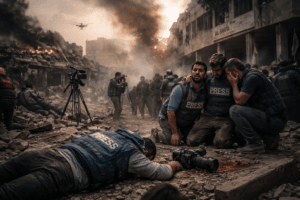
The imagery accompanying these statistics is haunting: funeral processions outside Al-Shifa Hospital, colleagues mourning colleagues, and the vacant spaces in newsrooms where voices once provided crucial documentation of life under siege. Among those lost are Al Jazeera’s Anas al-Sharif and Mohammed Qreiqeh, killed in an August 2025 airstrike—just two of nearly 300 journalists and media workers killed in Gaza over 26 months of conflict.
The Anatomy of a Targeting Doctrine
What makes these attacks particularly disturbing is their operational consistency. Muhammad al-Lahham, head of the Committee for Freedoms at the syndicate, identifies a “field doctrine based on the principle of ‘no witnesses, no narrative, no image.'” This represents a chilling evolution in information warfare: if you cannot control the narrative, eliminate those who document it.
The evidence supporting this claim is found in the patterns. Journalists are frequently attacked while wearing clearly marked press gear, operating from established media gathering points, and following safety protocols developed in conflict zones worldwide. The April 2025 strikes on a journalists’ tent at Nasser Hospital wounded nine reporters and destroyed equipment—a location well-known as a press center. Such repeated targeting of identifiable media personnel suggests intentionality that contradicts claims of accidental casualties in the fog of war.
The Human Cost Beyond the Death Toll
The violence extends beyond fatalities to create what the syndicate calls “life-altering injuries” designed to permanently remove journalists from their work. Akram Dalloul lost his sight. Jamal Badah underwent leg amputation. Muhammad Fayeq was left paralyzed. These are not random injuries but targeted strikes to specific body areas—head, neck, chest, abdomen—that maximize disabling impact.
This pattern reveals a brutal calculus: killing a journalist creates a martyr and draws international attention, but maiming them creates lasting trauma while reducing visible outrage. The injured become living reminders of the risks of reporting, potentially discouraging others from taking up the camera or notebook. Their suffering continues long after headlines fade, representing a quieter but equally effective form of silencing.
The International Context and Impunity Gap
Reporters Without Borders (RSF) named Israel as the country responsible for killing more journalists than any other in 2025. Yet despite condemnation from press freedom organizations worldwide, accountability remains virtually nonexistent. Israel has never arrested or charged any of its troops for killing journalists, creating what watchdogs describe as a culture of impunity.
This impunity extends beyond Gaza to the occupied West Bank, where veteran Al Jazeera correspondent Shireen Abu Akleh was killed in 2022 while wearing a press vest. Multiple investigations, including by the United Nations and major news organizations, concluded she was likely shot by Israeli forces, yet no one has been held responsible.
The international community’s response has been fragmented at best. While individual countries and organizations issue condemnations, there has been no coordinated, meaningful action to protect journalists in the region. This lack of consequences emboldens further targeting and normalizes violence against the press.
Why Journalists Matter in Conflict Zones
The systematic targeting of Palestinian journalists represents more than just a humanitarian crisis—it’s an assault on historical memory and democratic accountability. In conflicts where narratives are weaponized, independent verification becomes crucial. Journalists provide that verification, documenting events that would otherwise be denied or distorted.
Their work preserves the granular human reality behind statistics: not just “X number killed” but the story of the family wiped out, the child orphaned, the hospital destroyed. This documentation serves multiple crucial functions:
- Historical record: Creating an archive for future reconciliation and justice processes
- Immediate accountability: Potentially deterring atrocities through exposure
- Human connection: Helping distant audiences understand conflict’s human dimensions
- Policy influence: Informing diplomatic responses and humanitarian interventions
When these witnesses are systematically removed, the conflict becomes shrouded in competing claims without verification. The vacuum fills with propaganda from all sides, making resolution more difficult and truth increasingly elusive.
The Broader Implications for Global Press Freedom
The targeting of Palestinian journalists sets dangerous precedents with global implications. If such practices go unpunished, they risk becoming normalized in other conflicts. Already, journalists worldwide face increasing threats, with 2024 marking one of the deadliest years on record for media workers globally.
The specific tactics observed in Palestine—targeting identifiable journalists, attacking press gatherings, using disabling injuries—could be adopted by other actors in different conflicts. This represents a fundamental challenge to the principles of press protection established through international humanitarian law, particularly the Geneva Conventions’ provisions regarding journalists in conflict zones.
Resistance Through Documentation
Despite the risks, Palestinian journalists continue their work with remarkable courage. They’ve developed innovative survival strategies: rotating teams to avoid pattern recognition, using decentralized communication networks, and creating backup documentation systems. The monitoring website Shireen.ps, named after Abu Akleh, exemplifies this resilience—systematically tracking attacks on journalists even as its subjects face existential threats.
This persistence highlights a crucial truth: silencing attempts often galvanize the very documentation they seek to prevent. Each fallen journalist becomes a symbol around which others rally. Their stories, preserved by colleagues who continue working, gain additional moral authority precisely because of the risks taken to tell them.
Toward Meaningful Protection and Accountability
Addressing this crisis requires moving beyond statements of concern to concrete actions:
- International investigation: An independent, UN-backed investigation into journalist killings with subpoena power and public reporting
- Protective technology: Providing journalists with enhanced protective equipment and emergency evacuation protocols
- Digital preservation: Creating secure, distributed archives for documentation that survives physical destruction
- Legal accountability: Pursuing cases through international courts when domestic justice systems fail
- Industry solidarity: Creating international networks for rapid response and advocacy when journalists are targeted
- Public awareness: Educating global audiences about the importance of conflict journalism and the specific threats facing Palestinian reporters
The Unsilenced Narrative
The most profound insight emerging from this tragedy may be the paradox of silencing campaigns: they often amplify what they seek to suppress. Each journalist killed becomes a permanent witness through their absence. Their unfinished stories create haunting gaps in the historical record that speak as powerfully as any completed report.
The international community now faces a moral and practical test. Will we accept a world where bearing witness to atrocities becomes a death sentence? Or will we create meaningful protections for those who document uncomfortable truths?
As Muhammad al-Lahham of the Palestinian Journalists Syndicate reminds us, this is about more than individual tragedies—it’s about preserving the possibility of truth in a landscape where falsehoods proliferate. The targeting of Palestinian journalists represents not just a humanitarian crisis but a fundamental challenge to our collective ability to understand and respond to conflict.
In the end, the question is whether we value truth enough to protect those who risk everything to bring it to light. The answer will define not only the future of Palestinian journalism but the integrity of global information ecosystems in an age of increasingly weaponized narratives. The silenced voices echo louder than their suppressors might imagine, and their absence speaks volumes about what’s at stake when we fail to protect those who document our shared reality.
You must be logged in to post a comment.