
The Unseen War: How Raids and Settler Violence Are Reshaping the West Bank
While the killing of 26-year-old Abdel Rahman Darawsha during an Israeli military raid on Far’a refugee camp appears as an isolated incident, it is in fact a symptom of a broader, systemic shadow war reshaping the West Bank, characterized by a coercive two-pronged strategy of relentless army raids and escalating settler violence that collectively enforce a state of fear and facilitate annexation.
This coordinated pressure—evidenced by a record 260 settler attacks in a single month, often targeting vulnerable Bedouin communities and the crucial olive harvest—works in tandem with military operations to disrupt Palestinian life, destroy livelihoods, and fracture territorial continuity, creating facts on the ground that make a viable Palestinian state increasingly unattainable while operating under a pervasive sense of impunity.
The Unseen War: How Raids and Settler Violence Are Reshaping the West Bank
The report was brief, a common dispatch from the grinding conflict: Abdel Rahman Darawsha, 26, was shot and killed by Israeli forces during a raid on the Far’a refugee camp. In the context of the occupied West Bank, such news can, tragically, feel routine. But behind the clinical language of “raids,” “clashes,” and “casualties” lies a deeper, more systemic reality—one where the lines between military action and vigilante violence are blurring, creating a coercive environment that is fundamentally reshaping Palestinian life.
The killing of Darawsha on a Saturday night in Tubas is not merely a statistic; it is a snapshot of a territory in the grip of a shadow war, a conflict fought not in open battles but in refugee camp alleyways, olive groves, and Bedouin communities. To understand his death is to look beyond the single gunshot and see the wider landscape of pressure and annexation.
The Raid: A Recurring Nightmare in Far’a
Far’a refugee camp, south of Tubas, is a densely populated patchwork of narrow streets and concrete homes, a lasting symbol of the Palestinian displacement that began in 1948. For residents, an Israeli military raid is a familiar form of collective trauma. The typical script involves the sudden arrival of armored vehicles, the disembodied crackle of soldiers’ loudspeakers, and the inevitable tension that either simmers or explodes.
When Israeli infantry units deployed at the camp’s entrance and began firing live ammunition, as reported by Wafa, they were not entering a vacuum. These operations are officially framed as counter-terrorism measures, aimed at apprehending suspects or dismantling networks. However, for the young men who grew up in camps like Far’a, surrounded by the symbols of their own statelessness, the military presence is an ever-present provocation.
The death of a 26-year-old like Darawsha raises painful, often unanswerable questions. Was he a militant engaged in a firefight? A bystander caught in the crossfire? Or a young man throwing stones at armored vehicles, a symbol of futile resistance? The Israeli military and Palestinian authorities will likely offer conflicting narratives. Yet, the ultimate outcome is unchanged: another family in mourning, another community seared by loss, and another log on the fire of resentment that fuels the cyclical violence. This incident is part of a devastating trend; over 1,000 Palestinians have been killed in the West Bank since the Gaza war began two years ago, a number that dwarfs the Israeli fatalities in the territory during the same period and underscores the stark asymmetry of the conflict.
The Settler Onslaught: A Coordinated Campaign of Displacement
Parallel to the military raids, and often operating in a disturbing synergy with them, is the escalating violence by Israeli settlers. The same weekend Darawsha was killed, two other attacks unfolded, revealing a pattern of intimidation that is both strategic and brutal.
Near occupied East Jerusalem, about 50 settlers descended upon a Bedouin community in Jaba village. They were not a disorganized mob. Their actions were methodical: assaulting residents, injuring seven, and burning properties, inflicting “significant damage.” These Bedouin communities, often among the most vulnerable Palestinian groups, are frequent targets precisely because their remote locations and fragile dwellings make them easy to displace.
Similarly, in the village of Umm al-Khair, south of Hebron, another Palestinian was wounded in a settler attack. This village, nestled beside the sprawling Israeli settlement of Carmel, has become a case study in this coercive pressure. Its residents live under constant threat of home demolitions (as many structures lack nearly impossible-to-obtain Israeli building permits) and frequent harassment from their settler neighbors.
The data from the UN Office for the Coordination of Humanitarian Affairs (OCHA) is staggering and removes any doubt of isolated incidents. October saw more than 260 settler attacks—an average of eight per day. This is the highest monthly number since OCHA began documenting in 2006. These are not random crimes of passion; they are a coordinated campaign, exploiting the atmosphere of impunity and the overarching military presence to make life untenable for Palestinians in Area C of the West Bank, which is under full Israeli control.
The Olive Harvest as a Battlefield
The timing of this surge is critical. October and November are the olive harvest season in the West Bank, a deeply cultural and economic cornerstone of Palestinian life. For generations, families have gone to their groves to gather the year’s yield. Now, these groves have become front lines.
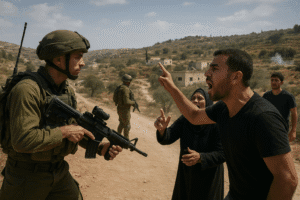
Settler attacks often focus on harvesters, aiming to destroy their livelihood. They set fire to ancient trees, assault farmers, and steal their produce. This economic warfare is devastating. An olive tree can take over a decade to bear fruit and can live for centuries; its destruction is not just a loss of income but a severing of a deep, ancestral connection to the land. When a settler argues with a Palestinian farmer mid-harvest, as captured in a recent photo, it is a microcosm of the larger conflict: a struggle over land, identity, and the right to exist in a place.
The Israeli military’s role in these moments is often passive, frequently standing by while attacks occur or declaring areas “closed military zones” that effectively prevent Palestinians from accessing their own fields, thereby enabling the settlers’ goals by other means.
A Coercive Environment: The Bigger Picture
So, what is the endgame of this shadow war? Analysts and human rights organizations point to a strategy of creating “facts on the ground.” The relentless military raids disrupt Palestinian social and political structures, maintain a constant state of fear, and eliminate potential resistance. The settler violence, meanwhile, serves as a brutal form of demographic engineering, slowly but surely pushing Palestinians off their land, fracturing their territorial continuity, and cementing Israeli control.
This two-pronged approach makes the establishment of a viable, contiguous Palestinian state increasingly impossible. Instead, the West Bank is being carved up into isolated cantons, surrounded by expanding settlements and outposts like Evyatar—where a settler can be seen walking calmly, a stark visual contrast to the violence unfolding just miles away.
The international community often condemns the violence, and the UN publishes its reports. But for Palestinians like the residents of Far’a camp, the Bedouin community in Jaba, or the farmers of Umm al-Khair, these statements are meaningless without tangible consequences. The impunity is the message.
The death of Abdel Rahman Darawsha is a tragedy for his family and community. But it is also a symptom of a much larger and deliberate process. It is a process not of a single battle, but of a slow, grinding annexation—a war fought raid by raid, olive tree by olive tree, and home by burned home. Until the systemic forces driving this conflict are addressed, the brief news alerts will continue, each one a footnote in the relentless reshaping of a land and its people. The shadow war continues, and its casualties are mounting long after the headlines fade.
You must be logged in to post a comment.