
The Unseen Siege: How Bureaucratic Barriers Are Strangling Gaza’s Lifelines and the Human Cost of Collapsing Aid
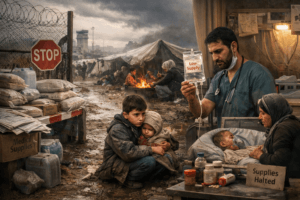
The Unseen Siege: How Bureaucratic Barriers Are Strangling Gaza’s Lifelines and the Human Cost of Collapsing Aid
Beyond Headlines of Ceasefire, a Silent Battle Rages to Keep Clinics Open and Children Fed
The news alert is stark: humanitarian operations in Gaza are at a breaking point. But behind the formal phrasing of statements from UN agencies and international NGOs lies a more visceral reality—a reality of cold children in makeshift tents, of surgeons rationing anesthesia, and of warehouse managers watching tons of life-saving supplies gather dust at checkpoints, barred by a new layer of bureaucracy. This isn’t merely a logistical crisis; it is a slow-motion unravelling of the very fabric of survival for 2.2 million people, where the weapon is not just munitions, but paperwork.
The Paper Wall: A Registration System That Blocks More Than It Registers
At the heart of the current precipice is what aid workers term a “paper wall.” Earlier this year, Israeli authorities introduced a new, compulsory registration system for international non-governmental organizations (INGOs) operating in the Occupied Palestinian Territory. In theory, regulation and coordination are reasonable. In practice, agencies describe the process as impossibly vague, politically charged, and designed in a way that forces them to violate core humanitarian principles of independence, impartiality, and neutrality to comply.
“To meet some of the proposed requirements, we would effectively have to sign away our ability to deliver aid based on need alone,” explains one country director for a major medical charity, speaking on condition of anonymity for fear of reprisal. “It would mean accepting a level of oversight that dictates who we can hire and where we can go, turning our humanitarian mission into a political tool. We cannot do that.”
The deadline for this untenable compliance is the end of December. Failure means deregistration. Deregistration triggers a forced closure of operations within weeks. This isn’t a hypothetical threat. Dozens of the very organizations that keep Gaza’s crippled infrastructure on life support are now packing their files and preparing contingency plans for departure.
The Anatomy of Collapse: What Disappears When an NGO Leaves
The statement from the Humanitarian Country Team is unequivocal: “These organisations are not optional extras… the humanitarian response will not survive.” This is not hyperbole. To understand why, one must look at what these INGOs do, far beyond the generic term “aid delivery.”
They are the specialized backbone of survival. International NGOs often bring specific, critical expertise that local groups, while incredibly resilient, may lack the capacity or funding to maintain. They run the advanced field hospitals that handle complex trauma and burn cases from conflict-related injuries. They operate the stabilization centers for severe acute malnutrition, treating babies with specialized therapeutic milk and ready-to-use foods. They manage the complex water, sanitation, and hygiene (WASH) systems that prevent cholera and other deadly disease outbreaks in overcrowded displacement camps.
The projected impact is chilling: the departure of these groups would force the immediate closure of one in three health facilities in Gaza. This translates to tens of thousands of chronic patients losing access to dialysis, chemotherapy, and hypertension medication. It means pregnant women having no safe delivery room. It means the few remaining mental health services for a traumatized population evaporating.
A Crisis Within a Crisis: Winter Deepens and Systems Are Already Broken
This new emergency lands on a population already driven to the edge. Gaza’s economy is shattered. Unemployment exceeds 80%. Public infrastructure, from electricity grids to sewage plants, remains devastated from past conflicts and lacks materials for repair due to the long-standing blockade. Winter rains now flood tent encampments, turning streets into rivers of mud and wastewater.
“We received winter clothing kits for the children,” says Aya, a mother of four living in a UNRWA school-turned-shelter in Khan Younis. “We are grateful. But a sweater doesn’t stop the damp from making my youngest son cough all night. He needs a dry home, he needs consistent nutrition to fight off illness. The clinic we used to go to is talking about closing. Where will I take him then?”
Her fear points to the cascading nature of this collapse. The threat to INGOs comes on top of severe, years-long restrictions and funding freezes imposed on UNRWA, the UN Relief and Works Agency for Palestine Refugees. UNRWA is the de facto government for basic services for a majority of Gazans, running schools, primary health clinics, and food distribution. With it hamstrung, the international NGO network was the essential secondary support structure. Knocking out that second pillar leaves nothing to hold up the weight of human need.
The Human Insight: Aid Workers in an Impossible Bind
The real human insight lies in the impossible position of the aid workers themselves. These are individuals who have dedicated their lives to humanitarian service. They navigate unbearable moral dilemmas daily: deciding which family gets a shelter kit when there are only ten for a hundred needy families; watching a patient die from a treatable condition because the specific antibiotic is on a “dual-use” list blocked at the crossing.
Now, they face a bureaucratic ultimatum that mocks their life’s work. “We spent years building trust with communities, training local staff, setting up systems that work,” says Marco, an Italian water engineer with a decade of experience in Gaza. “Now I’m supposed to sit through meetings about compliance forms while the water treatment parts we imported six months ago rust at the Kerem Shalom crossing. It feels like a deliberate farce. The message is clear: ‘We will not bomb you today, but we will not let you live either.’”
The Legal and Moral Abyss: Access is an Obligation, Not a Gift
Aid agencies insist, correctly, that under international humanitarian law (IHL), facilitating rapid and unimpeded humanitarian relief to civilians in need is a legal obligation of the occupying power. It is not an act of charity or a subject for political negotiation. The deliberate obstruction of aid can constitute a violation of IHL.
The new registration system, in the view of many legal scholars and agencies, appears to be a mechanism for such obstruction—a means to systematically dismantle the international witness and operational capacity within Gaza by administrative means, rather than overt military ones. It shifts the blame, creating a public narrative that NGOs “failed to comply” rather than that aid was blocked.
The Path Forward: Beyond Urgent Appeals
The Humanitarian Country Team has called on the international community to exert pressure. This must go beyond statements of “deep concern.” Donor states, particularly those with significant leverage, need to move beyond humanitarian diplomacy to diplomatic action with concrete consequences. This includes:
- Publicly and unequivocally demanding the suspension of the deregistration process and the establishment of a transparent, principled dialogue with the humanitarian community to design a workable system.
- Linking broader political and economic relations to tangible improvements in humanitarian access, making the free flow of aid a measurable metric.
- Urgently scaling up funding for local Palestinian NGOs, but with the clear understanding that they cannot alone replace the scale and expertise of the international system overnight.
- Supporting independent monitoring and documentation of access denials to build accountability.
The world is watching a test of our collective humanity play out in real-time. The outcome will not be determined on battlefields, but in the cold meeting rooms where registration forms are reviewed, and at the crossing gates where food and medicine are turned away. The people of Gaza are not just facing the wounds of war, but the silent, bureaucratic suffocation of their hope. Saving them requires recognizing that a permit denied can be as lethal as a bullet, and acting accordingly before the last lifeline is cut.
You must be logged in to post a comment.