
The Unseen Revolution: How 2025 Became the Year Technology Grew Up in India
The year 2025 marked a pivotal maturation of technology in India, moving beyond hype to become an invisible, accountable infrastructure woven into daily life. Artificial Intelligence shed its magical aura to become a practical layer automating repetitive tasks in governance, finance, and media, shifting workforce pressure from job loss to skill evolution. UPI solidified as an unquestioned backbone of commerce, transforming into economic muscle memory, while smartphones settled into a phase of reliable utility over flashy innovation. This quiet normalization, however, was shadowed by a sophisticated surge in cybercrime, demanding new levels of digital literacy. As health tech evolved from fitness tracking to preventive guardianship, the collective public expectation shifted from wondering “what’s new?” to demanding “why isn’t this seamless yet?”—setting the stage for a 2026 defined by deeper integration, uncompromising reliability, and a focus on automating effort while elevating human judgment and security.
The Unseen Revolution: How 2025 Became the Year Technology Grew Up in India
In the final weeks of 2025, a subtle but profound transformation settled across India’s digital landscape. The change wasn’t marked by dramatic product launches or earth-shattering announcements. Instead, it arrived quietly, like the shift from adolescence to adulthood—less about flashy potential, more about steady, reliable presence. This was the year technology stopped shouting for attention and started doing the hard, necessary work of integration. The era of hype gave way to the age of expectation, setting a foundational stage for a 2026 defined not by what technology could do, but by what it must deliver.
The Disappearing Act of Innovation
For years, technological advancement in India followed a predictable, breathless rhythm. Each new smartphone release, each app update, each “next big thing” was packaged as a revolution. But by 2025, a collective maturity had taken hold. The gasps were replaced by nods. The “wow” factor had been supplanted by a more demanding, more human question: “Why isn’t this seamless yet?”
This shift in public sentiment represents one of the most significant cultural changes in India’s relationship with tech. The digital native generation, led by Gen Z, no longer views constant connectivity as innovative; they see it as a baseline utility, as fundamental as electricity or running water. For them, buffering isn’t an inconvenience—it’s a system failure. This raised baseline of expectation became the silent engine of progress in 2025, pushing companies and services beyond novelty and toward genuine utility.
AI: The Invisible Infrastructure
The most telling evolution of 2025 was the quiet assimilation of Artificial Intelligence. The grand, sometimes terrifying, narratives of AI as job-destroyer or world-conqueror faded into the background. In their place emerged a practical, pervasive layer of intelligence woven into the fabric of daily systems.
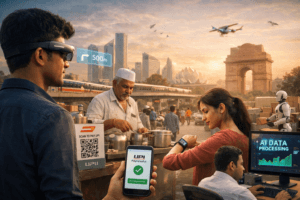
From Magic to Mechanism: AI shed its “magical” aura and became a tool. In government offices, it began processing documents and sorting grievances, cutting through bureaucratic delays. In banking, algorithms worked tirelessly in the background, spotting fraudulent transactions with a speed no human team could match. In newsrooms, AI assisted with data sifting and research, not with writing the front-page story. The technology became so embedded that we stopped naming it. Meeting summaries generated automatically, smart replies in emails, predictive text that actually works—these are no longer “AI features.” They are simply how things work.
This normalization has crucial implications for the workforce. The feared “job apocalypse” did not materialize. Instead, a more nuanced transformation occurred: AI automated the repetitive, not the reflective. It handled the administrative “nonsense,” freeing human cognition for tasks requiring judgment, empathy, and creative context. The pressure shifted from job loss to skill evolution, demanding a workforce adept at managing, interpreting, and collaborating with intelligent systems.
UPI: The Unquestioned Backbone
If 2025 crowned a champion of Indian tech, it is undoubtedly the Unified Payments Interface (UPI). With over 18 billion transactions monthly, UPI has transcended being a payments platform. It has become economic muscle memory.
From street-side chaiwallahs to high-end retailers, the QR code is now the universal sign of commerce. The innovation was no longer in UPI’s existence, but in its expansions and integrations. The linking of credit cards to the UPI framework was a masterstroke, particularly appealing to younger demographics and seamlessly bridging formal and informal credit. Furthermore, India’s export of the UPI model to nations like Singapore, the UAE, and Nepal marked a new chapter in digital diplomacy—a rare instance of the Global South exporting a fintech standard to the world.
The Dark Reflection: Cybercrime’s Sophisticated Surge
However, this unparalleled convenience cast a long shadow. As digital payments became ubiquitous, so did digital crime. Over 2.5 million cybercrime cases in 2025, with monthly losses nearing ₹1,000 crore, tell a story of a parallel, malignant evolution.
Cybercriminals mastered the art of legitimacy. Phishing messages no longer look like obvious scams; they mimic official communications with clean design, urgent language, and persuasive “drip.” The KYC update scam became a national menace, preying on trust and urgency. This arms race has made digital literacy a non-negotiable component of citizenship. Awareness is no longer just about using technology, but about defending oneself within it. The lesson of 2025 is clear: every user must learn to distinguish between seamless service and a seamless trap.
Hardware as Humble Tool: The Smartphone’s Quiet Maturity
The smartphone market reflected the broader theme of maturation. Crossing 800 million users, the Indian market saw growth flatten and priorities solidify. The quest for the “iconic” launch was replaced by a demand for reliability.
Innovation shifted from radical redesign to refined essentials: battery life that lasts a day, cameras that perform in low light, and accessible service networks. The experimental—like foldables—remained a niche luxury, deemed too fragile and expensive for mainstream practicality. For the vast majority, the smartphone in 2025 was a utilitarian portal: for UPI, for work, for navigation, for learning. It was a tool first, a status symbol second—a significant shift in consumer psychology.
Health Tech: From Gadget to Guardian
Perhaps the most personal dimension of tech’s maturation was in health. Wearables evolved from fitness trackers to health guardians. The conversation moved from “how many steps?” to “how was your sleep, stress, and heart rhythm?”
Driven by worsening urban air quality, air purifiers transitioned from luxury appliance to household essential. This shift signifies a broader move toward preventive and ambient healthcare. Technology began acting as a constant, passive monitor, offering insights and alerts that empower individuals to take action before a crisis occurs. It became less about quantifying life and more about qualifying it.
On the Horizon: The Integrated Future of 2026
The quiet foundation laid in 2025 sets a clear, demanding trajectory for 2026. The coming year will be defined by integration, accountability, and automated effort.
- The Expectation of Seamlessness:Users will no longer marvel at AI; they will expect it to work flawlessly in the background. The tolerance for glitches, poor UX, and broken promises will vanish. Technology will be judged on its reliability and its ability to handle complex, high-stakes tasks invisibly.
- The Primacy of Digital Safety:As UPI and digital identities become even more central, security will shift from a feature to the core brand promise. We will see a rise in embedded digital insurance, biometric multi-factor authentication as a default, and perhaps a societal push for public awareness campaigns on cyber hygiene akin to those for public health.
- The Rise of Context-Aware Automation:Emerging technologies like real-time translation earbuds and early-stage humanoid robots point to a future where technology handles specific, repetitive human efforts at scale. The focus will be onautomating effort, not replacing empathy. Robots may manage warehouse logistics or routine customer service queries, but the human role will elevate to one of oversight, complex problem-solving, and emotional intelligence.
- The Device as a Discreet Portal:The smartphone will continue its reign, but judged on fundamentals. The next interface evolution, however, may begin with Augmented Reality (AR) glasses, moving interactions from the palm to the periphery of vision, offering information without interruption.
A New Digital Social Contract
The journey from dial-up to 5G, from cash to UPI, has been dizzying. But 2025 marked a pivotal moment: technology moved from being aspirational to being accountable. It moved out of the spotlight and into the foundations.
The father-son dynamic emblematic of this shift—between the millennial who remembers technology’s awkward adolescence and the Gen Z native who expects its adult competence—is more than a generational divide. It is a snapshot of a nation transitioning from digital adoption to digital assimilation.
As we enter 2026, the challenge is no longer about access or innovation for its own sake. It is about building on this mature foundation with wisdom. It’s about ensuring that this invisible infrastructure is equitable, secure, and human-centric. The quiet revolution of 2025 taught us that technology’s greatest achievement is not in being seen, but in being seamlessly, reliably, and responsibly felt in every aspect of our lives. The stage is set not for a louder year, but for a deeper one.
You must be logged in to post a comment.