
The Unseen Guardians: How Subtle Technology is Securing the Future of Our Past
A quiet revolution in heritage conservation is underway, moving beyond heavy-handed reinforcements to a philosophy of “quiet engineering” that uses subtle, high-tech interventions to protect historic structures. This approach employs discreet tools like carbon fiber mesh hidden behind original plaster, seismic isolation systems beneath floors, and laser-scanned digital twins to monitor structural health, allowing palaces and warehouses to safely adapt to modern uses like hotels and cultural centers.
While this invisible technology successfully balances safety with aesthetic authenticity, it raises an ethical question about erasing the narrative of ongoing care, prompting a broader shift in conservation from merely restoring the past to intelligently and reversibly equipping it for the future, ensuring these landmarks remain living, functional parts of our urban fabric.
The Unseen Guardians: How Subtle Technology is Securing the Future of Our Past
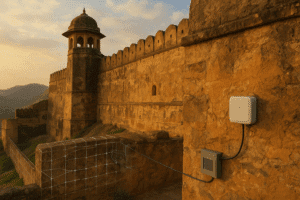
We marvel at the grandeur of a centuries-old fort, its walls whispering tales of empires. We admire the intricate frescoes of a palace and the robust, time-worn brickwork of a colonial warehouse. What we don’t see are the silent, invisible sentinels now embedded within these structures—a network of sensors, fibers, and digital models working tirelessly to ensure they stand for centuries more.
Across the globe, a quiet revolution is underway in the world of heritage conservation. Gone are the days of heavy-handed restorations or sterile preservation that turned living history into a museum diorama. Today, a new philosophy is taking root, one that uses cutting-edge technology not as a glaring intervention, but as a subtle, intelligent partner. This is the era of “quiet engineering,” where the goal is not to freeze a building in time, but to teach it how to thrive in the 21st century.
The Paradigm Shift: From Brutal Reinforcement to Minimal Intervention
The traditional approach to strengthening old buildings often involved bulky steel beams, concrete buttresses, and other visually intrusive methods. While effective, these solutions could compromise the very heritage they sought to save, altering a building’s aesthetic and sometimes even its structural logic.
The new paradigm, as exemplified by projects like the transformation of Jaipur’s 19th-century Narain Niwas Palace into a hotel, is defined by minimal visibility with maximal impact. When engineers discovered the original lime plaster and load-bearing walls couldn’t handle modern stresses like HVAC systems, they didn’t tear them down. Instead, they turned to aerospace-inspired carbon fiber reinforcement, discreetly tucked behind existing walls.
This approach is akin to keyhole surgery for buildings. Techniques now common in conservation include:
- Composite Mesh Layers: Thin, incredibly strong grids of carbon fiber or polymer that are embedded within plaster to absorb seismic shock without adding significant weight or volume.
- Micro-Anchoring: Threading slender, stainless-steel rods through the cores of brick or stone walls, effectively “stitching” the structure together from the inside.
- Seismic Isolation Systems: As seen at the Rajmahal Palace Hotel, this involves placing advanced isolators beneath the foundation or floor slabs, allowing the entire building to sway gently as a single unit during an earthquake, independent of the ground’s violent shaking.
These are not mere upgrades; they represent a fundamental shift in how we view heritage. We are no longer treating old buildings as fragile artifacts to be caged, but as adaptive organisms that can learn new tricks.
The Digital Twin: A Guardian in the Cloud
Perhaps the most powerful tool in this new conservation arsenal is the creation of a “digital twin.” Using laser scanning (LiDAR) and photogrammetry, conservators can create a millimeter-accurate, 3D virtual replica of a structure. For landmarks like Mumbai’s Chhatrapati Shivaji Maharaj Terminus, this isn’t just a fancy model; it’s a diagnostic and predictive tool of unparalleled power.
This digital twin becomes a living record. Engineers can use it to:
- Run Simulations: Test how the structure would behave under extreme loads—earthquakes, high winds, or the stress of new use—without touching the physical building.
- Monitor Health: By correlating the digital model with sensor data from the real building (tracking cracks, moisture, tilt, and temperature), conservators can spot problems before they become crises. A hairline fracture widening by a fraction of a millimeter a year is invisible to the human eye but is a glaring red flag in the digital twin.
- Plan with Precision: As demonstrated in the adaptive reuse of Mumbai’s Ballard Estate warehouses into the IF.BE cultural hub, having a perfect digital model allows architects to design new interventions, like mezzanines or staircases, that fit perfectly without unnecessary drilling or cutting.
This moves conservation from a reactive discipline—fixing what has broken—to a proactive one of stewardship. The technology acts as a silent, constant guardian, offering real-time diagnostics while remaining utterly invisible to the visitor’s gaze.
The Ethical Dilemma: When is Invisible Too Invisible?
This push for invisibility raises profound ethical questions. If a building is entirely stabilized with hidden technology, does it risk becoming a facade? Where is the line between respectful integration and the erasure of a structure’s authentic history of decay and resilience?
Craftsmanship is a core part of heritage. The skill of the original stonemason, the carpenter, and the plasterer is a story told in the building’s fabric. When interventions are completely concealed, we risk losing the narrative of its ongoing care.
This is why some projects, like the conservation work at Rajasthan’s Amer Fort, intentionally leave certain stabilizations partially visible. Subtly exposed steel pins and joints acknowledge the coexistence of eras. This “honest” approach argues that transparency itself is a form of authenticity. It tells a complete story: this is a building from the 16th century, and this is how we, in the 21st, chose to care for it.
The challenge, therefore, is not to hide technology at all costs, but to harmonize it. The most successful projects are those that achieve a delicate balance—ensuring safety and functionality while allowing the original spirit and craft of the place to remain the dominant narrative.
A Global Movement: The Future is Adaptive and Reversible
The principles of quiet engineering are being applied globally, proving this is a universal shift in conservation philosophy.
- In Lisbon, the adaptive reuse of former textile warehouses involves lightweight, reversible steel mezzanines that can be removed without a trace, preserving the option for future reinterpretations.
- In Japan, seismic damping devices are ingeniously disguised within the tatami mats and floor platforms of historic wooden houses, protecting them from earthquakes without altering their iconic aesthetics.
- In Kolkata, at The Calcutta Bungalow, Abin Design Studio faced the challenge of introducing modern plumbing and wiring into a 1920s townhouse. Their solution was a raised micro-flooring system—a hidden cavity that conceals all conduits while allowing the historic timber structure beneath to breathe.
This global trend underscores a key principle: reversibility. The best modern interventions are those that do their job brilliantly but can also be undone, leaving no permanent scar on the historic fabric. This humility—the acknowledgment that our solutions are for today, and that future generations may have better ones—is a cornerstone of modern conservation ethics.
Conclusion: Preservation as Nuanced Innovation
The quiet reinvention of heritage safety is more than a technical achievement; it is a philosophical one. It demonstrates that the deepest form of respect for the past is not to enshrine it in amber, but to thoughtfully equip it for the future.
As our cities grapple with climate change, seismic risks, and the urgent need for sustainable development (repurposing an old building is almost always greener than building a new one), this philosophy of “quiet engineering” offers a compelling path forward. It proves that the safest buildings are not necessarily the most heavily fortified, but the ones most intelligently and respectfully reimagined.
The true success of this movement is measured by what we don’t see. It’s in the confident footsteps of visitors in a once-fragile palace, the vibrant community thriving within a restored warehouse, and the assurance that the whispers of history will continue to be heard for generations to come, thanks to the unseen guardians woven into their very soul.
You must be logged in to post a comment.