
The Unseen Dead: How Advanced Munitions Erase Both Bodies and Accountability in Gaza
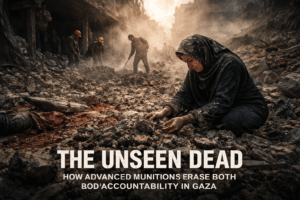
The Unseen Dead: How Advanced Munitions Erase Both Bodies and Accountability in Gaza
The most haunting absence is not an empty space, but one that should be full. In Gaza, families sift through dust not just for survivors, but for proof that their loved ones ever existed at all. A recent, thorough investigation has shed light on a grim phenomenon of Israel’s war: the systematic “evaporation” of thousands of Palestinians, leaving behind no bodies to bury, only questions and ash. This is not merely a casualty count, but an exploration of a terrifying technical reality and its devastating human and legal consequences.
The Forensic Arithmetic of Absence
The figure—2,842 human beings classified as “evaporated”—is not an estimate. It is a number arrived at through a grim, methodological calculus performed by Gaza’s Civil Defense teams in the most harrowing conditions imaginable. As spokesperson Mahmoud Basal explains, it is a “method of elimination.” When a residential building, a school, or a shelter is struck, rescue teams ascertain the number of people known to be inside. They then conduct exhaustive searches, recovering what remains. Intact bodies are counted. The discrepancy—those unaccounted for—is not immediately classified as “evaporated.” Only after scouring rubble, hospitals, and morgues yields nothing but the most minuscule biological traces—a blood pattern on concrete, a fragment of tissue—is the term applied.
This process transforms a home into a forensic equation: five family members minus three recovered bodies equals two human beings who have, for all practical purposes, disappeared from the physical world. The weight of this arithmetic is carried by people like Yasmin Mahani, who walked at dawn through the ruins of the al-Tabin school, stepping on flesh and blood, searching in vain for her son Saad. Her testimony, “Not even a body to bury,” captures the profound secondary trauma inflicted by this absence, denying even the sacred ritual of closure.
The Tools of Vaporization: Thermobarics and Thermal Munitions
The investigation points to a specific cause: Israel’s widespread use of high-temperature, high-pressure munitions. Military experts identify these as thermobaric and enhanced thermal weapons, sometimes called “vacuum” or “aerosol” bombs. Their function is as brutal as it is efficient. A fuel cloud is dispersed, then ignited, creating a massive fireball that sucks oxygen from the environment. To prolong and intensify the burn, metals like aluminum, magnesium, and titanium are added to the mix, creating sustained temperatures between 2,500 and 3,000 degrees Celsius.
At these extremes, the science is unforgiving. Dr. Munir al-Bursh of Gaza’s Health Ministry outlines the biological inevitability. The human body is mostly water. Exposed to energy exceeding 3,000 degrees combined with overwhelming pressure, bodily fluids don’t just boil; they instantaneously vaporize. Soft tissue turns to ash. Bone may shatter into fine particulates. What remains is often just a shadow on the wall or a fine, greasy dust—traces utterly unrecognizable to a grieving parent searching with their bare hands.
Specific Munitions and Their Chilling Design
The report names the instruments of this destruction, moving from the general to the chillingly specific:
- The GBU-39 Small Diameter Bomb: A precision glide bomb, cited in the al-Tabin school strike. Its design philosophy is particularly disturbing. As expert Vasily Fatigarov notes, it is engineered to keep a building’s structure relatively intact while annihilating everything inside through a combination of overpowering pressure waves and searing thermal energy. It kills by rupturing lungs and incinerating tissue, often leaving a hollow, standing shell filled with ashes.
- The BLU-109 Bunker Buster: Used in an attack on the purported “safe zone” of al-Mawasi, this bomb is built to penetrate deep into reinforced structures before detonating. Its delayed fuse allows it to bury itself, then explode within confined spaces, creating a colossal internal fireball. The investigation notes it “evaporated 22 people” in that strike.
- The MK-84 “Hammer”: A 2,000-pound unguided bomb packed with tritonal (TNT mixed with aluminum powder). This mixture can generate temperatures up to 3,500°C (6,332°F), ensuring complete cremation at the epicenter of the blast.
These are not indiscriminate WWII-era “dumb” bombs. Many are precision-guided, which underlines a critical legal and ethical paradox: the precision lies in delivery, not in discriminatory effect within the blast radius. A bomb precisely dropped on a residential building will precisely vaporize every civilian inside.
The Legal Vacuum: Complicity and Failed Accountability
This leads to the investigation’s most damning pillar: the question of legal responsibility. International humanitarian law is unequivocal on principles of distinction and proportionality. Weapons that cannot discriminate between combatants and civilians, or that cause disproportionate suffering, are prohibited.
Legal scholar Diana Buttu frames this as a “global genocide,” implicating arms suppliers. “We see a continuous flow of these weapons from the United States and Europe,” she states. “They know these weapons do not distinguish between a fighter and a child, yet they continue to send them.” This positions Western nations not as passive observers but as active enablers, potentially complicit in war crimes through the sustained provision of knowing the likely use of such munitions in a densely populated urban environment.
The context makes this complicity stark. These transfers continue despite the International Court of Justice’s provisional measures ordering Israel to prevent acts of genocide, and despite the International Criminal Court’s arrest warrant for Prime Minister Benjamin Netanyahu. As professor Tariq Shandab states, the international justice system has “failed the test of Gaza.” The blockade itself, strangling food and medicine, compounds what may constitute crimes against humanity. The investigation suggests that without political will in international courts, the path to accountability may rely on universal jurisdiction cases filed in national courts abroad—a slow, uncertain recourse.
The Enduring Scars on the Living
For the families of Rafiq Badran, who lost four children, or Yasmin Mahani, searching for Saad, legal frameworks are abstract. Their reality is a loss without a grave, a grief without a focal point. This “evaporation” weaponizes memory itself, leaving survivors in a tortuous limbo, haunted by the impossibility of ritual burial. It represents a profound violation of cultural and religious rites, adding a layer of psychological devastation atop the physical destruction.
The phenomenon documented in this investigation reveals a horrifying evolution in warfare. It moves beyond destroying lives to erasing the very evidence that those lives existed. It creates a battlefield where thousands can be made to disappear not into secret prisons, but into the air itself, leaving behind only the testimony of the traumatized and the stubborn, painful arithmetic of absence. In doing so, it challenges not only our moral imagination but the very mechanisms the world has built to uphold justice and human dignity. The weapons may vaporize their victims, but they also expose, with glaring clarity, the vaporization of accountability on a global scale.
You must be logged in to post a comment.