
The Unseen Collapse: How Withheld Palestinian Tax Revenues Are Strangling a Nation
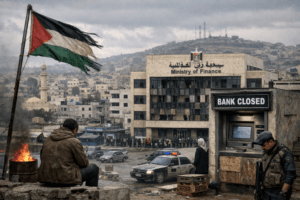
The Unseen Collapse: How Withheld Palestinian Tax Revenues Are Strangling a Nation
For ten straight months, Israel has frozen $4.4 billion in Palestinian clearance funds. The Finance Minister says the Palestinian Authority is now operating “ten degrees below minimum”—and running out of room to survive.
RAMALLAH, West Bank — The fluorescent lights flickered faintly in the Ministry of Finance conference room on Thursday afternoon. Outside, the February rain fell in gray sheets over Ramallah. Inside, Minister Estephan Anton Salameh stood before a bank of microphones, his voice steady but his message anything but.
“For the tenth consecutive month,” he said, pausing briefly, “we have not received a single penny.”
He did not need to specify from whom. Everyone in the room already knew.
The money Israel is withholding—approximately $4.4 billion, or 13 billion shekels—represents not merely revenue but oxygen. It is the financial air the Palestinian Authority (PA) breathes. Without it, Salameh warned, the institutions that serve 5.3 million Palestinians in the West Bank and Gaza are not just struggling. They are, in his words, “operating ten degrees below the minimum.”
What does that mean in human terms?
It means medicines that sit unpurchased in international catalogs. It means public school teachers showing up to classrooms without chalk, without updated textbooks, without the salary they were promised two months ago. It means police officers who continue to direct traffic and investigate crimes while their own bank accounts hover near zero. It means a civil servant in Hebron, married with three children, who now spends his evenings driving for a ride-share app just to cover the gap his government paycheck no longer fills.
This is not hyperbole. This is the arithmetic of administrative collapse.
The Architecture of Dependence
To understand what is happening now, one must first understand the mechanism Israel controls.
Clearance revenues—known in Arabic as al-maqassa—are taxes Israel collects on goods destined for Palestinian markets that transit through Israeli ports and border crossings. Under the Paris Protocol of 1994, which governs economic relations between Israel and the Palestine Liberation Organization, these funds are supposed to be transferred monthly to the PA.
In practice, they have become a political lever.
When Salameh took the podium, he laid out numbers that tell a story of progressive strangulation. In 2025, total clearance revenues reached approximately 10.3 billion shekels. Of that, Israel transferred just 1.95 billion—covering only the first four months of the year. The remaining 8.35 billion shekels never arrived.
But even that understates the damage.
Salameh revealed that in addition to withholding current revenues, Israel has imposed deductions totaling $4.4 billion under various justifications: alleged payments to families of imprisoned militants, debts to Israeli utilities, administrative fees, and an expanding list of lawsuits filed against the PA in Israeli courts.
“There are 475 active lawsuits,” Salameh said, “with a total claimed value of 45 billion shekels, plus additional compensation demands approaching 20 billion shekels.”
To put that in perspective: The entire annual budget of the Palestinian Authority is roughly 16 billion shekels. The lawsuits alone—regardless of their legal merit—now represent a liability nearly four times the PA’s annual spending.
The PA is not merely cash-strapped. It is being systematically indebted into oblivion.
Beyond Austerity: When Cutting Is No Longer Enough
For years, when financial crises hit Ramallah, the response followed a familiar pattern: delay salary payments, reduce ministerial travel, freeze new hiring, renegotiate contracts with suppliers. Civil servants learned to live with uncertainty. Banks learned to extend credit against the promise of future clearance transfers. Hospitals learned to ration supplies.
That era, Salameh suggested, is over.
“Austerity is no longer a choice,” he said. “It has become compulsory.”
What distinguishes the current crisis from previous ones is not merely its duration or its dollar amount. It is the exhaustion of all remaining flexibility. The PA now requires approximately one billion shekels per month merely to function at what Salameh called its current “deficient level.” Domestic revenues—taxes collected directly by Palestinian authorities—totaled roughly five billion shekels in 2025. That covers less than half the annual operating need.
Foreign aid, long a stopgap, has proven unreliable. In 2025, donors provided approximately $850 million—a significant increase from previous years, Salameh acknowledged, and a sign of sustained international political support. But emergency funding mechanisms activated by donor countries delivered only $250 million of the $1.2 billion that had been anticipated.
The gap between need and reality is no longer a crack. It is a chasm.
The Human Ledger
What these numbers obscure—what no finance minister can fully convey in a press conference—is the lived experience of institutional decay.
In the Ministry of Health, procurement officers have spent months watching essential medical equipment sit in international warehouses because letters of credit cannot be opened. In the Ministry of Education, school maintenance budgets have been redirected to cover basic payroll. In the security services, commanders report that morale has plummeted not because of operational dangers but because of the quiet humiliation of officers unable to provide for their families.
A senior official in the Preventive Security Apparatus, speaking on condition of anonymity, described the situation in stark terms: “We are expected to maintain order, prevent attacks, coordinate with Israeli security, and project authority—all while our own people cannot pay their rent. The contradiction is unsustainable.”
That unsustainability has begun to manifest in visible ways. Salameh noted with what seemed genuine admiration that recent security operations in Jenin, Nablus, and Hebron proceeded with “observed discipline.” But he was careful to frame this not as a testament to institutional capacity but as evidence of “a societal value system”—a deeply ingrained Palestinian commitment to public order that persists despite, not because of, the institutions meant to sustain it.
The subtext was unmistakable: Social cohesion is not an inexhaustible resource. It, too, can be depleted.
2026: The Reckoning Year
When Salameh turned to the coming fiscal year, his language shifted from diagnostic to existential.
“The financial outlook for 2026,” he said, “is expected to be the most challenging in the history of the National Authority.”
This is not a prediction. It is a warning.
The 2026 budget is still under preparation, but its contours are already dictated by forces beyond Ramallah’s control. Clearance revenues—which normally constitute 70 percent of public income—cannot be assumed. Foreign support remains uncertain at least through June. The accumulated debt, now approximately $15.4 billion, continues to accrue interest and compound.
Salameh described the budget process as focused on “sectors with an existential dimension.” Translation: Ministries and programs deemed non-essential will face cuts so severe they may cease to function. The question is no longer how to maintain services but how to prevent complete institutional collapse.
And yet, even in this context, the minister insisted on principles that might seem indulgent under the circumstances. The draft budget, he said, includes measures aimed at “achieving social justice and preventing tax evasion and smuggling.” These are not merely technical objectives, he added. They are “national priorities.”
The message was directed as much at Palestinian taxpayers and business owners as at international observers. In a time of collective sacrifice, the burden must be shared equitably. Those who can pay must pay. Those who evade must be pursued. The legitimacy of the Authority, already severely strained, cannot survive a perception that the wealthy are sheltering their capital while civil servants go unpaid.
The Irony of Control
There is a bitter paradox embedded in the current crisis.
The PA, which Israel and much of the international community have long criticized as corrupt, inefficient, and institutionally weak, is now being praised—faintly, conditionally—for maintaining basic governance under impossible conditions. Israeli defense officials acknowledge, privately if not publicly, that the collapse of the Authority would be catastrophic, creating a vacuum that Hamas or other armed factions would swiftly fill.
And yet the policy of withholding clearance funds continues.
Salameh offered his own interpretation of this contradiction. By framing the funds as something to be “zeroed out” or deducted to zero under accumulating legal claims, Israel is not merely punishing the PA. It is systematically dismantling the economic foundation of the two-state solution—without ever formally declaring that process underway.
“No country in the world can continue to function in the absence of such a large portion of its revenues,” Salameh said. He did not need to add: That is precisely the point.
The Weight of Waiting
After the press conference concluded, the journalists packed their recording equipment and dispersed into the rain. The minister returned to his office, where budget spreadsheets and debt projections awaited.
In a city like Ramallah—the administrative heart of a state that exists provisionally, contingently, on the sufferance of occupying powers and donor governments—crises come and go. Some pass. Some metastasize. This one, those who work in these ministries sense, is different.
The question no one can answer—not the minister, not the diplomats, not the civil servants waiting for salaries that may never arrive—is how much longer the institutions can hold.
Salameh’s numbers tell one story. But the deeper story is not in the spreadsheets. It is in the quiet anxiety of a ministry accountant who has not taken a vacation in three years because she cannot afford the lost overtime. It is in the high school principal in Nablus who buys classroom supplies with her own money. It is in the police officer in Jenin who continues to report for duty each morning even though his bank has refused to extend further credit against his frozen salary.
This is the human ledger of fiscal collapse. It does not appear in any budget document. But it is, in the end, the only accounting that truly matters
You must be logged in to post a comment.