
The Unseen Collapse: How Scorching Temperatures Are Silencing India’s Informal Women Workforce
Extreme heat in India is inflicting a severe and gendered economic crisis on the nation’s vast informal workforce, with women bearing a disproportionate burden due to their concentration in the most insecure jobs—like agricultural labor, construction, and home-based work—coupled with relentless unpaid care responsibilities. Without formal contracts or social security, heatwaves force impossible choices between health and income, leading directly to lost wages through reduced productivity and absenteeism, a loss quantified in surveys averaging over ₹1,500 per woman annually. Despite being listed as vulnerable in Heat Action Plans, these women remain largely invisible in policy, which ignores income protection and the specific risks of indoor labor, leaving grassroots initiatives like parametric insurance to fill a critical gap in a system that fails to connect climate resilience with gender and economic justice.
The Unseen Collapse: How Scorching Temperatures Are Silencing India’s Informal Women Workforce
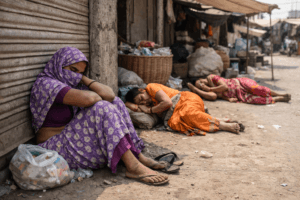
Every summer, as the sun climbs higher and the air grows thick and heavy, a silent economic catastrophe unfolds across India. It doesn’t make headlines like a stock market crash, but its impact is devastatingly personal. For millions of women working in India’s vast informal sector—the agricultural labourer in a parched field, the home-based garment worker in a sweltering room, the construction helper balancing bricks under a blinding sky—extreme heat is not just a weather event. It is a force that systematically erodes their health, security, and meagre incomes, pushing already precarious lives further to the edge.
The climate crisis, manifesting in longer, more intense heatwaves, is exposing and exacerbating deep-seated gender and economic inequalities. While all informal workers suffer, women bear a disproportionate and multifaceted burden, one that existing policies are failing to address.
The Gendered Anatomy of Heat Vulnerability
A woman’s vulnerability to heat is not merely physiological; it is a product of her position in the economy and society. Two interconnected factors create a perfect storm:
- The Concentration in High-Risk Informal Work: Over 92% of Indian women in paid work are in the informal sector. They are overwhelmingly clustered at the bottom of the informality pyramid: as casual daily-wage labourers, contributing (unpaid) family workers in farm or home enterprises, and own-account workers like street vendors. These categories, identified by research networks like Women in Informal Employment Globalizing and Organizing (WIEGO), carry the highest poverty risk. They come with no contracts, no paid leave, no social security, and no occupational safety protections. When the mercury soars, work stops, and income stops instantly.
- The Unrelenting Double Burden: The national Time Use Survey reveals an unshakeable truth: Indian women spend over seven hours daily on unpaid domestic and care work, compared to men’s mere two. A heatwave doesn’t lighten this load. Cooking in a stifling kitchen, fetching water, and caring for children and the elderly continue unabated, often in poorly ventilated homes. This means a woman facing heat stress isn’t just losing paid income; she is exhausting herself in unpaid labour, with no recovery time, depleting her health and resilience.
As Professor Saudamini Das explains, heat attacks women’s earnings through two clear pathways: reduced working hours due to illness or unbearable conditions, and decreased productivity—working slower to survive. In piece-rate work, where pay is tied to output, this slowdown translates directly into a smaller wage. A study in Delhi found productivity drops of 20-25% on hot days. For a woman assembling garments at home, that’s a quarter of her already low income gone.
The Stark Data: Quantifying the Loss
While official statistics largely ignore this demographic, recent surveys paint a grim picture:
- A 2025 study by the MS Swaminathan Research Foundation found 97% of over 3,300 women workers reported income loss during summer, averaging over ₹1,500.
- The FAO’s Unjust Climate report indicates female-headed households lose significantly more income than male-headed ones as temperatures rise, with a staggering 34% decline in income per 1°C increase in long-term temperatures.
- A survey of informal workers in South India found each unit increase in heat stress raised the likelihood of productivity loss for women by 339%.
These aren’t abstract numbers. They represent skipped meals, children pulled from school, debt spirals, and impossible choices between a day’s wage and a risk of heatstroke.
Policy Blind Spots: Where Heat Action Plans Grow Cold
India’s primary policy response to extreme heat has been the development of Heat Action Plans (HAPs). A 2024 review by the Centre for Policy Research, however, reveals critical gaps:
- The Income Ignorance: Most HAPs focus on preventing mortality and illness—vital goals—but are virtually silent on income and livelihood protection. They list “informal workers” and “women” as vulnerable but propose few concrete measures to compensate for lost wages.
- The Indoor Neglect: Plans are geared towards outdoor heat. They miss millions of home-based workers—embroiderers, papad makers, agarbatti rollers—who work in poorly ventilated, often tin-roofed homes where indoor temperatures can exceed 50°C, ruining materials and health.
- The Funding Void: Only 11 of 37 plans assessed had any identified budget. Without assured financing and legal mandates, HAPs remain advisory, lacking teeth for enforcement. As researcher Tamanna Dalal notes, labour officials in some cities are unaware a HAP even exists for their jurisdiction.
This creates a stark governance paradox: those most affected by heat are least visible in the plans designed to protect them.
Seeds of Resilience: Grassroots Solutions Point the Way
In the vacuum of state-led social protection, innovative grassroots and civil society initiatives are emerging, offering a blueprint for what inclusive policy could look like:
- Parametric Insurance: Pioneered by the Self-Employed Women’s Association (SEWA), this model provides automatic payouts when temperatures cross a set threshold. It removes bureaucratic claim hurdles, getting crucial funds quickly to women. A 2023 pilot reached 21,000 women.
- Integrated Support Systems: Initiatives like the Women’s Climate Shock & Insurance Initiative combine insurance with low-threshold cash assistance, early warnings, and practical tools—cooling kits, shaded rest areas, water stations. This holistic approach tackles both income loss and the conditions that cause it.
- Data from the Ground: Organizations like SEWA and MSSRF are generating the vital, gender-disaggregated data that official surveys lack, documenting sector-specific impacts from agriculture to waste-picking.
The Path Forward: From Vulnerability to Resilience
Addressing this crisis requires a fundamental shift in how we view heat—not just as a health disaster, but as an economic and gender justice issue.
- Gender-Transformative HAPs: Heat Action Plans must be legally mandated, funded, and explicitly designed to protect incomes. This includes exploring paid heat leave mechanisms, disaster compensation funds for lost wages, and mandatory provisions for shaded rest breaks and cool drinking water at all work sites, including residential areas for domestic workers.
- Bridge the Data Chasm: National surveys like the Periodic Labour Force Survey must systematically collect data on heat-induced income and productivity loss, disaggregated by gender, occupation, and informality. You cannot manage what you do not measure.
- Extend Labour Protections: The long-term goal must be to gradually bring informal workers under the umbrella of labour laws and social security, recognizing their work as integral to the economy. Heat resilience is impossible without economic security.
- Invest in Adaptive Infrastructure: Public investment in affordable cooling solutions (passive cooling architecture, affordable electricity for fans), green urban spaces, and reliable water access can reduce the baseline heat burden for millions.
The scorching truth is this: India’s economic resilience to climate change is inextricably linked to the resilience of its informal women workers. Their loss is a national loss. Building a heat-resilient future demands policies that see them, value their work, and protect not just their lives, but their livelihoods. The time for cooling rhetoric has passed; now is the moment for actionable, inclusive, and urgent heat justice.
You must be logged in to post a comment.