
The Unseen Chill: Why Delhi’s Double-Digit Temperatures Feel Like a Deep Freeze
Despite Delhi’s temperatures staying in double digits, the intense cold sensation is caused by a combination of dense fog and high humidity, which trap pollution and block sunlight from warming the air while also accelerating the body’s heat loss. This weather is part of a broader pattern of a severe North Indian winter marked by weak Western Disturbances, leading to persistent fog, major travel disruptions like flight cancellations, and poor air quality that has forced prolonged school closures, with some relief expected only by late January.
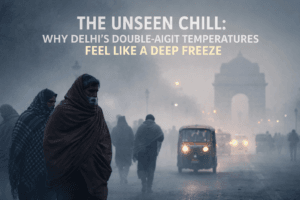
The Unseen Chill: Why Delhi’s Double-Digit Temperatures Feel Like a Deep Freeze
It’s a frustrating paradox familiar to millions in North India: you wake up, shivering, check the temperature, and see it’s 12°C—yet it feels like it’s near freezing. This winter, dense, persistent fog has been the primary culprit, acting as a meteorological blanket that warps our perception of cold, disrupts daily life, and signals deeper shifts in regional climate patterns.
This article explores the complex interplay of fog, humidity, weak weather systems, and global climate influences that make Delhi’s winters feel far more brutal than the thermometer suggests.
The Core Culprit: Fog, Humidity, and Stagnant Air
When residents experience a “bone-chilling” morning despite double-digit temperatures, the answer lies not in the air temperature alone but in the micro-weather conditions at ground level. The dense fog that shrouds the city is not just a visual nuisance; it’s a powerful atmospheric agent with several chilling effects.
Trapping Cold and Pollution: This thick blanket of fog traps moisture and pollutants close to the surface. Normally, sunlight would warm the ground and the air throughout the day. However, the fog acts as a reflective barrier, significantly reducing the amount of solar energy that reaches the surface. The result is that cold air lingers much longer, making mornings and evenings feel disproportionately colder.
The Humidity Factor: Adding to the misery is the high humidity that accompanies the fog. While we associate humidity with summer stickiness, in winter, it has a different effect. High humidity accelerates the rate at which the human body loses heat, making the ambient cold feel much more intense. Furthermore, when skies are clear (or in this case, shrouded in a way that prevents solar heating), the Earth’s surface loses heat rapidly after sunset, leading to colder mornings. The combination of calm winds and this high humidity creates a stagnant, chill-inducing environment that is slow to dissipate.
Table 1: How Fog Warps the “Feels Like” Temperature
| Factor | Typical Winter Condition | Current Foggy Condition | Impact on Perceived Cold |
| Daytime Sunlight | Direct warming of ground and air. | Blocked by dense fog layer. | Prevents daytime heating; cold air persists. |
| Wind | Light breeze mixes air layers. | Often calm or very light. | Eliminates wind chill, but allows cold air to pool at surface. |
| Humidity | Lower, drier air. | Very high near the surface. | Moist air conducts heat away from body faster, intensifying cold sensation. |
| Heat Radiation | Ground heat escapes at night. | Fog sometimes traps some heat, but prevents daytime recharge. | Complex effect, but net result is a prolonged, persistent chill. |
Beyond the Fog: Weak Disturbances and Shifting Winds
The fog itself is a symptom of larger-scale meteorological patterns that have defined North India’s winter. The primary driver of winter precipitation and cloud cover in the region is the **Western Disturbance (WD)**—an extra-tropical storm system that travels from the Mediterranean region.
This season, however, these systems have been conspicuously weak. Between October 15 and December 17, 2025, 12 Western Disturbances affected India, but most were classified as “feeble,” particularly in the lower and upper levels of the atmosphere. A weak WD brings some moisture and cloud cover but lacks the energy to cause widespread rain or snow that would flush out pollutants and disperse fog. Instead, it contributes to the buildup of smog and persistent foggy conditions.
This weakness is linked to the behavior of the subtropical westerly jet stream, a high-altitude, fast-moving river of air that steers WDs towards India. Normally positioned over northwest India in winter, the jet stream this season has shown an unusual tendency to shift repeatedly towards the northeast. This displacement is a key reason for the reduced activity and impact of WDs over the northwestern plains, leaving the region dry, calm, and prone to fog formation.
The Global Climate Connection: From the Arctic to the Pacific
The unusual behavior of local weather systems is increasingly seen through the lens of global climate change and teleconnections—where changes in one part of the world influence weather thousands of miles away.
- Arctic Amplification: The Arctic is warming two to three times faster than the global average. This reduces the temperature gradient between the poles and the tropics, which can weaken and destabilize the jet stream. A weaker jet stream tends to meander more, creating larger waves that can allow cold Arctic air to plunge southward into the mid-latitudes and disrupt typical storm tracks.
- La Niña’s Influence: The current persistence of La Niña conditions in the Pacific Ocean also plays a role. This climate phase is known to influence temperature patterns and can favor colder conditions over parts of the Indian subcontinent during winter.
- A Trend of Change: Scientists note a concerning trend of declining winter precipitation in northern India, even as foggy conditions prevail. This shift has serious implications for water resources, agriculture, and the intensity of cold waves.
Impacts and Outlook: Disruption and a Glimmer of Relief
The consequences of this fog-chill combo are severe and multifaceted:
- Travel Chaos: Visibility routinely plummets below 50-200 meters, causing massive disruptions. On December 30, 2025, over 100 flights were cancelled at Delhi’s airport alone, with hundreds more delayed. Similar disruptions have plagued roads and railways.
- Health and Life: Air quality deteriorates to “severe” levels as pollutants are trapped by the fog. This has led to prolonged school closures in Delhi and other states to protect children from the toxic mix of cold and pollution. The economic cost is also steep, with logistics and business travel severely hampered.
- The Forecast: The IMD has forecast dense fog and cold wave conditions to continue over North India, including Delhi, until at least January 31, 2026. However, a change is on the horizon. A fresh Western Disturbance is expected to approach from the night of January 30. This system is predicted to bring scattered rain and snow to the Western Himalayas and adjoining plains from January 31 into early February, which should lead to a gradual rise in minimum temperatures by 2-5°C thereafter.
Conclusion
Delhi’s biting chill in double-digit temperatures is a perfect storm of local meteorology and global climate shifts. The dense fog, a product of high humidity and stagnant air, acts as a refrigerator lid, locking in the cold. This condition is enabled by a season of weak Western Disturbances, guided by a misbehaving jet stream—patterns increasingly influenced by Arctic warming and Pacific climate cycles. While immediate relief from the chill is forecast with the incoming weather system, the winter of 2025-26 stands as a stark example of how climate change manifests not just in rising temperatures, but in complex, disruptive, and bone-chilling ways.
You must be logged in to post a comment.