
The Unseen Battle: How Gaza’s Winter Crisis Exposes a Global Failure of Conscience
Gaza’s deepening winter crisis represents a man-made humanitarian catastrophe where children die from exposure and preventable diseases amid widespread devastation, exacerbated not by natural forces but by calculated political decisions, most notably Israel’s ban on 37 major international NGOs under the guise of security—a move that weaponizes bureaucracy to restrict life-saving aid in violation of international law, while the international community’s muted response and political ambivalence, particularly from the US, enable a strategy of suffocating control and profiteering that tests the very foundations of global conscience and the integrity of humanitarian action.
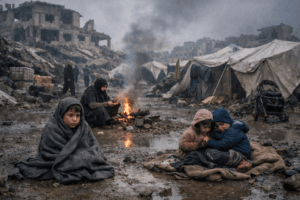
The Unseen Battle: How Gaza’s Winter Crisis Exposes a Global Failure of Conscience
As winter tightens its grip on Gaza, a humanitarian catastrophe unfolds not just from the elements, but from deliberate political choices. The images are visceral: families huddled in flimsy tents amidst rubble, children succumbing not to bombs but to hypothermia, and the grim irony of aid being blocked while profiteering flourishes. This is not merely a tragic postscript to war; it is a active, man-made deepening of suffering that tests the very foundations of international law and human decency. The world’s response—or lack thereof—will be a defining measure of our collective humanity.
Beyond the Weather: The Architecture of a Man-Made Disaster
The immediate scene is one of biblical-scale devastation. With nine out of ten homes destroyed over two years of conflict, Gaza’s landscape is one of fractured concrete and shattered lives. The winter rains turn camps into quagmires, the winds tear through inadequate shelters, and the cold becomes a silent killer. Yet, to attribute this suffering solely to the season is to miss the point entirely. The infrastructure that could provide resilience—homes, water systems, electricity grids—has been systematically obliterated. What remains is a population stripped of all buffers, left utterly exposed.
The ceasefire may have halted active fighting, but it ushered in a perilous new phase of slow-motion crisis. Aid deliveries, while staving off outright famine, are a trickle against a tsunami of need. Acute food insecurity threatens 1.6 million people, a staggering statistic that represents hollow cheeks and stunted growth, not just abstract data. The collapse of sanitation is a public health time bomb, where the next wave of deaths may come from cholera or typhoid, logged in spreadsheets as “disease” rather than “war,” yet just as much a consequence of the conflict.
The NGO Ban: Weaponizing Bureaucracy Against Humanity
Israel’s decision to deregister 37 major international NGOs, including giants like Oxfam and Médecins Sans Frontières, is not an administrative footnote. It is a strategic escalation in the containment of Gaza’s humanitarian space. Framed under the guise of “security and transparency,” the demand for staff lists in an environment where humanitarian workers have been arbitrarily detained and killed is not a request—it is a threat. It forces an impossible choice: violate the core humanitarian principles of neutrality and independence by submitting to politically-motivated scrutiny, or cease operations and abandon those in need.
This move is part of a pattern, a choreography of control. The banning of “dual-use” items like tent poles and generators from aid shipments, while allowing traders to import them, creates a cruel marketplace of suffering. It transforms survival into a commodity, ensuring that while the average Palestinian battles the cold, actors on the sidelines can profit. It deliberately creates a bottleneck where aid is allowed just enough to prevent global outrage from boiling over, but never enough to restore dignity or safety.
The Hollow Echoes of International Law
International humanitarian law is unequivocal: parties to a conflict must allow and facilitate rapid and unimpeded passage of humanitarian relief for civilians in need. It is not an act of charity subject to a state’s whims; it is a legal obligation. Israel’s restrictions, from the comprehensive siege to the bureaucratic strangulation of NGOs, represent a clear violation of these tenets. The United Nations human rights chief’s description of the NGO ban as “outrageous” is a diplomatic understatement; it is a breach of the rule-based order the world claims to uphold.
The muted response from powerful nations reveals a devastating hypocrisy. While countries like the UK, Canada, and France issue joint statements of concern, their political and military alliances with Israel often remain untouched. This creates a permissive environment where violations can continue with impunity. It signals that the lives of Gazans are somehow less valuable, their suffering less urgent, their rights under international law less enforceable.
The Political Calculus: Stalling While Suffering Deepens
The political landscape surrounding Gaza is a study in bad faith. Within Israel, Prime Minister Benjamin Netanyahu appears to use humanitarian pressure as a lever, stalling the peace process while maintaining a suffocating grip on the territory. The NGO ban serves a domestic political narrative of “security,” despite a glaring absence of public evidence for widespread Hamas infiltration of these organizations.
On the international stage, the dynamics are equally grim. The editorial notes the frustration in Washington, but also the alarming ambivalence of a Trump administration. The warning of “hell to pay” for Hamas is paired with a visible relaxation about Israel’s refusal to withdraw from occupied Gaza. This creates a paradox where disarmament is demanded of one party while territorial conquest is tacitly accepted for the other, gutting any peace plan of its legitimacy and balance. It reduces a complex, decades-long political conflict to a one-sided security ultimatum, with civilians bearing the cost.
A Test for the Global Conscience
Gaza’s winter is more than a seasonal hardship; it is a crucible. It tests:
- The Integrity of Humanitarian Action: Can aid organizations uphold their principles under intense political pressure, or will the space for impartial life-saving work be eradicated entirely?
- The Courage of Allied Nations: Will Israel’s allies move beyond statements to concrete consequences for violations of international law, using their considerable leverage to demand access and protection?
- The Power of the Public Gaze: In an age of shortened news cycles, can global attention remain fixed on this grinding, chronic crisis, recognizing that the absence of headlines does not mean the absence of suffering?
The greatest threat to Gaza is not the rain or the cold. It is the chilling indifference—the bureaucratic violence, the political cynicism, the global distraction. As the editorial powerfully concludes, “It is not bad weather but bad faith that is the greatest threat.”
To look away now is to become complicit in a strategy of exhaustion, where a population is worn down not just by war, but by the calculated denial of the means to rebuild, to warm, to heal. The response must be a unified, unwavering demand: for the immediate and unconditional restoration of humanitarian access, for the protection of aid workers, and for a political solution that recognizes that Palestinian safety and Israeli security are not opposites, but inextricably linked. The lives hanging in the balance in Gaza’s tents are the measure of our common humanity. We are all being tested.
You must be logged in to post a comment.