
The Unreported Tragedy: How Systemic Neglect and Secrecy Silenced Hamza Adwan and 86 Others
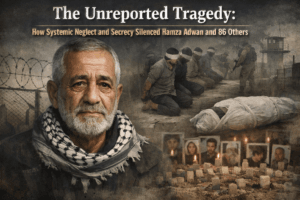
The Unreported Tragedy: How Systemic Neglect and Secrecy Silenced Hamza Adwan and 86 Others
The news from the Israeli military was delivered not with an apology, but as a cold, administrative footnote, closing a file. Hamza Abdullah Adwan, a 67-year-old grandfather from Gaza, a man with a heart condition, a father of nine who had already buried two children, was not just dead. He had been dead for four months. According to the terse response received by Palestinian rights groups, he died on September 9, 2025. His family, who had last seen him when he was taken at a military checkpoint on November 12, 2024, spent those 120 days in a torturous limbo, receiving “conflicting information” about his fate. His story is not an anomaly; it is the horrifying pattern of a system operating in the shadows.
Hamza Adwan’s death, confirmed only in January 2026, brings the officially announced number of Palestinian prisoners who have died in Israeli custody since the outbreak of the recent war to 87. Of these, 51 are from Gaza, like Hamza. But these numbers are not mere statistics; they are a ledger of profound human suffering, a testament to what rights groups describe as a policy of “widespread torture, starvation, medical neglect, sexual abuse, and detention under inhumane conditions.” His passing elevates the grim total of known Palestinian prisoner deaths since 1967 to 324—a number that activists insist is a severe undercount, representing only those whose names have been forcibly unearthed from a system of enforced disappearance.
Beyond the Headline: The Machinery of Disappearance
The central horror of Hamza’s story lies in the four-month gap between his death and his family’s knowledge of it. This is not bureaucratic delay; it is a tactic. It is the machinery of administrative detention and systemic opacity working as designed. For families, this period is a unique psychological hell, suspended between hope and grief, unable to mourn, unable to move on. The “conflicting information” reported by his family is a common tool, sowing confusion and paralyzing advocacy.
This practice fits into a broader, well-documented pattern of enforced disappearances, particularly concerning detainees from Gaza. As noted in the joint statement, “many detainees from Gaza who died in Israeli custody remain subject to enforced disappearance, alongside dozens who were summarily executed.” The reference to images of returned bodies post-ceasefire serving as “evidence of systematic executions” points to a reality beyond neglect: one of active, violent intent. When a state holds individuals beyond the reach of law, refuses to disclose their location or condition, and then reveals their death months later without cause, it strips them not only of liberty but of their very humanity and their right to a known fate.
Medical Negligence as a Silent Weapon
Hamza was detained “despite suffering from serious health conditions, including heart disease, and was in need of continuous medical care and follow-up.” This detail is critical. In any lawful custodial system, the duty of care is paramount. In Israel’s prison system, according to exhaustive reports from organizations like Physicians for Human Rights Israel and Addameer, medical neglect is a chronic, institutional failure that escalates into a tool of punishment and abuse during times of crisis.
Prison clinics are often understaffed and under-resourced. Requests for specialist care are routinely delayed or denied. Medication is confiscated or not provided. For an elderly man with a cardiac condition, the conditions of detention—which include overcrowding, poor sanitation, sleep deprivation, and nutritional deprivation—are themselves a death sentence. The stress of interrogation, the uncertainty, the lack of familial contact, all exacerbate chronic illnesses. His death, listed without cause, is almost certainly a death by medical negligence, a form of indirect violence that leaves no visible bruise but is just as fatal.
The Larger Canvas: 87 Names and a Legacy of Impunity
The announcement of Hamza’s death is a stark reminder that the violence of this conflict is not confined to airstrikes and artillery shells. It permeates the prison cells, the interrogation rooms, the corridors of a military bureaucracy that processes human beings as numbers. The 87 announced deaths represent faces, families, and stories. They include young men arrested at checkpoints, political activists, civilians swept up in mass detention campaigns, and elderly, sick individuals like Hamza who posed no conceivable threat.
The joint statement’s accusation of “starvation” and “sexual abuse” aligns with emerging, harrowing testimonies from released detainees. Accounts speak of being bound in painful stress positions for days, deprived of food and water, subjected to verbal and physical humiliation, and kept in “barracks” where they sleep on bare concrete in extreme cold or heat. These are not isolated abuses; they are methods of systemic degradation designed to break spirit and extract confession.
Furthermore, the issue of accountability remains a glaring void. The call from the Commission and the Palestinian Prisoner’s Society for the international human rights system to “take effective action” echoes decades of similar appeals. The International Criminal Court has an ongoing investigation, and UN special rapporteurs have issued condemnations. Yet, on the ground, the sense of total impunity persists. When deaths in custody are investigated by the same military authority responsible for the detention, and when results are rarely published or lead to indictments, a clear message is sent: these lives are expendable.
The Agricultural Parallel: A Strategy of Strangulation
The news of Hamza’s death, juxtaposed on the same news portal with the Ministry of Agriculture’s report of over $103 million in losses for 2025, is not coincidental. It paints a comprehensive picture of a reality that targets Palestinian life in every form. The razing of agricultural land near Nablus, the shelling that leads to building collapses in Gaza City weeks or months later, the destruction of olive groves and greenhouses—these are not just military actions. They are attacks on food sovereignty, economic viability, and the rootedness of a people to their land.
Similarly, the death of a detainee is an attack on the social fabric. It creates a trauma that radiates through families and communities. Each unknown fate, each body returned without explanation, each death certificate citing vague causes, sows fear and demonstrates a power dynamic of absolute control. It tells every Palestinian family that their loved one, if taken, exists in a legal and physical black hole.
Conclusion: The Human Cost of the Unseen War
Hamza Adwan did not die in a crossfire. He died in a cell, or perhaps in a military field hospital, away from the eyes of his children, his wife, and the world. His story forces us to look away from the explosive headlines and into the slow, administrative violence that often escapes the news cycle. It challenges the international community to look beyond casualty figures from airstrikes and recognize the casualties of incarceration, neglect, and deliberate secrecy.
The 87 named dead, and the countless others unknown, are a testament to a crisis that will long outlive any ceasefire. Their stories underscore that true peace and justice are impossible without addressing the entire architecture of occupation, including its judicial and penal systems. Until the machinery that allowed Hamza Adwan to disappear and die in silence is dismantled, and until accountability replaces impunity, these silent reports of death in custody will continue to be written, each one a profound, unanswered call for our collective humanity. His legacy, and that of the 86 others, must be a relentless pursuit of the truth they were denied in life and in death.
You must be logged in to post a comment.