
The Unremarkable Horror of a Saturday Night: Anatomy of a Shooting at the Jabara Checkpoint
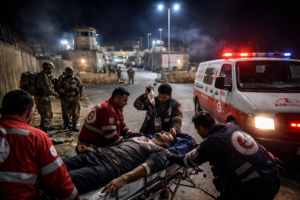
The Unremarkable Horror of a Saturday Night: Anatomy of a Shooting at the Jabara Checkpoint
TULKAREM, Occupied West Bank – In the thin, cold air of a Saturday night in late March, the Jabara checkpoint south of Tulkarem became the latest stage for a scene that has played out countless times across the Occupied Palestinian Territory. By the time the clocks struck 11:56 PM, the Palestine Red Crescent Society (PRCS) had already been summoned into the familiar rhythm of emergency: the flash of ambulances, the sterile scent of gauze, and the grim task of stabilizing two men who had just become entries in a long, sorrowful ledger.
According to a brief bulletin released by the official Palestinian news agency WAFA, two Palestinian citizens were injured by live ammunition fired by Israeli occupation forces at the military barrier. The victims—a 53-year-old man shot in the neck and chest, and a 54-year-old man shot in the leg—were transported to a hospital for treatment. In the world of news tickers and breaking headlines, this incident was allotted a few lines. But for the families involved, for the residents of Tulkarem, and for the broader Palestinian society watching the steady deterioration of life in the West Bank, the event was anything but small.
To understand the weight of what happened at Jabara that night, one must strip away the clinical language of news briefs. This was not merely a “clash” or an “incident.” It was the violent enforcement of a status quo that has become normalized to the point of invisibility for much of the international community, yet remains the suffocating reality for millions of Palestinians living under military occupation.
The Geography of Suffocation
Jabara is not just a dot on a map; it is a pressure point. Located south of Tulkarem, a city in the northwestern West Bank near the Green Line, the checkpoint sits on a critical artery that connects Palestinian communities to agricultural lands and to each other. For decades, the network of checkpoints, roadblocks, and military zones—collectively known as the matrix of control—has fragmented the West Bank into isolated cantons.
For a 53-year-old man and a 54-year-old man to be traveling through Jabara on a Saturday night is, in a normal context, unremarkable. Perhaps they were returning from work, visiting family, or tending to land that lies on the other side of the barrier. But in the context of occupation, the mundane act of movement becomes an act of defiance. It requires navigating roads that can be sealed without warning, passing through metal turnstiles, and submitting to the scrutiny of young soldiers stationed behind concrete towers.
When the Israeli forces opened fire at the checkpoint, they did so in an environment where they hold every tactical advantage. The use of “live fire”—bullets designed to kill or maim—against civilians at a checkpoint raises immediate questions of proportionality. Were the victims posing an imminent threat? Were they armed? The WAFA report, corroborated by the PRCS, indicates that the men were shot while at the checkpoint. The nature of their injuries—one to the neck and chest, the other to the leg—suggests a targeted application of firepower that left one man fighting for his life with wounds to his vital organs.
The Human Cost Beyond the Headline
In the rush to cover the macro-level politics—the settlements, the diplomatic stalemate, the sporadic ceasefire agreements—the human granularity is often lost. Who are these two men? The initial report from WAFA does not name them immediately, leaving them as archetypes: the 53-year-old and the 54-year-old.
In Palestinian society, these ages are significant. These are not hot-headed youths throwing stones at a distance; these are middle-aged men. They are likely fathers, perhaps grandfathers. They belong to a generation that has witnessed the Oslo Accords, the Second Intifada, the construction of the separation wall, and the gradual, relentless expansion of Israeli settlements. They are the men who have shouldered the burden of economic survival under one of the highest unemployment rates in the region.
For the 53-year-old with injuries to his neck and chest, the trajectory of the bullets implies a direct line of fire aimed at the center of mass. Survival from such wounds depends on a matter of minutes—minutes that the PRCS teams in Tulkarem are all too familiar with. The fact that he was transferred to a hospital suggests a critical window where the difference between life and death was measured in the speed of a Red Crescent ambulance navigating checkpoints to reach him.
The 54-year-old, shot in the leg, faces a different but equally devastating reality. A gunshot wound to a lower extremity in a context where medical infrastructure is often under-resourced can lead to long-term mobility issues, chronic pain, and the inability to work. In a community where families rely on daily wages, the shooting of a leg is not just a physical assault; it is an economic death sentence.
The Night’s Context: A Pattern of Violence
What makes the shooting at Jabara particularly chilling is its banality within the broader scope of the day’s events. As the WAFA news agency’s homepage illustrated on that Saturday, the Tulkarem shooting was just one thread in a tapestry of routine aggression.
On the same day, colonists (often referred to internationally as settlers) set fire to a health clinic and a truck in Burqa village, east of Ramallah. In Al-Ram, a young Palestinian man was injured by Israeli forces’ gunfire. In Hebron, six Palestinians, including a journalist, were detained in overnight raids. In Nablus, colonists raided a school, spraying racist graffiti on its walls.
This list of incidents—a clinic burned, a journalist detained, a school vandalized, two men shot—paints a picture of systemic violence that targets every pillar of Palestinian civil society. When a health clinic is set on fire, it is an attack on the sanctity of healthcare. When a school is vandalized with racist graffiti, it is an attack on the future of education. When a journalist is detained, it is an attack on the freedom of information. And when two unarmed civilians are shot at a checkpoint, it is the physical manifestation of a military system that views Palestinian bodies as threats by default.
The international community often struggles to comprehend the psychological toll of this simultaneity. It is not merely that violence occurs; it is that it occurs on multiple fronts simultaneously, leaving no room for respite. For a Palestinian family in Tulkarem hearing about the shooting at Jabara, the news is processed alongside the news of the arson in Burqa and the raids in Hebron. The cumulative effect is a deep-seated exhaustion—a recognition that the occupation does not rest, and neither can they.
The Role of the Palestine Red Crescent Society
Amidst this chaos, the Palestine Red Crescent Society (PRCS) emerges as a lifeline. The WAFA report notes that PRCS teams dealt with the injuries at Jabara. This simple sentence belies the immense complexity and danger of their work.
PRCS paramedics operate in a gray zone. They are protected under international humanitarian law, yet they frequently face delays at checkpoints, harassment, and, in some tragic instances, are targeted themselves. To extract two men from a live-fire zone at a checkpoint requires coordination with the very military forces that opened fire. It requires ambulances to wait on the side of the road until the shooting stops, watching as injured men bleed out.
The fact that the two victims were transferred to the hospital is a testament to the bravery of the medical teams in Tulkarem. But it also serves as a reminder of the fragility of the healthcare system in the West Bank. With hospitals often facing shortages of supplies—from basic gauze to advanced surgical equipment—due to restrictions on imports and chronic underfunding, the treatment of gunshot wounds puts a tremendous strain on local resources. The neck and chest wounds of the 53-year-old likely required immediate surgery, utilizing precious operating room time and blood supplies that are often in critical shortage.
The Political Silence and the Weight of Impunity
As the sun rose over the West Bank on Sunday, March 22, the political reaction was predictable. The Palestinian Presidency and the Palestinian Liberation Organization (PLO) likely issued statements condemning the “escalation” and calling for international intervention. The Israeli military, when asked for comment, would likely issue a standard boilerplate statement: “Forces spotted suspects at the checkpoint who were acting in a suspicious manner. They were fired upon. The incident is under review.”
This script is as old as the occupation itself. And it is sustained by a system of impunity. According to numerous human rights organizations, including Amnesty International and B’Tselem, Israeli forces rarely face accountability for the shooting of unarmed Palestinian civilians. Investigations are often opened and quietly closed. The victims, meanwhile, are left with permanent disabilities, trauma, and legal fees to try and seek justice in a system stacked against them.
For the two men injured at Jabara, the road ahead is not just physical rehabilitation. It is the bureaucratic nightmare of navigating the Israeli military court system if they wish to file a complaint. It is the financial burden of medical bills. It is the psychological weight of surviving a violent encounter that could easily have ended in death.
A Broader Perspective: The Escalation in the West Bank
The events of March 21 do not exist in a vacuum. They are part of a steady, alarming escalation in the West Bank that has been documented throughout 2025 and into 2026. The United Nations Office for the Coordination of Humanitarian Affairs (OCHA) has consistently reported rising casualty figures, increased settler violence, and the highest levels of movement restrictions in years.
The use of checkpoints like Jabara as sites of live-fire incidents is particularly troubling. Checkpoints are supposed to be security installations, but for Palestinians, they have become places of humiliation, extortion, and mortal danger. The shooting at Jabara reinforces the perception that for the occupying forces, Palestinian life is cheap. It suggests that the standard operating procedure for dealing with civilians at a barrier—even those who may simply be attempting to return home—is to escalate to lethal force without exhausting de-escalation tactics.
Conclusion: The Unmarked Anniversary
As the two men lie in a hospital in Tulkarem—one perhaps sedated with a chest tube draining blood, the other staring at a ceiling with a bandaged leg—the world moves on. There will be no international inquiry into the shooting at Jabara. No flags will fly at half-mast. The checkpoint will be operational by morning, with soldiers manning the tower, stamping permits, and scanning the horizon for the next “suspect.”
In Palestinian collective memory, however, this night will be etched in the personal histories of two families. It will be recounted to grandchildren as a story of survival. It will become part of the broader narrative of resistance and resilience that defines the Palestinian experience.
The WAFA report ended with a simple byline: “T.R.” But behind those initials lies a reality that demands more than a brief. It demands a reckoning. Until the international community moves beyond condemnation to concrete action—until there is accountability for the use of live fire against civilians, until the system of checkpoints and settlements that fuels this violence is dismantled—the Saturday night shooting in Tulkarem will remain not an aberration, but a feature of life under occupation.
For now, all that is left is the vigil at the hospital: the quiet prayers of families, the steady beep of medical monitors, and the unspoken acknowledgment that in a land where conflict is the default, survival is the only victory.
You must be logged in to post a comment.