
The Unraveling of Hope: How Israel’s UNRWA Closures Strangle a Palestinian Future
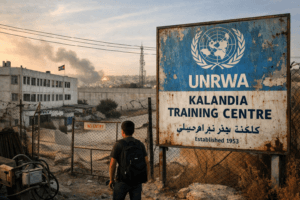
In January 2026, Israeli authorities escalated a campaign to dismantle UNRWA operations in East Jerusalem by notifying the agency of imminent utility cutoffs to ten critical facilities—including schools, health clinics, and the historic Kalandia Vocational Training Centre—following a 2024 Knesset law banning the agency’s activities. This action, which follows the forced closure of a major health centre, directly violates Israel’s obligations under international law as an occupying power and defies a 2025 International Court of Justice order to facilitate UNRWA’s humanitarian work.
The moves threaten to deprive hundreds of thousands of Palestinian refugees of essential education and healthcare, eliminate a major source of employment, and risk creating a destabilizing humanitarian crisis. The international community, including the UN Secretary-General, views this systematic targeting as an assault on the UN’s privileges and immunities and a broader challenge to the international rules-based order, framing the conflict as a clash between a political strategy to dissolve Palestinian refugeehood and the necessity of preserving vital humanitarian infrastructure.
The Unraveling of Hope: How Israel’s UNRWA Closures Strangle a Palestinian Future
“If they do, a lot of students won’t be able to keep learning,” says 18-year-old Nooreddin Saba’e, training to be an electrician at a UNRWA vocational school. “It will make getting this education really difficult.”
In January 2026, a stark notice arrived at the offices of the United Nations Relief and Works Agency (UNRWA) in Jerusalem: within 15 days, the power and water to ten of its critical facilities would be cut off. Among them stands the historic Kalandia Training Centre, a vocational school that for over 70 years has been a lifeline for generations of Palestinian refugees. This move, enacted through recent Israeli legislation, represents a dramatic escalation in a systematic campaign to dismantle UNRWA’s operations in East Jerusalem and the West Bank, directly challenging international law and threatening to extinguish educational and healthcare services for hundreds of thousands.
This is not an isolated bureaucratic decision but a calculated step in a broader political strategy with profound humanitarian and geopolitical consequences.
1 The Immediate Crisis: A Systematic Shutdown in Jerusalem
The crisis unfolding in East Jerusalem is methodical and multi-pronged, moving beyond rhetoric to concrete, disruptive action against UN facilities.
- Forced Closure of Vital Services: On January 12, 2026, Israeli forces entered the UNRWA Jerusalem Health Centre, ordering its immediate closure for 30 days and demanding the removal of UN signage. This health centre serves hundreds of Palestine refugee patients daily, and for many, it represents their only access to primary healthcare. UN Secretary-General António Guterres strongly condemned this act as an “unlawful entry” and a violation of the UN’s privileges and immunities.
- Utility Cutoffs to Critical Infrastructure: Following an amendment to Israeli law passed on December 31, 2025, utility companies began issuing notices to sever water and electricity to ten UNRWA buildings. The affected facilities include schools, health clinics, administrative offices, and the Kalandia Training Centre. This move has been described by a UNRWA spokesperson as “kind of an anti-humanitarian gesture” and “particularly shocking”.
- Legal Justification and Escalation: These actions are framed as the implementation of legislation passed by the Israeli Knesset in 2024 and amended in late 2025, which bans UNRWA’s activities in Israel. The law itself cites allegations of staff involvement with militant groups, claims that UNRWA vehemently denies and which a UN review found were addressed with “a more robust approach to neutrality than comparable entities”.
Key Facilities Targeted for Utility Cutoffs
The following table summarizes the types of critical UNRWA infrastructure under direct threat in East Jerusalem, highlighting the breadth of services being jeopardized.
| Type of Facility | Primary Service Impact | Vulnerable Population |
| Schools (Multiple) | Primary and preparatory education | Thousands of refugee children |
| Health Clinics (Including Jerusalem Health Centre) | Primary healthcare, chronic disease management | Hundreds of daily patients, often the only option |
| Vocational Training Centers (e.g., Kalandia) | Skills training (mechanics, construction, electrical) | Youth seeking employment |
| Administrative Offices (e.g., Sheikh Jarrah HQ) | Coordination of all humanitarian services | Entire refugee community dependent on UNRWA |
2 Historical Context: From Lifeline to Target
To understand the gravity of the current moment, one must recognize UNRWA’s deep-rooted and unique role. Established by the UN General Assembly in 1949, UNRWA was created to provide direct relief and humanitarian assistance to Palestinians displaced during the 1948 Arab-Israeli war. Its mandate, unique among refugee agencies, has been renewed repeatedly, signifying the international community’s acknowledgment of an unresolved issue.
The Kalandia Training Centre embodies this history. As UNRWA’s oldest vocational training centre, it has operated for over seven decades on land owned by Jordan, physically separated from Jerusalem by Israel’s separation wall. For generations, it has offered courses in diesel mechanics, electrical work, plumbing, and construction—practical skills designed to foster economic self-sufficiency and dignity for refugee youth.
The political perception of UNRWA in Israel, however, has shifted dramatically. Critics, particularly on Israel’s political right, have long argued that the agency perpetuates the refugee issue by allowing refugee status to be inherited by descendants. They also accuse its education materials of fostering hostility and its staff of being compromised by groups like Hamas. These criticisms crystallized into legislative action following the October 2023 Hamas-led attack on Israel, despite a lack of publicly presented evidence for broader organizational complicity.
3 Violations of International Law and Obligations
The international community views Israel’s recent actions not merely as harsh policy, but as direct contraventions of legal frameworks.
- Breach of UN Privileges and Immunities: The Convention on the Privileges and Immunities of the United Nations guarantees the inviolability of UN premises. The forced entry, closure, and seizure of UNRWA facilities flagrantly violate this cornerstone of multilateral diplomacy. Secretary-General Guterres has explicitly stated these actions are “inconsistent with [Israel’s] obligations under international law”.
- Defiance of the International Court of Justice (ICJ): In a striking rebuke, a UNRWA spokesperson noted that in October 2025, the ICJ had “restated in crystal clear fashion that the State of Israel is obliged under international law to facilitate UNRWA’s operations, not hinder or prevent them”. The current campaign of closures and cutoffs is a direct challenge to this judicial order.
- Neglect of Duties as an Occupying Power: Under International Humanitarian Law (IHL), an occupying power has the responsibility to ensure the welfare of the civilian population under its control. By actively dismantling the primary healthcare and education infrastructure for Palestinian refugees in East Jerusalem—occupied territory under international law—Israel is shirking this fundamental obligation. As UNRWA’s Jonathan Fowler stated, if the agency is pushed out, “it is incumbent upon an occupying power to look after the well-being of a population under occupation”.
4 The Human Cost: Education, Health, and Hope Under Threat
Beyond the legal arguments lies an imminent humanitarian catastrophe. The potential collapse of UNRWA’s services would have a devastating, multi-generational impact.
- A Lost Generation of Students: Commissioner-General Philippe Lazzarini has warned that in the West Bank alone, at least 50,000 children could be deprived of education. For families in refugee camps, UNRWA’s free schools are often the only alternative to no education at all. The closure of vocational centers like Kalandia cuts off a critical path to employment, particularly urgent given that West Bank unemployment has skyrocketed to 32% since the war in Gaza began.
- A Public Health Catastrophe: Approximately half a million Palestine refugees in the West Bank could lose access to primary healthcare through UNRWA’s clinic network. For patients like 60-year-old Itaf Shada, a widow with diabetes and high blood pressure, these clinics are a literal lifeline. “For poor people like us, UNRWA is like an artery. It’s what keeps us alive,” she says.
- Economic Collapse and Dependency: UNRWA is the second-largest employer in the West Bank after the Palestinian Authority. Its dissolution would throw thousands out of work, exacerbating poverty and instability. Furthermore, it would erase the institutional knowledge and logistical network built over 75 years, which experts argue “can’t just be replaced overnight”.
5 Global Implications and the Path Forward
This confrontation transcends the Israeli-Palestinian conflict, setting dangerous international precedents.
- A Test for the International Rules-Based Order: The systematic targeting of a UN agency by a member state strikes at the heart of the UN system. As UNRWA’s spokesperson cautioned, “This is something which potentially has global implications because of this pattern of disregard for international law”. If such actions are met with impunity, it weakens the protections for humanitarian work worldwide.
- Diplomatic Reactions and Next Steps: The UN Secretary-General has already elevated the issue to the highest levels, expressing grave concerns directly to the Israeli Prime Minister and briefing the Presidents of the General Assembly and Security Council. The immediate demands from the UN are clear: restore the seized properties, ensure utility services are maintained, and cease all actions that hinder UNRWA’s mandated operations.
- The Stakes: Two Contradictory Visions: Ultimately, this crisis represents a clash between two visions of the future. One, articulated by UNRWA’s critics, seeks to dismantle the agency in the belief that this will dissolve Palestinian refugeehood and its political claims. The other, upheld by the UN and humanitarian advocates, sees the agency as an essential stabilizer, providing education, health, and dignity that are fundamental human rights and prerequisites for any future peace. The closure of the Kalandia Training Centre is a microcosm of this battle—it’s not just about shutting down a workshop, but about extinguishing a decades-long project of fostering practical hope.
The world now watches to see whether the inviolability of UN premises and the rulings of international courts will be upheld, or whether they will be swept aside by unilateral force. The fate of thousands of students, patients, and vulnerable refugees hangs in the balance, awaiting the international community’s response to this profound challenge.
You must be logged in to post a comment.