
The Unraveling of a Maestro’s Legacy: Zubin Mehta’s Political Stand and its Resonance in a Divided Israel
In a significant cultural and political statement, renowned conductor Zubin Mehta, the non-Israeli former music director of the Israel Philharmonic Orchestra for half a century and a rare recipient of the Israel Prize, has canceled all his upcoming engagements in Israel, explicitly citing his objection to Prime Minister Benjamin Netanyahu’s policies toward Palestinians and expressing hope for a change in leadership. This decision, stemming from his belief that art cannot be separated from politics, represents a profound rupture of a deep, decades-long relationship and serves as a potent symbolic protest from within Israel’s own cultural establishment.
By aligning himself with other dissenting artists like Daniel Barenboim and highlighting his work with the integrated West-Eastern Divan Orchestra, Mehta frames his boycott not as a rejection of Israel itself but as a moral stance against its current political direction, forcing a difficult conversation about complicity, the conscience of the artist, and the limits of cultural diplomacy in the face of enduring conflict.
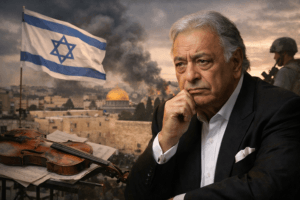
The Unraveling of a Maestro’s Legacy: Zubin Mehta’s Political Stand and its Resonance in a Divided Israel
A Conductor’s Protest: More Than a Cancellation, a Cultural Reckoning
The recent announcement by Zubin Mehta, the legendary conductor and former musical director of the Israel Philharmonic Orchestra (IPO), to cancel all his engagements in Israel marks a profound moment in the intersection of art, politics, and identity. This isn’t merely a scheduling change or a personal boycott; it is the fracturing of a half-century relationship, a symbolic rupture that echoes far beyond the concert hall. Mehta’s decision, explicitly tied to his condemnation of Prime Minister Benjamin Netanyahu’s policies toward Palestinians, forces a uncomfortable conversation about the limits of cultural diplomacy, the conscience of the artist, and the price of speaking out.
For decades, Mehta embodied a bridge. An Indian-born Parsi conductor who led one of Israel’s most cherished cultural institutions for 50 years, his story was one of harmonious contradiction. He was the non-Jewish maestro who became an Israeli cultural icon, awarded the special Israel Prize—an honor rarely bestowed on non-citizens—in 1991. His tenure with the IPO was not just a job; it was a love affair with a nation and its orchestra, through wars, intifadas, and periods of fleeting hope. This deep history is what makes his current stance so powerfully resonant and painfully significant. When a figure so deeply woven into the fabric of Israel’s cultural narrative steps away in protest, it signals a disillusionment that cannot be easily dismissed.
The Weight of a 50-Year Bond: Why Mehta’s Voice Carries Unique Gravity
To understand the impact of Mehta’s protest, one must appreciate the depth of his connection to Israel. Appointed music advisor in 1969 and music director in 1977, his leadership spanned generations. He wasn’t a distant international star making occasional guest appearances; he was a foundational pillar. He guided the orchestra’s artistic growth, shared in the nation’s collective traumas and triumphs, and performed in bunkers during the Gulf War. This insider status grants his criticism a particular weight. It comes not from a place of outsider ignorance or prejudice, but from intimate, decades-long observation and engagement.
His receipt of the Israel Prize was framed as “recognition of his devotion to Israel and the IPO.” That word—”devotion”—is key. His current actions are framed not as an abandonment, but as a painful, perhaps even heartbreaking, intervention by someone who feels that devotion compromised by the nation’s political direction. It is the voice of a disappointed friend, which often carries more sting than that of a critic.
The Unavoidable Intersection: When Artists Choose to Engage Politically
Mehta’s firm rejection of the idea that music can be separated from politics places him squarely in a longstanding, contentious debate. The “art for art’s sake” argument posits that culture exists in a transcendent realm, offering respite and unity beyond political fray. Yet, many artists throughout history, from Picasso’s Guernica to Dylan’s protest songs, have argued that silence in the face of injustice is itself a political act.
In the specific context of Israel, this tension is magnified. The state has long utilized cultural achievements as a cornerstone of its soft power and international branding—a narrative of a vibrant democracy and artistic haven in a troubled region. Figures like Mehta were central to that narrative. His withdrawal undermines that project, suggesting that the reality on the ground—the “occupation,” as he terms it—has become so morally untenable that continuing cultural business as usual is complicity.
He notably aligns himself with other artist-dissenters like Daniel Barenboim, who has faced significant backlash in Israel for his political stances, including performing Wagner and accepting Palestinian citizenship. By citing his work with the West-Eastern Divan Orchestra—the ensemble of Israeli and Arab musicians founded by Barenboim and Edward Said—Mehta points to an alternative model. This orchestra, where musicians “sit together, get along well, and make music without any problems,” serves as a living metaphor for the coexistence he finds absent in current policy. It proves, in his view, that the barriers are political, not human.
The Core of the Critique: Netanyahu’s Policies and the Call for Change
Mehta’s comments are direct and personal, focusing squarely on Netanyahu. His hope that the Prime Minister is “outvoted at the next election” moves his statement from generalized criticism to explicit political advocacy. This specificity is significant. He is not rejecting Israel itself—his life’s work testifies to a deep connection to the country—but a specific leadership and its approach to the Palestinian issue.
His reference to his early encounter with antisemitism in Vienna adds a poignant layer. It suggests a lifelong awareness of the dangers of prejudice and exclusion, framing his stance on Palestinian treatment as an extension of that sensitivity. For a man who experienced the ugliness of bigotry, watching policies he perceives as oppressive is, perhaps, an intolerable contradiction to the values he believes art and Israel should represent.
The Ripple Effect: What This Means for Israel’s Cultural Landscape
The immediate consequence is the loss of Mehta’s baton in Israeli concert halls—a significant artistic blow. But the long-term implications are more nuanced.
- Within Israel: The reaction will likely be polarized. Some will view him as a traitor to an institution he helped build, leveraging his cultural stature to unfairly pressure Israel on a complex security and political issue. Others, particularly in the arts and left-leaning circles, may see him as a courageous voice validating their own concerns, highlighting the growing alienation of parts of the liberal cultural elite from the government.
- Internationally: Mehta’s stance adds a powerful, credentialed voice to the informal chorus of artists and academics who advocate for cultural engagement to be contingent on political change. It provides a potent reference point for others considering similar actions, making it harder to dismiss such boycotts as rooted in antisemitism or ignorance when a figure of Mehta’s historic pro-Israel devotion leads the way.
- For the IPO: The orchestra faces a delicate balancing act. It must honor its profound history with Mehta while navigating the political sensitivities his comments ignite. It underscores the tightrope walk cultural institutions in Israel must perform between artistic independence, national identity, and political reality.
Beyond the Headlines: The Enduring, Painful Questions
Zubin Mehta’s decision ultimately forces us to confront difficult questions with no easy answers:
- What is the debt of the artist to society? Is their primary duty to their art, providing beauty and escape, or to their conscience, using their platform to speak against perceived injustice?
- Can cultural bonds survive political rupture? Mehta’s 50-year relationship with Israel was thought to be unbreakable, built on mutual love for music. His protest shows that even such deep ties have a breaking point when core moral convictions are challenged.
- Where is the line between legitimate criticism and harmful isolation? Does withdrawing cultural engagement pressure change or merely foster bitterness and isolation? Does dialogue, as exemplified by the West-Eastern Divan Orchestra, require a foundation of political approval, or can it exist in spite of it?
Zubin Mehta’s canceled concerts are more than empty dates on a calendar. They are the silence where music once was—a silence that speaks volumes. It tells a story of a fractured love, a principled stand, and the relentless intrusion of a painful political conflict into the world of artistic harmony. Whether one agrees with his politics or not, his action underscores a sobering truth: in regions of enduring conflict, the concert hall is never truly an escape. It is a reflection, and sometimes, a battleground for the very ideals a society strives to embody. The maestro has left the podium, but the dissonant chord he has struck will resonate for a long time to come.
You must be logged in to post a comment.