
The Unraveling Lifeline: How UNRWA’s Struggle in Gaza Holds a Key to Peace
UNRWA serves as a critical lifeline and de facto public service provider for millions of Palestinian refugees, particularly in Gaza where it delivers half of all services, yet it faces an existential crisis fueled by severe funding cuts, political opposition, and direct challenges to its operations.
The agency’s schools and clinics represent stability amid devastation, but attempts to dismantle it risk creating a dangerous vacuum that could undermine both humanitarian relief and the fragile political transition. As a temporary institution marking 75 years of operation due to the unresolved conflict, UNRWA’s struggle underscores the tension between immediate human needs and long-term political solutions, with its potential collapse threatening not only essential aid but also any foundation for lasting peace in Gaza.
The Unraveling Lifeline: How UNRWA’s Struggle in Gaza Holds a Key to Peace
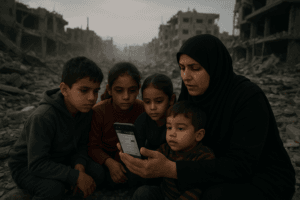
In a scene that captures the surreal reality of life in Gaza, five children huddle around a single mobile phone. Their mother reads aloud WhatsApp messages from a teacher, distributing homework to a classroom that no longer physically exists. This image of education persevering amid devastation is not just a story of resilience; it’s a glimpse into the daily operations of the United Nations Relief and Works Agency (UNRWA), an organization now finding itself at the epicenter of a deepening humanitarian and political crisis.
Two months after a fragile ceasefire took effect in the Gaza Strip, the conditions on the ground remain catastrophic. For over two million residents, the cessation of active bombing has not meant a return to normalcy, but a continuation of an emergency where basic survival is a daily struggle. Amid this landscape, UNRWA continues its work through more than 12,000 staff members who administer vaccinations, transport drinking water, and attempt to provide some semblance of structure and hope. Yet the agency itself is under unprecedented pressure—facing financial shortfalls, political opposition, and direct challenges to its operations that threaten not just its ability to deliver aid, but its very existence.
The current battle over UNRWA represents more than a typical humanitarian funding crisis. It reflects a fundamental conflict over the future of Gaza and the Palestinian people—a struggle between immediate human needs and long-term political agendas, between preserving a lifeline for millions and redefining the mechanisms of aid and governance in one of the world’s most volatile regions.
The Classroom as Shelter: Education Amid Ruins
Before the latest escalation of conflict, UNRWA operated 180 schools in Gaza. Today, these institutions serve a dual, heartbreaking purpose. At night, mattresses cover classroom floors, providing shelter for a population that has been displaced multiple times. During daylight hours, those mattresses are stacked aside so children and their teachers can gather in circles for lessons in math, science, and Arabic.
This makeshift education system represents what Tamara Alrifai, UNRWA’s Director of External Relations and Communications, calls “a pillar in the lives of Palestinian refugees.” She explains that families see education as “a passport out of vulnerability and poverty. It is probably the one thing that has not been taken away from them”. Since the ceasefire, this commitment to learning has manifested in digital spaces as well, with more than 300,000 children accessing UNRWA’s online learning platforms and nearly a thousand new registrations occurring each day.
The determination to continue education amid such circumstances speaks to a profound understanding among Palestinian refugees that knowledge represents not just personal advancement, but preservation of identity and future possibility. In a territory where over 80% of housing units have been destroyed and famine was officially declared in August, the classroom—whether physical or virtual—remains one of the few spaces where normalcy can be simulated and future horizons imagined.
A Vacuum in the Making: The Political Battle Over Aid
The humanitarian needs in Gaza are overwhelming—“the people of Gaza need everything,” Alrifai states bluntly. Yet behind the immediate crisis of food, medicine, and shelter lies a more complex political struggle with profound implications for Gaza’s future.
Historically, UNRWA has provided nearly half of all public services in Gaza, with the Palestinian Authority administering the remainder. This arrangement created what Alrifai describes as an almost “governmental” role for the agency in the lives of Palestinian refugees not just in Gaza, but across five operational areas: the West Bank, Syria, Jordan, and Lebanon. Today, this arrangement is being directly challenged.
“We are witnessing concrete attempts to prevent UNRWA from operating in Gaza,” Alrifai warns. “This would remove half of the public-service sector and create a dangerous vacuum”.
This concern takes on particular urgency in the context of reconstruction planning. The international community recognizes that rebuilding Gaza’s shattered infrastructure must be linked to a political process that ensures stability. UNRWA points to the New York Declaration, which outlines a path toward establishing a Palestinian state encompassing both the West Bank and Gaza, and explicitly confirms UNRWA’s role until such a state becomes fully functional.
The attempt to marginalize or replace UNRA occurs alongside other troubling developments. In January, Israel enacted a law banning UNRWA activities in areas “considered by Israel under its control” and revoked entry visas for all UNRWA staff. Then, on December 8, Israeli police entered the agency’s East Jerusalem compound in Sheikh Jarrah, seizing computers and equipment under the pretext of alleged unpaid taxes.
The United Nations responded with unusual force. Secretary-General António Guterres “strongly condemns the unauthorized entry” and emphasized that UN premises are “inviolable and immune from any other form of interference” under international conventions. The incident saw Israeli police motorcycles, trucks, and forklifts enter the compound, with communications cut and the UN flag replaced by an Israeli flag.
The Funding Crisis: Political Decisions with Human Consequences
The operational challenges UNRWA faces are compounded by a severe financial crisis. The agency now contends with a 25% budget loss, primarily due to cuts in U.S. funding and the withdrawal of several major donors. This funding crisis is partly driven by what Alrifai describes as “unverified accusations of links to terrorist organisations”.
The financial situation reflects a broader pattern that extends beyond Gaza. According to UN humanitarian officials, global humanitarian funding has reached crisis levels, with resources received for 2025 appeals being “the lowest in a decade”. This has resulted in humanitarians reaching 25 million fewer people than in the previous year.
For UNRWA specifically, the consequences of underfunding are immediate and severe. The agency’s schools, health clinics, and food distribution centers serve approximately 5.9 million Palestinian refugees across the Middle East. When funding drops, services are curtailed precisely when needs are most acute.
This financial pressure has sparked diplomatic mobilization. At a UN General Assembly meeting in September 2025, several nations made impassioned pleas for support. Jordanian Foreign Minister Ayman Safadi warned bluntly that “UNRWA is collapsing,” while UN Secretary-General António Guterres called the agency “irreplaceable” and “indispensable”.
Interestingly, some diplomats have framed the funding debate in political terms. Spanish Foreign Minister Jose Manuel Albares suggested that “countries that do not like the UNRWA works should push for the establishment of a Palestinian state that would take on UNRWA’s tasks”. This argument highlights the paradoxical situation: those most critical of UNRWA’s permanent refugee services are often least supportive of the political solution—a Palestinian state—that would make those services unnecessary.
The West Bank Parallel: A Deteriorating Situation
While international attention focuses on Gaza, conditions in the West Bank have deteriorated sharply. “What we saw in 2025 is the highest level of settler violence against Palestinians, especially during the olive harvest, along with the highest number of Israeli security operations inside Palestinian cities,” Alrifai reports.
This violence has produced its own displacement crisis, with residents of the Jenin and Tulkarem refugee camps forced from their homes. UNRWA has responded by quickly admitting these displaced refugees into programs in nearby cities, but as Alrifai notes, “the fact remains that they were forced from their homes”.
The situation in the West Bank demonstrates how UNRWA’s role extends beyond immediate humanitarian response to providing continuity of services amid instability. When violence erupts and populations are displaced, the agency’s existing infrastructure and personnel can be mobilized to provide shelter, food, and medical care—a capacity that would not exist without the agency’s permanent presence in these communities.
The Seventy-Five Year Question: Temporary Solution or Permanent Necessity?
December 2025 marks a significant milestone for UNRWA—75 years since the agency’s founding in the aftermath of the 1948 Arab-Israeli war. The occasion is both a testament to endurance and a reminder of political failure.
Last week, the UN General Assembly voted overwhelmingly to renew UNRWA’s mandate for another three years. While Alrifai finds it “encouraging to know that most of the world supports UNRWA,” she also expresses the painful reality that “every three years, a temporary agency created in 1950 must be renewed because the original problem remains unresolved”.
This temporal paradox lies at the heart of the UNRWA dilemma. Designed as a temporary solution to what was hoped would be a temporary displacement, the agency has instead become a permanent institution because the political issues underlying the refugee crisis remain unresolved. With each mandate renewal, the international community effectively acknowledges the continued failure to achieve a political solution while recognizing the immediate humanitarian necessity of maintaining services for millions of vulnerable people.
Between Humanitarian Need and Political Solution
The core tension surrounding UNRWA pits immediate humanitarian imperatives against long-term political visions. From a purely humanitarian perspective, the agency’s value is unquestionable. In Gaza alone, despite immense obstacles, UNRWA and its partners have managed significant achievements since the ceasefire:
- Healthcare access has improved, with 30 organizations now providing services in northern Gaza—nearly double the pre-ceasefire number.
- Vaccination sites have increased from 22 to 33 across the Strip.
- Food assistance reached an additional 100,000 people in December.
- Educational infrastructure is slowly being restored, with 65 classrooms fully rehabilitated and repairs nearing completion on 18 more.
Yet these humanitarian efforts occur within a political context that increasingly views UNRWA not as a neutral aid provider, but as an obstacle to particular political outcomes. The agency’s very existence acknowledges the unresolved status of Palestinian refugees—a recognition that some political actors would prefer to avoid.
The Path Forward: Vacuum or Foundation?
As international calls for transforming the ceasefire into lasting peace intensify, Alrifai argues that “this is the worst time to create a vacuum within a traumatised population”. The question facing the international community is whether UNRWA will be supported as a stabilizing foundation during political transition or dismantled to create a vacuum that other forces might fill.
The practical challenges of replacing UNRWA are formidable. The agency’s 12,000 staff in Gaza alone represent institutional knowledge, community trust, and logistical capacity that cannot be quickly replicated. As UNRWA chief Philippe Lazzarini noted, these staff continue providing “health services, doing nutritional screening for the children, ensuring access to clean water, managing shelters, [and] providing… psychosocial support to the children” against all odds.
Perhaps the most poignant perspective comes from considering what UNRWA represents to those it serves. For Palestinian refugees, the agency is more than a service provider—it is one of the few tangible connections to an international system that has repeatedly failed to resolve their plight. Its schools, health clinics, and food distributions represent a promise that, even in the absence of a political solution, the world has not completely abandoned its responsibility.
As children in Gaza continue their lessons on mobile phones and in makeshift classrooms, they embody both the tragedy of the present and the hope for a different future. Their education, facilitated by an agency now fighting for its survival, represents the belief that knowledge and normalcy can be preserved even amid chaos. Whether this belief will be supported or undermined may well determine not just the future of UNRWA, but the trajectory of Gaza itself in the critical period ahead.
The international community now faces a choice with profound implications: preserve the primary institutional connection to Gaza’s population during a fragile transition, or risk creating precisely the vacuum that has historically been filled by extremism and renewed conflict. In this decision, humanitarian concern and political wisdom point in the same direction—toward sustaining the lifeline that, for millions, represents the difference between despair and the possibility of a better future.
You must be logged in to post a comment.