
The Unquiet Borders: Gaza’s Fragile Truce and Lebanon’s Simmering Front
Despite a fragile ceasefire holding in Gaza, tensions are escalating on Israel’s northern border with Lebanon, as Hezbollah leader Naim Qassem defiantly declared the group will not disarm despite intensifying Israeli airstrikes aimed at preventing its re-arming.
While Gaza sees a tentative calm, allowing for critical humanitarian efforts like a UN vaccination campaign, the underlying conflict remains unresolved, underscored by the grim exchange of the body of an Israeli soldier killed in 2014 for hundreds of Palestinian bodies. Israeli Prime Minister Benjamin Netanyahu reinforced this instability, stating the war “has not ended” and vowing to demilitarize Gaza, even as his meeting with Jared Kushner signaled ongoing high-level political maneuvering, creating a precarious landscape where the conflict is not concluding but merely shifting fronts.
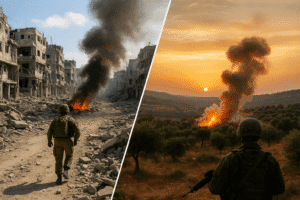
The Unquiet Borders: Gaza’s Fragile Truce and Lebanon’s Simmering Front
Meta Description: As a fragile ceasefire holds in Gaza, Israel’s northern border with Lebanon erupts with new violence. This deep dive analyzes Hezbollah’s defiance, Netanyahu’s unresolved war, and the precarious political landscape shaping the Middle East.
Introduction: A Tale of Two Fronts
While the guns have largely fallen silent in Gaza under a tentative ceasefire, the Middle East remains a tinderbox. The recent identification of the body of Israeli soldier Hadar Goldin, killed in 2014, is a stark reminder that the conflicts in this region are never fully buried; they are exhumed, traded, and leveraged in an endless cycle of grievance and retribution. This single event, while bringing a measure of closure to one family, underscores a much larger, unresolved reality: the war of narratives and weapons is merely shifting venues, not concluding.
South of the Litani River in Lebanon, the air once again fills with the smoke of Israeli airstrikes. In Jerusalem, a prime minister declares the war is not over, even as a former U.S. presidential adviser meets with him, signaling the enduring geopolitical stakes. This is not a post-war environment; it is an interwar one, characterized by fragile calm in one arena and escalating violence in another. The central question is no longer just about Gaza’s future, but whether a broader regional conflagration can be avoided.
Hezbollah’s Defiance: The Unyielding Stance of the “Resistance”
The most potent signal of escalating tensions comes from Lebanon. Hezbollah Deputy Secretary-General Naim Qassem’s recent declaration that the group “will not disarm despite pressure from Israeli strikes” is more than just rhetoric; it is a fundamental statement of identity and purpose. For Hezbollah, its extensive arsenal is not merely a military tool but the very source of its political power and its claimed legitimacy as the vanguard of “resistance” against Israel.
The intensifying Israeli strikes in southern Lebanon, which the IDF claims target “Hezbollah terrorists” and their infrastructure, represent a calculated pressure campaign. Israel’s goal appears to be to enforce the terms of UN Security Council Resolution 1701—which called for the disarmament of all militant groups in Lebanon—by force, since diplomacy has failed for nearly two decades. By striking deeply within Lebanon, Israel aims to degrade Hezbollah’s capabilities and raise the cost of its belligerence.
However, Qassem’s speech makes it clear this strategy may be counterproductive. His framing of the conflict as a defense of “our land, our people, and our dignity” positions any concession on disarmament as a national humiliation. In the complex tapestry of Lebanese politics, where Hezbollah is both a state-within-a-state and a major political party, external pressure often strengthens its hand, allowing it to portray itself as Lebanon’s sole defender. This creates a dangerous feedback loop: more Israeli strikes fuel Hezbollah’s narrative of defiance, justifying its arms cache and ensuring the cycle of violence continues.
Gaza’s Fragile Calm: The Grim Arithmetic of the Dead
While Lebanon simmers, Gaza exists in a state of exhausted and devastated limbo. The ceasefire may be “broadly holding,” but the underlying issues that sparked the war remain entirely unaddressed. The return of Hadar Goldin’s body, and the belief that four other deceased Israeli hostages remain in Gaza, highlights one of the most painful and intractable aspects of this conflict: the use of human remains as bargaining chips.
The exchange—Goldin’s body for the return of 300 Palestinian bodies to Gaza—is a macabre transaction that reveals the depth of the animosity. For Israel, the principle of bringing every soldier home, dead or alive, is sacrosanct. For Hamas, the bodies of militants and civilians held by Israel are potent symbols of the ongoing struggle and a currency for negotiation. That only 89 of the 300 returned bodies have been identified, according to Gaza’s Health Ministry, speaks volumes about the chaos and destruction on the ground, where record-keeping is a casualty of war and many families have been wiped out.
Beneath this grim exchange lies a humanitarian catastrophe that the ceasefire has only begun to ameliorate. The UN’s launch of a vaccination campaign for 44,000 children is a critical step, but it also exposes the desperate state of Gaza’s public health. The statistic that one in five children under three is either unvaccinated or has missed doses is a ticking time bomb. The threat of measles or polio outbreaks in crowded, makeshift displacement camps could claim more lives than the recent violence. As UN official Tom Fletcher stated, while aid efforts are making a difference, “many obstacles remain.” The road to recovery is not just paved with good intentions but with the need for open crossings, the absence of red tape, and a lasting political solution.
Netanyahu’s Unfinished War: Political Survival and Strategic Ambiguity
In the midst of this, Israeli Prime Minister Benjamin Netanyahu’s declaration to the Knesset that “the war has not ended” serves multiple purposes. On a strategic level, it is a warning to Hamas and the world that Israel will not tolerate the group re-arming in Gaza. His vow that “Gaza will be demilitarized” and that “it will either happen the easy way, or it will happen the hard way” sets a clear, if ambiguous, red line.
However, this stance is deeply intertwined with domestic politics. For Netanyahu, perpetual conflict management has long been a strategy for political survival. Declaring the war “not ended” allows him to deflect tough questions about the war’s initially stated objectives, the intelligence failures of October 7th, and the lack of a coherent “day after” plan for Gaza. It frames him as the indispensable security hawk in a dangerous world, a narrative he is likely to leverage in any future election.
The simultaneous meeting with Jared Kushner is highly symbolic. It signals to both a domestic and international audience that Israel retains strong, if unofficial, ties with influential figures in the likely event of a second Trump administration. It keeps alternative diplomatic channels open, separate from the current Biden-led efforts, and reinforces Netanyahu’s image as a global statesman navigating complex alliances.
The Northern Front: A Wider War in the Making?
The escalating situation in Lebanon poses the most significant threat of a wider regional war. The Israeli-Lebanese border has been a flashpoint since the Gaza war began, but the recent intensification of strikes is alarming. The IDF’s claim to have killed over 330 Hezbollah operatives since the November 2024 ceasefire indicates a low-level war of attrition that is steadily escalating.
Each “targeted strike” risks miscalculation. The death of a senior commander, a strike that causes mass civilian casualties, or an attack deep inside Beirut could force Hezbollah’s hand, compelling it to unleash its vast arsenal of rockets in a way it has so far carefully calibrated to avoid. For Israel, the presence of a well-armed Iranian proxy on its border is an unacceptable threat. The current strategy seems to be one of preemptive degradation, but it walks a razor’s edge between deterrence and provocation.
Conclusion: The Illusion of Peace and the Reality of Managed Conflict
The current moment in the Middle East is one of managed conflict, not peace. Gaza is being patched up just enough to prevent a total collapse, while the core issues of governance, security, and reconstruction are deferred. Meanwhile, the epicenter of violence is simply shifting north, where the same underlying dynamics—a non-state actor with a powerful militia, a state determined to project strength, and a population trapped in the middle—are playing out with even higher stakes.
The return of a soldier’s body after eleven years is a powerful, poignant event. But in the grand calculus of this conflict, it is also a transaction that fuels the next phase of confrontation. Until the root causes are addressed—the political vacuum in Gaza, the armed hegemony of Hezbollah in Lebanon, and the absence of a viable political horizon for Palestinians—the region will remain trapped in this brutal cycle. The quiet in Gaza is merely the eye of the storm, and the thunder gathering in Lebanon suggests the other half is yet to come.
You must be logged in to post a comment.