
The Unquenchable Fire: Why Palestine Remains the Epicenter of a Shattered Middle East
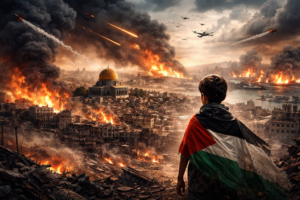
The Unquenchable Fire: Why Palestine Remains the Epicenter of a Shattered Middle East
The headlines are a blur of escalating chaos. In the first months of 2026, the world watches as strikes rain down on Iran, its retaliatory salvos sending the Gulf into a state of paralytic seizure. Global energy markets convulse, and the threat of a wider, uncontainable war feels more real than it has in decades. To the casual observer, it’s a volatile cocktail of ancient sectarian rivalries, nuclear ambitions, and aggressive realpolitik, stirred by the erratic hand of a second Trump administration. It is bewildering, terrifying, and seemingly senseless.
But beneath the surface of this strategic fog, there is a clear, gravitational pull. A single, unresolved injustice binds every seemingly disparate thread of this crisis. As Nesrine Malik powerfully argues, the thread that binds the war in Iran, the chaos in the Gulf, and the rising tide of repression in the West is Palestine. To understand the fire sweeping the region, one must first understand its original, unquenched spark.
For a moment—a fleeting, delusional moment—it seemed the world had successfully managed the “Palestine problem.” The strategy, spearheaded by the United States and embraced by a cadre of regional powers, was one of containment and circumvention. The Abraham Accords were its shining monument, a promise of a “New Middle East” where economic prosperity and security cooperation would render the plight of the Palestinians obsolete. The logic was brutally pragmatic: build a coalition against Iran by enticing Arab states with advanced technology, security guarantees, and investment. In this new paradigm, the Palestinian Authority would be a footnote, their demands for statehood a minor irritant to be managed with empty rhetoric and the illusion of a stalled peace process.
This was the bet. The UAE and Bahrain normalized relations with Israel, followed by others, banking on the stability of the Pax Americana. The belief was that the occupation of the West Bank, the blockade of Gaza, and the systematic denial of Palestinian rights could be quarantined—a chronic, low-grade ailment that would not infect the healthy body of the new regional order. It was a philosophy of separation, a belief that security could be built around an injustice, rather than by resolving it.
October 7, 2023, was the day that illusion was shattered. The attack was many things—a horrific act of violence, a catastrophic intelligence failure—but above all, it was a violent, undeniable reinsertion of Palestine onto the center stage of Middle Eastern politics. It was proof that the most carefully constructed security architecture is vulnerable if it is built on a foundation of unresolved human suffering.
What followed was not just a war in Gaza, but a cascade of consequences that revealed the sheer folly of trying to contain the uncontainable. Israel, in its stated mission to destroy Hamas and secure its borders, expanded its definition of “threat” to include any group backed by its primary antagonist, Iran. This logic, backed by unwavering US support, turned Lebanon and Syria into battlegrounds. Hezbollah, long a deterrent on Israel’s northern border, was drawn into a conflict of attrition that has devastated parts of Beirut and the south. The Israeli military, operating with a freedom enabled by American weaponry and diplomatic cover, has effectively rendered the sovereignty of its neighbors conditional on their ability to control groups it deems hostile.
And now, the logic has reached its terrifying conclusion: a direct confrontation with Iran itself. The strikes on Iranian military and nuclear facilities are framed by Washington and Jerusalem as a necessary step to ensure regional security. But for the billions watching across the Arab world and beyond, the line is unmistakable. The bombing of Tehran is a direct consequence of the bombing of Gaza. The destruction in Isfahan is the echo of the destruction in Jabalia. The children killed in Iran are, in the tragic arithmetic of this conflict, casualties of the same policy that has killed children in Rafah.
Nowhere is the failure of the old “integration” strategy more starkly illuminated than in the Gulf. The very states that signed peace deals with Israel, that opened their skies and their markets, now find themselves in an impossible vice. They are not partners; they are hostages. When Iran retaliates against Israel by striking at US bases on their soil or targeting oil infrastructure in their waters, it is the UAE, Saudi Arabia, and Qatar that pay the price. Their economies, built on stability and global trade, are held ransom to a conflict they were promised would be contained.
The recent threat by Republican Senator Lindsey Graham—that Gulf nations must get more involved in the fight against Iran, “or consequences will follow”—was a moment of shocking, almost comical candor. It stripped away the pretense of partnership and revealed the transactional nature of the relationship. The message was clear: you are our clients, not our allies. Your role is to provide the bases, buy the weapons, and absorb the blowback, all while remaining silent as the stated goal of one of our closest allies is the de facto annexation of Palestinian land. It is a colossal diplomatic slap, a wake-up call to any leader who believed they could buy immunity by normalizing with Israel.
This is the human insight at the core of the geopolitical earthquake. The citizens of the Arab world are not fooled. For them, the images of destruction in Gaza were not a distant tragedy; they were a visceral reminder of a collective wound. The Arab street, long pacified by state-controlled media and the promise of economic prosperity, is stirring. The grumblings in the souks of Amman, the angry social media posts from Dubai, the quiet anxiety in the palaces of Riyadh—they all stem from the same source: the dawning realization that their governments have hitched their futures to a power that sees them as expendable.
This sentiment is the thread that connects the Middle East to the West. The war has not remained in the Middle East; it has been exported through diaspora communities and social media. The student encampments that paralyzed American and British universities in 2024 were not about foreign policy arcana; they were a raw, intergenerational expression of solidarity with a people they saw as experiencing a lived Nakba in real-time. The subsequent crackdowns, the legislative attacks on the right to protest, the surveillance of activists—this is the “repression in the west” that Malik identifies. It is the authoritarian impulse required to silence those who refuse to accept the premise that Palestinian lives are a secondary concern. The conflict is reshaping political landscapes, exposing the limits of free speech, and creating a new, volatile political divide in the very heart of liberal democracies.
Netanyahu’s government, with its stated preference for “managing the conflict” over solving it, has now yoked the entire world to this expanding crisis. The argument that security can be achieved through overwhelming military force, through the destruction of every last militant and the toppling of hostile regimes, has been tried. And it has failed. It fails because it cannot kill an idea. It cannot bomb into submission the demand for justice. The more force is applied, the more the core issue—the statelessness and subjugation of the Palestinian people—radiates outwards.
Even if the improbable happens and the Iranian regime falls, the fundamental problem will remain. The occupation will still be there, a festering wound in the heart of the region. The anger and humiliation will simply find new expressions, new leaders, and new battlefields. The “integration” strategy was an attempt to build a house while ignoring a crack in its very foundation. Now, that foundation is crumbling.
The path back from the abyss is not through more sophisticated military alliances or more devastating bombs. It requires the radical, and for many, unpalatable, recognition that the security of all—Israelis, Arabs, and the world—is inextricably linked to the freedom of the Palestinians. The original sin cannot be managed away; it must be absolved. Until there is a just and lasting peace that grants the Palestinian people their full rights and self-determination, there will be no end to the chaos. The fire will continue to burn, spreading from Palestine to the Gulf to Iran and beyond, consuming everything in its path, because its source was never extinguished. It was only, foolishly, ignored.
You must be logged in to post a comment.