
The Unpunished Killings: How Impunity for Settler Violence Has Become Israel’s New Normal
A Guardian analysis reveals that since 2020, no Israeli citizen has been prosecuted for killing a Palestinian civilian in the occupied West Bank, with the last indictment over a death caused by security forces occurring in 2019 and the last settler prosecution in 2018—a period during which Israeli soldiers and settlers have killed at least 1,100 Palestinian civilians, over a quarter of them children. Dozens of former Israeli military, police, and intelligence chiefs have signed a previously unreported letter warning of “organized activity, which sometimes includes those wearing uniforms,” while former prime minister Ehud Olmert has called for International Criminal Court intervention, saying violent settlers are “assisted, supported and inspired by government circles.” Israeli human rights groups report that over 96% of police investigations into settler violence end without indictment, and less than 1% of complaints against soldiers lead to charges, reflecting a legal system that human rights lawyers say “functions less as mechanisms for justice and more as shields for perpetrators.”
The Unpunished Killings: How Impunity for Settler Violence Has Become Israel’s New Normal
For the first time in more than six years, the question of accountability hangs in the air over the occupied West Bank like the dust that follows an army convoy. Not because justice has finally arrived, but because its absence has become so complete that even Israel’s former security establishment—the very architects of the military occupation—are now sounding alarms that would have been unthinkable a decade ago.
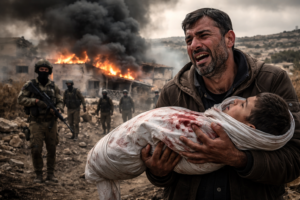
The Guardian’s analysis of legal data and public records reveals a stark reality: since 2020, not a single Israeli citizen has been prosecuted for killing a Palestinian civilian in the occupied West Bank. The last indictment over a death caused by Israeli security forces came in 2019. The last settler prosecuted for killing a Palestinian was in 2018. In a territory where Israeli soldiers and settlers have killed at least 1,100 Palestinian civilians since the beginning of this decade—more than a quarter of them children—the machinery of Israeli justice has simply stopped functioning.
This isn’t a failure of the system. It is, as human rights lawyers and now former security chiefs are acknowledging, what the system was always designed to become.
A Letter That Should Never Have Needed to Be Written
In a public letter to Israel’s current military chief that has not previously been reported, a remarkable coalition of former security commanders demanded urgent action against what they described as “almost daily” attacks on Palestinians. The signatories include two former heads of Israel’s military, one of whom also served as defense minister; five former chiefs of the Mossad and Shin Bet intelligence agencies; and four former police commissioners.
These are not the voices of the international left or Palestinian advocacy groups. These are the men who built and commanded the institutions that now stand accused of complicity in a campaign of violence.
“We are no longer talking about a handful of lawbreaking hooligans,” the letter warned. “This is organised activity, which sometimes includes those wearing uniforms, who shoot at innocent people and burn the property and homes of civilians.”
The framing is deliberate. By invoking “organized activity” involving uniformed personnel, these former commanders are describing something that moves beyond conventional definitions of settler violence. They are describing a fusion of state power with settler ideology—a merger that has transformed what was once a fringe phenomenon into something approaching official policy.
The Numbers That Tell the Story
To understand the scale of impunity, consider the data from Yesh Din, an Israeli human rights organization that has tracked law enforcement responses to settler violence for nearly two decades. Between 2020 and 2025, more than 96 percent of police investigations into settler violence in the occupied West Bank concluded without an indictment. Out of 368 cases, only eight—2 percent—ended with full or partial convictions.
The disparity is even more striking when examining cases involving Israeli security forces. Palestinians submitted 1,746 complaints about harm caused by Israeli soldiers between 2020 and 2024, including more than 600 about killings. Less than 1 percent resulted in indictments.
“The Israeli law-enforcement systems, both civil and military, function less as mechanisms for justice and more as shields for perpetrators,” said Ziv Stahl, director of Yesh Din. “They repeatedly produce stalled investigations and closed cases, effectively prioritising immunity over the rule of law.”
This isn’t merely a statistical anomaly. It represents a fundamental transformation in how Israel’s legal establishment approaches violence against Palestinians. For years, the prosecution of a small number of cases served a dual purpose: it provided a veneer of accountability while insulating Israel from international scrutiny. When a robust national legal system prosecutes crimes, international courts are less likely to assert jurisdiction. The rare indictments were never about justice for Palestinian victims. They were about maintaining a legal shield.
The Collapse of the Performance
“The system is programmed to manufacture impunity, not accountability,” said Michael Sfard, an Israeli human rights lawyer who has spent decades representing Palestinian victims of settler violence. “But it was smart enough to also have very rare occasions of accountability, that could be referred to as examples of how law enforcement was working.”
That performance has now collapsed. Under pressure from a far-right government and facing intense political backlash over even the suggestion of prosecuting Israeli citizens for violence against Palestinians, judges and prosecutors have largely abandoned the pretense.
“It is too costly,” Sfard said of prosecuting such cases. “We’re not paying a price internationally for the impunity. And they are paying a price internally for this performance of accountability, which is anyway a lie.”
The lie is now exposed. But the exposure brings no comfort to the families of the 1,100 Palestinians killed since 2020—including, this month alone, brothers aged five and seven and their parents, all shot in the head as the family returned from a Ramadan shopping trip.
An Uncomfortable Legacy
The former security chiefs now calling for action against settler violence face a difficult question that the article raises but cannot fully resolve: why should anyone trust their sudden concern?
As Amjad Iraqi, senior Israel/Palestine analyst at the International Crisis Group, observed: “Palestinians might welcome this Israeli criticism, but they have not forgotten that many of these former officials facilitated the expansion of the settlement enterprise, and with it settler and military violence.”
The Israeli settler population in the occupied West Bank has increased steadily for several decades, including during the periods when these same security elites held positions of command or political power. The settlements are not a recent phenomenon or a product of the current far-right government. They are a project of the Israeli state that was shaped and led across the political spectrum—including by many of the men now expressing alarm.
“Such Israeli critics often give the impression that settler violence could be tamed by simply ousting the far right government,” Iraqi said. “That would certainly have an effect, but it doesn’t recognise that the settlements are a project of the state that was shaped and led across the political spectrum.”
This distinction matters. The current crisis is not simply the result of extremists seizing control of Israeli policy. It is the logical culmination of decades of state policy that prioritized settlement expansion over the rights and lives of Palestinians. The violence is not a deviation from the system. It is the system operating without its former constraints.
The International Question
It is in this context that former prime minister Ehud Olmert’s call for intervention by the International Criminal Court takes on particular significance. Olmert, who served as prime minister from 2006 to 2009 and oversaw settlement expansion during his tenure, now says he has “decided not only to not remain silent, but to draw the attention of the ICC in The Hague so that it may take enforcement measures and issue arrest warrants.”
His focus is on civilian settlers whom he says are “assisted, supported and inspired by government circles” as they wage a campaign of ethnic cleansing. The pogroms in Palestinian villages, he said, are reminiscent of those “once directed against Jews in Europe.”
“If law enforcement authorities in Israel do not fulfil their duty, perhaps international legal authorities will do what is necessary to save the Palestinians and us from the criminal acts being committed by Jewish terrorists right in front of all our eyes.”
The irony is not lost on observers. Olmert, like many of the security chiefs now speaking out, represents a political class that spent decades building the very infrastructure of occupation that has now spiraled beyond its control. His appeal to international courts—once the great fear of Israeli policymakers who saw the ICC as a threat to the state’s legitimacy—signals a recognition that the domestic mechanisms of accountability are not just broken but have been deliberately dismantled.
A System Designed to Protect
The former justice ministers from Benjamin Netanyahu’s own Likud party who signed a February letter accusing the current government of allowing the “active and horrific ethnic cleansing” of Palestinians in the occupied West Bank add another dimension to the crisis. Dan Meridor and Meir Sheetrit, both of whom served as justice minister for Likud, joined more than 20 prominent legal figures in warning that “anyone who lends a hand to these attacks, by deed or omission, bears responsibility.”
“The ultimate legal and moral responsibility for stopping this campaign of terror lies with the Israeli government,” their letter said. “It is not doing so.”
The statement from within Netanyahu’s own political camp underscores how far the situation has evolved. When former Likud justice ministers use the term “ethnic cleansing” to describe what is happening in the West Bank, the political center has shifted in ways that cannot be dismissed as fringe criticism.
What Comes Next
Israel’s military chief, Eyal Zamir, last week demanded action against settler violence, calling on “all authorities in the country to act against this phenomenon and stop it before it is too late.” Whether his call will produce any meaningful response remains to be seen. The military has sovereignty over occupied territory, but it has shown little appetite for confronting settlers or restraining the soldiers who increasingly act in concert with them.
For Palestinian families in the West Bank, the pattern is painfully familiar. Each killing generates headlines, international condemnation, and promises of investigation. Each investigation concludes without charges. Each conclusion reinforces the lesson that Israeli lives have value that Palestinian lives do not.
The funeral of the four members of the same family killed this month—the parents and their two young sons, all shot in the head—drew international attention. But attention, as Palestinians have learned over decades of occupation, is not the same as accountability.
The former security chiefs now calling for action may be motivated by genuine concern about where Israeli society is heading. Their warnings about the erosion of the military’s “moral strength” and the existential threat posed by lawlessness may be sincere. But for the families who have buried children killed by Israeli soldiers and settlers, the concern arrives too late.
The question now is whether the international community will fill the vacuum that Israel’s legal system has created. Olmert’s appeal to the ICC represents a remarkable inversion of Israel’s traditional stance. But even if the court acts, the process will be slow, the outcomes uncertain, and the victims already buried.
In the meantime, the system continues to function as designed. Investigations are opened, files are closed, and the killing continues. The only thing that has changed is that the people who built the system are now admitting, in public letters and carefully worded statements, that they can no longer pretend it was ever about justice.
You must be logged in to post a comment.