
The Unlikely Architects: How Indian Doctors Built a Global Currency of Trust
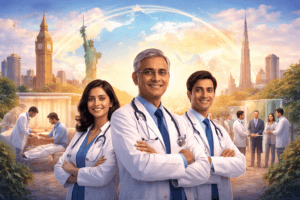
The Unlikely Architects: How Indian Doctors Built a Global Currency of Trust
We often speak of soft power in terms of cultural dazzle—the global sweep of a K-pop anthem, the universal reach of a Hollywood blockbuster, or the addictive pull of a Turkish drama. But what if the most potent form of soft power isn’t about consumption, but about competence? What if it’s built not in recording studios or on film sets, but in the quiet, urgent rooms of hospitals and clinics, through relationships forged in vulnerability and care? This is the story of India’s most powerful, and perhaps accidental, export: trust. And its primary architects were not diplomats or artists, but generations of Indian doctors.
The Foundation: Stethoscopes and Stereotypes
Picture a National Health Service (NHS) surgery in 1970s Britain, in a gritty, industrial town. The local physician isn’t a caricature from a Dickens novel but a diligent young graduate from Delhi or Chennai. This was arithmetic, not accident. From the 1950s onward, Indian doctors arrived to fill a desperate void. British medical graduates were fleeing to North America for better pay, leaving the nascent NHS—a monumental social project—on the brink.
These Indian doctors didn’t gravitate towards London’s prestigious teaching hospitals. They went where they were needed most: to the underserved mining villages of Wales, the struggling northern mill towns, the overnight geriatric wards. For decades, they formed the backbone of primary and secondary care in communities often neglected by the domestic workforce. They became “Dr. Patel” or “Dr. Sharma”—not exotic curiosities, but the steady hands who delivered generations, managed chronic illnesses, and provided a pillar of consistency.
This was intimacy at scale. Trust isn’t built through propaganda or marketing; it’s built when a family places a life in your hands. Over millions of such interactions—night calls, difficult diagnoses, moments of profound grief and joy—a narrative was quietly rewritten. The Western perception of India, often mired in colonial-era tropes of poverty and mysticism, began to pivot. “Made in India” was no longer just about jute or tea; it became synonymous with reliability, expertise, and compassionate skill.
The Ripple Effect: From Wards to Boardrooms
The trust capital amassed by these physicians did not remain confined to healthcare. It created a psychological runway for the waves of Indian professionals that followed. When the Y2K panic hit in the late 1990s and Western corporations needed legions of software engineers to debug archaic code, they turned to India. Was this a blind gamble? Not entirely. The corporate decision-makers of that era were often the very people whose lives, or whose parents’ lives, had been touched by those Indian doctors. A subconscious link had been forged: Indians were problem-solvers you could trust with critical systems.
The engineers who fixed the millennium bug proved that Indian technical prowess could safeguard global infrastructure. This paved the way for the rise of Indian IT giants like Infosys and TCS, and more importantly, for individual talent to rise within Silicon Valley. The trajectory is a logical cascade:
- Doctors proved Indians could be trusted with lives.
- Engineers proved Indians could be trusted with systems.
- CEOs now prove Indians can be trusted with global corporations and institutions.
The ascendancy of figures like Satya Nadella (Microsoft), Sundar Pichai (Alphabet), and Ajay Banga (World Bank) is often celebrated as an immigrant success story—which it is. But look deeper, and it’s also the culmination of that decades-long trust deposit. Their Indian heritage is not a sidebar; it’s a key part of their narrative. They are walking testaments to an educational system and a professional ethos that the world has learned, through repeated demonstration, to respect.
The Historical Echo: Traders of Ideas, Not Just Goods
This model of influence has a profound historical precedent. Historian William Dalrymple, in The Golden Road, illustrates how ancient India spread its civilization—concepts of mathematics, astronomy, statecraft, and religion—not through conquest, but through merchants and monks. Indian ideas permeated Southeast Asia because local rulers found them useful and adaptable, not because they were imposed by force.
The modern parallel is striking. Post-independence India did not send out state-sponsored “competence ambassadors.” It exported highly skilled individuals due to a confluence of domestic over-supply and foreign demand. These individuals, like the ancient merchants, carried their capability as their cargo. They offered solutions, and the host societies, out of sheer necessity and later appreciation, embraced them. This soft power is earned, not manufactured; it is volunteered, not imposed.
The Gathering Storm: Erosion of a Hard-Won Legacy
Yet, this formidable reservoir of trust faces unprecedented threats from two fronts.
First, the rise of large-scale scams emanating from Indian call centers and tech hubs is enacting a vicious counter-narrative. The “Microsoft tech support” scammer with an Indian accent has become a global trope, eroding the very foundation of trust that professionals built. Where a call from an Indian once signaled help (your doctor’s office), it now increasingly triggers suspicion. This criminal activity exploits the same linguistic and technical proficiency that made Indian professionals valuable, effectively weaponizing competence against the population that learned to trust it.
Second, the reputational crises of Big Tech now reflect upon the Indian leaders at their helms. As companies like Google and Facebook face scrutiny over data privacy, misinformation, and monopolistic practices, the Indian identity of their CEOs inadvertently becomes part of the story. The soft power of “Indian genius” risks being tangled with the negative perceptions of “Big Tech arrogance.”
The Cost of Closing Doors: A Lesson for the West
The current trend of restrictive immigration policies in nations like the UK and the US is not just a workforce miscalculation; it’s a soft power folly. By drastically cutting visas for Indian healthcare workers, these countries are severing a vital human pipeline that sustained their public institutions for 70 years. But they are also unknowingly dismantling a profound relationship-building mechanism.
The Indian doctor in NHS was never just a employee; she was a bridge. She was the daily, human point of contact between a modern Britain and a rising India. Her departure represents more than a staffing shortage; it signifies the closing of a chapter in cross-cultural understanding built on gratitude and reliance.
The Unreplaceable Export
Can other forms of Indian soft power fill this void? Bollywood, for all its vibrancy, has niche global appeal. Yoga and curry are beloved, but they are consumables. They do not create the sustained, personal, and trust-based bonds that a doctor-patient relationship fosters over 30 years.
The genius of India’s accidental soft power model was that it was embedded and essential. It worked because it solved the host society’s most critical problems—first in healthcare, then in technology, now in leadership. It demonstrated, unequivocally, that Indian professionals were not just participants in the global system but were becoming its essential architects and repair crew.
The ultimate export was not a person, a line of code, or a corporate strategy. It was a simple, powerful conviction: When there is a problem to be solved, you can trust an Indian to help solve it. This is a legacy built one patient, one line of code, one business decision at a time. It is a legacy that took decades to build, but, as the current storms suggest, could take far less time to undermine. The story reminds us that in a fractured world, the most durable influence is not broadcasted—it is earned through service, and it is called trust.
You must be logged in to post a comment.