
The Unintended Consequences of a Ban: How Outlawing Palestine Action Backfired
Despite internal warnings from its own advisers that a ban could “inadvertently enhance” the group’s profile and heighten community tensions, the UK government proscribed Palestine Action as a terrorist organization, a move that has since backfired by dramatically increasing public awareness and support for the group, precisely as predicted, as the prohibition transformed its cause into a potent symbol for widespread dissent against UK arms sales to Israel and sparked protests over the perceived erosion of civil liberties.
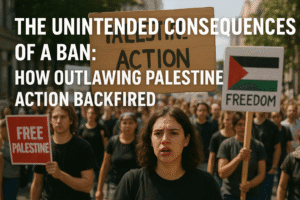
The Unintended Consequences of a Ban: How Outlawing Palestine Action Backfired
In the high-stakes theatre of counter-terrorism policy, a government’s most powerful weapon is often the proscription order. By declaring an organisation terrorist, the state aims to dismantle its finances, cripple its operations, and banish its ideology from public discourse. It is a tool designed to extinguish a flame. But as a recently revealed government document confirms, sometimes the very act of stamping it out can scatter embers, igniting a far wider blaze.
This is the story of the UK government’s proscription of Palestine Action, a move its own advisers warned could “inadvertently enhance” the group’s profile. The confidential briefing, obtained by investigative journalists, reveals a government proceeding with a politically charged decision in the face of explicit internal cautions about heightened community tensions, perceptions of bias, and a potential backlash against the erosion of civil liberties. The months since the ban have proven these warnings prophetic, creating a case study in how counter-terrorism strategy can misfire in an era of intense public dissent.
The Pre-Ban Warning: A Blueprint for Backfire
Dated March 2025 and prepared by a coalition of Home Office officials, civil servants from the Ministry of Housing, Communities and Local Government, and counter-terrorism policing experts, the document was a community impact assessment. Its purpose was to forecast the societal ripple effects of a ban. What it painted was a picture of a fraught and divided public, for whom such a move would be deeply provocative.
The advisers astutely noted that Palestine Action was a “small single issue group with lower mainstream media exposure” than behemoths like Just Stop Oil. However, they recognised that its model of direct action—primarily targeting sites linked to the UK-Israel arms trade through occupations and property damage—was effective at garnering attention through arrests and dramatic imagery.
Crucially, the document grounded its analysis in public sentiment. It cited polling showing that 60% of Britons believed Israel had “gone too far” in its war in Gaza and that a similar majority supported a ban on arms shipments to Israel. The advisers made the vital connection: “These are positions around which PAG (Palestine Action group) forms its identity… In the event that PAG is proscribed, their profile may inadvertently be enhanced, finding support among similarly minded members of the public who oppose the British footprint in the Israeli arms industry.”
This was the core of the warning. The state was considering using its most severe peacetime powers against a group whose central grievance was shared by the majority of the population. The ban, therefore, risked being perceived not as a necessary security measure, but as a political act: a silencing of popular dissent.
The Aftermath: When Prediction Becomes Reality
When then-Home Secretary Yvette Cooper announced the ban in June 2025, following an alleged action at RAF Brize Norton, the government’s fears were swiftly realised. The proscription did not make Palestine Action disappear; it transformed its symbol into a banner.
Almost immediately, protests erupted where thousands were arrested for the simple act of holding up signs that read, “I oppose genocide, I support Palestine Action.” These arrests, for displaying a placard, became a powerful visual representation of the very “creep of terrorism powers into the realm of free expression and protest” that the government’s own advisers had warned about.
Huda Ammori, a co-founder of the group, stated the obvious: “Awareness of the issues and popularity of the group have grown exponentially. The ban has backfired.” What was once a niche direct action network was now a household name, its cause amplified by the state’s heavy-handed response. The government had fallen into a classic trap: by trying to crush a symbol, they had only made it more potent.
The Deeper Dilemma: Security, Bias, and the “Terrorism” Label
The internal document also highlighted two other profound risks that strike at the heart of social cohesion and the rule of law.
First, it warned that a ban could heighten Muslim-Jewish tensions and be perceived as government bias in favour of Israel. For many British Muslims, who have felt a deep sense of anguish and helplessness over the war in Gaza, the proscription could be seen as the state criminalising their solidarity. This risks further alienating communities and undermining trust in public institutions, a sentiment no counter-terrorism strategy can afford to ignore.
Second, the assessment acknowledged that the use of terrorism laws might be seen as an attack on civil liberties. The line between violent extremism and disruptive protest is a foundational boundary in a democratic society. By applying a terrorism designation to a group whose primary public-facing tactic has been criminal damage (a serious crime, but not typically classified as terrorism), the government risked blurring this line. This concern, the document noted, existed “within government as well as the wider public,” suggesting the decision was contentious even among those tasked with implementing it.
The “Streisand Effect” in Modern Politics
This saga is a textbook example of the “Streisand Effect,” a phenomenon where an attempt to suppress information leads to its wider dissemination. The government, in its effort to make Palestine Action irrelevant, handed it a megaphone. The ban became the single biggest recruitment drive the group could never have orchestrated itself.
The official response from the Home Office, that the group’s activities “put the safety and security of the public at risk,” is a standard justification for proscription. However, it fails to engage with the nuanced warnings its own experts provided. It treats the symptom—the direct actions—while ignoring the diagnosis of the underlying condition: widespread public discontent with UK foreign policy.
A Cautionary Tale for the Future of Protest
The proscription of Palestine Action is more than a single policy decision; it is a signpost for the challenges facing liberal democracies in an age of globalised conflict and grassroots activism. It raises critical questions:
- When does a protest group become a terrorist organisation? Is the threshold violence, or is it the sustained disruption of industries linked to a foreign policy a significant portion of the electorate disagrees with?
- How can a government maintain national security without alienating large segments of its population? The blunt instrument of proscription may secure a short-term legal victory but at the cost of long-term social trust.
- What is the true cost of ignoring expert advice? The government was presented with a clear-eyed forecast of the ban’s potential to backfire and chose to proceed, seemingly for immediate political reasons.
The internal briefing paper reveals a government at odds with itself—a bureaucracy capable of sophisticated, clear-eyed analysis of public sentiment, and a political leadership willing to override that analysis. The result is a policy that has, thus far, achieved the opposite of its intended goal. Instead of quenching a fire, the UK government has poured gasoline on the flames of dissent, demonstrating that in the modern world, the power to ban is not always the power to control.
You must be logged in to post a comment.