
The Unheard Story: Palestinian Christians Navigate Occupation, War, and a Bittersweet Christmas
Amidst a fragile ceasefire, Palestinian Christians in Bethlehem marked Christmas 2025 with bittersweet celebrations, their joy tempered by the ongoing trauma of Israel’s war in Gaza and a decades-long decline under occupation. Once a significant minority, their community has dwindled to fewer than 50,000 in the West Bank and Gaza due to economic hardship, movement restrictions, and violence, including targeted attacks on churches like the deadly bombing of Gaza’s Saint Porphyrius Church. While Christmas lights returned to Manger Square as an act of resilience, the festivities were shadowed by checkpoints, settler violence in the West Bank, and the existential fear that one of the world’s oldest Christian communities is fighting for survival in its ancestral homeland, emphasizing a shared Palestinian identity and an uncertain future.
The Unheard Story: Palestinian Christians Navigate Occupation, War, and a Bittersweet Christmas
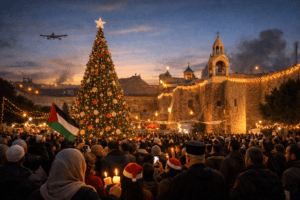
The lights on the large Christmas tree in Bethlehem’s Manger Square cast a warm glow for the first time in two years. After a long period of “darkness and silence,” as the city’s mayor described it, festive scenes have tentatively returned to the traditional birthplace of Jesus. Yet, for the Palestinian Christians gathering here, the joy is profoundly complex. It exists alongside the persistent hum of Israeli drones over Gaza, the memory of loved ones killed in church bombings, and the daily reality of military checkpoints that turn a short pilgrimage into an hours-long ordeal.
This Christmas in the Holy Land is a story of fragile celebration shadowed by an existential threat. One of the world’s oldest Christian communities, which has maintained a continuous presence for two millennia, is now fighting for its survival amidst war, occupation, and a steep demographic decline.
A Community Shrinking in Its Ancient Homeland
Palestinian Christians are direct descendants of the first followers of Jesus, a lineage that blends Aramaic-speaking Jewish converts with Romans, Greeks, and other peoples of the region. They form a rich tapestry of denominations, including Greek Orthodox, Roman Catholic, Armenian Orthodox, and various Protestant churches. Historically, they were integral to the social and cultural fabric of Palestine.
Today, their numbers tell a story of dramatic change. A community that made up an estimated 10-12% of the population in the early 20th century has dwindled to a small minority. The most recent comprehensive figures paint a stark picture of their current distribution.
Table: The Shrinking Palestinian Christian Population in the Holy Land
| Region | Estimated Christian Population (Pre-2023 War) | Key Notes and Concentration Areas |
| West Bank & East Jerusalem | ~47,000 – 51,000 | Concentrated in Bethlehem, Ramallah, and East Jerusalem’s Old City. |
| Gaza Strip | ~1,000 (Pre-war) | Reduced to less than 800 after the 2023-2025 war. |
| Within Israel (Palestinian Arab citizens) | ~123,000 | Often identified as Palestinian Christians, subject to discrimination within Israel. |
This decline is the result of decades of emigration, driven by the economic hardships and pervasive instability of life under Israeli occupation, as well as lower birth rates compared to Muslim neighbors. The construction of Israel’s separation wall in the early 2000s further isolated Christian communities, especially around Bethlehem, severing connections to land, family, and holy sites. A local businessman described Bethlehem today as feeling like “a big jail”.
Christmas in Bethlehem: A Celebration of “Half Joy, Half Sadness”
For two years, Bethlehem canceled its public Christmas festivities in solidarity with Gaza. The 2025 celebrations, enabled by a fragile ceasefire, were therefore deeply symbolic—a declaration of resilience. Mayor Maher Canawati called it a message “that the Palestinian people love life and peace”.
However, for attendees, the experience was bittersweet. “Today’s atmosphere is half joy and half sadness,” said George Zalloum from East Jerusalem, “because we have brothers who are still dying in Gaza”. The logistical journey to the birthplace of Christ itself illustrated the daily realities of occupation. Pilgrims from nearby West Bank towns reported waiting 90 minutes or more at Israeli military checkpoints to enter Bethlehem. “The road to Bethlehem was difficult,” one worshipper noted, echoing the modern-day challenges of a journey that was once straightforward.
The celebrations were also a vital, if partial, economic lifeline. Bethlehem’s economy, heavily reliant on pilgrimage and tourism, has been devastated. Hotel occupancy had plummeted to 25%, with owners reporting hundreds of millions in losses. The Christmas crowd, though smaller than pre-war years and dominated by Palestinian citizens of Israel and foreign workers rather than international tour groups, offered a glimpse of hope.
Under Siege: Attacks on Churches and Community
While Bethlehem experienced a tentative revival, the situation for Christians, particularly in Gaza, remained dire. Their places of worship, some of which are among the oldest in Christendom, have not been spared in the conflict.
- In Gaza: The community has suffered catastrophic losses. An Open Doors report estimated 75% of Christian-owned homes in Gaza were damaged or destroyed during the war. Their sanctuaries have been repeatedly hit:
- Church of Saint Porphyrius (Oct 2023): Gaza’s oldest active church, built in 1150, was struck by an Israeli attack. At least 18 displaced people, including children seeking shelter, were killed. One grieving father said, “They bombed my angels and killed them without warning”.
- Holy Family Parish (Multiple attacks): Gaza’s only Roman Catholic church has been attacked several times. In July 2025, an Israeli tank shell struck the compound, killing three people and wounding the parish priest. Israel later stated it “deeply regrets” the “stray ammunition” and pledged an investigation. Earlier, in December 2023, two women were shot and killed by an Israeli sniper within the same church compound.
- Ahli Arab Hospital: A Christian-run medical facility, was severely damaged in a devastating explosion in October 2023.
- In the West Bank and Jerusalem: Violence and harassment have surged. According to the Religious Freedom Data Center, at least 201 incidents of violence against Christians were documented between January 2024 and September 2025, most in Jerusalem’s Old City. These range from spitting and verbal abuse to vandalism and assaults. In 2025 alone, settlers bulldozed a historic hilltop in the Christian town of Beit Sahour, and the ancient St. George Church in Taybeh was targeted by arsonists.
This environment contributes to what community leaders describe as a systematic campaign that threatens their very existence. “There is no justice in our land,” warned a coalition of Palestinian Christian organizations. “We are on the verge of a catastrophic collapse… this could be our last chance to save the Christian presence in this land”.
A Shared Identity and an Uncertain Future
Amidst these trials, Palestinian Christians emphasize a unified national identity with their Muslim neighbors. They share not just the struggle of occupation but also cultural bonds. Historically, Muslims and Christians in Palestine have shared feast days and saints, with Muslim families sometimes visiting Christian shrines. Today, as one Bethlehem resident stated, “We live together in peace. Our problem is with the Israeli government”.
This shared fate is why the celebration in Bethlehem resonated beyond the Christian community. As an Italian tourist observed, “I see this feast as a celebration for every Palestinian, not only Christians”.
The future remains precarious. The war in Gaza could re-ignite, and the expansion of Israeli settlements continues to encircle and pressure Palestinian towns. For the Christians of Gaza, the question is existential. The community has dwindled from roughly 1,000 to less than 800, and with homes and institutions destroyed, the exodus may accelerate. Palestinian pastor Mitri Raheb fears “the last chapter of Christianity in Gaza is being written”.
This Christmas, the light in Bethlehem is a testament to profound resilience. It is the light of a community that, in the words of Latin Patriarch Pierbattista Pizzaballa, has “decided to be light” amid destruction. Yet, it shines on a path filled with immense uncertainty—a path that will determine whether one of Christianity’s founding communities can continue to live and pray on the land it has called home for 2,000 years. The celebrations in Manger Square were not just a holiday observance but a powerful, quiet act of defiance against disappearance.
You must be logged in to post a comment.