
The Undying Hearth: Inside India’s 200-Year-Old Royal Kitchen That Refuses to Shut Down
In Lucknow, India, a nearly 200-year-old royal kitchen built in 1837 by Awadh ruler Muhammad Ali Shah continues to serve thousands of meals daily during Ramadan and Muharram, funded by interest from a 3.6 million rupee trust he established with the East India Company in 1839. The dilapidated structure is currently being restored by the Archaeological Survey of India using traditional lime mortar made from slaked lime, wood apple pulp, black gram, natural gum, and jaggery—rather than modern cement—to preserve its original Awadhi architecture. Despite the restoration work, the kitchen remains operational, feeding the poor, widows, and faithful with recipes and portion sizes dictated by the king’s original will, embodying a living tradition that locals say makes the food feel as if it is still sent by Muhammad Ali Shah himself.
The Undying Hearth: Inside India’s 200-Year-Old Royal Kitchen That Refuses to Shut Down
Lucknow, India – In an era of instant noodles and meal delivery apps, where culinary traditions often fade faster than a generation can pass, there is a kitchen in northern India that has been simmering, roasting, and stewing without interruption for nearly two centuries.
It is not a museum piece. It is not a tourist trap reenacting history for a quick photograph. It is a live, breathing, flame-licked heart of a bygone kingdom.
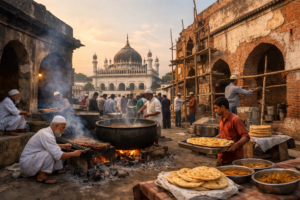
Tucked inside the sprawling complex of the Chota Imambara in Lucknow, the Shahi Bawarchikhana (Royal Kitchen) of the former Awadh kingdom is defying the logic of time. While the nobles who once dined here have turned to dust, and the British Empire they negotiated with has collapsed, the kitchen’s clay ovens are still hot. Every day, especially during the holy months of Ramadan and Muharram, thousands of plates are filled here—not for profit, but as a matter of duty written into a king’s will nearly 200 years ago.
Now, in a unique collaboration between archaeologists and the community, the walls of this legendary kitchen are being restored to their original glory. But for the people of Lucknow, the ongoing construction is merely a cosmetic fix; the soul of the kitchen, they say, never needed repair.
A King’s Contract with the Future
To understand the resilience of this kitchen, one must go back to 1837. Muhammad Ali Shah, the then-ruler of Awadh, built the Chota Imambara as a mausoleum for himself and his mother. But next to the ornate halls and grieving chambers, he built something utilitarian: a massive kitchen.
However, the king was a pragmatist. He knew that dynasties fall. In 1839, he handed over a staggering sum of 3.6 million rupees to the East India Company. It was a transaction that sounds odd to modern ears: a local king giving a fortune to a colonial trading giant. But Muhammad Ali Shah had a condition.
The money was to be held in trust. The interest generated from it was to be used exclusively for two purposes: maintaining the monuments of Awadh and, more critically, running the royal kitchen forever.
When India gained independence in 1947, the East India Company was long gone, but the legal contract survived. The funds were transferred to a local Indian bank, and today, the Hussainabad Trust (monitored by the state government) continues to use the interest from that 1839 deposit to buy meat, rice, and spices.
“The king didn’t just build a kitchen,” explains historian Roshan Taqui. “He built a financial instrument for eternity. He knew that if the kitchen relied on the mercy of future kings or governments, it would fail. By tying it to a trust fund, he ensured that the poor of Lucknow would always eat.”
The Chemistry of Eternity: Restoring a Masterpiece
Walk through the corridors of the kitchen today, and you will see a fascinating dichotomy. On one side, men in skull caps are kneeling on the floor, skewering kebabs over wood-fired stoves. On the other side, archaeologists are mixing a peculiar paste of lentils, fruit pulp, and jaggery.
The Archaeological Survey of India (ASI) began a meticulous restoration of the dilapidated structure last October. The walls, made of lakhauri bricks (thin, burnt clay bricks typical of the region), were crumbling. The plaster was peeling. Sections of the floor were caving in.
But the ASI faced a challenge: they couldn’t use modern cement. To restore a 19th-century Awadhi kitchen, you need 19th-century materials.
“Modern cement is rigid,” says Aftab Hussain, the superintending archaeologist leading the project. “It traps moisture and destroys ancient bricks. We had to go back to lime mortar.”
What is lime mortar? In Lucknow, it is a recipe passed down through generations of mistris (masons), not found in engineering textbooks. The team soaks slaked lime for a month. Then, they mix in the pulp of wood apples (bel), black gram (urad dal), natural gum (gond), jaggery (unrefined sugar), and red brick dust.
The result is a sticky, pinkish-brown paste that smells faintly of a bakery. Unlike cement, this organic mortar is flexible. It breathes. It moves with the humidity of the Ganges plains. It is the same mortar that held the Taj Mahal together, and now, it is being reapplied to the walls of a working kitchen by laborers who learned the technique from their fathers.
“When we apply this mortar, it feels like we are healing the building, not just repairing it,” says a senior laborer on site, wiping sweat from his brow. “Cement would have killed this place. This keeps it alive.”
The Twin Kitchen Strategy
One of the most brilliant aspects of Muhammad Ali Shah’s design was his obsession with redundancy. He built two identical kitchens flanking the Imambara.
It is a design choice that has paid off handsomely in 2024. While the ASI workers scrape and plaster the west wing of the kitchen, the east wing is in full swing.
“It is almost 5 PM,” says Murtaza Hussain Raju, the kitchen in-charge, adjusting his skull cap. “In a few minutes, 700 coupons will be distributed. We will feed the widows, the orphans, and the laborers.”
During Ramadan, the menu is fixed by royal decree. It hasn’t changed since 1839. The poor receive sheermal (sweet saffron flatbread), korma (slow-cooked meat curry), and kebabs that melt on the tongue. The portions are weighed. The quality of the meat is specified in the king’s will.
“During Muharram, for the first nine days, it is vegetarian,” Raju adds, stirring a massive pot with a ladle the size of an oar. “Lentils, potato curry, and a sweet flatbread. After that, we add the meat. We don’t decide this. The Nawab decided this almost two hundred years ago. We are just his hands.”
The Taste of Continuity
For the people of Lucknow, the Shahi Bawarchikhana is not a relic; it is a birthright.
Syed Haider Raza is 80 years old. He walks with a cane now, but his eyes light up when he approaches the distribution counter.
“I have been coming here since I was a child,” Raza says, clutching a metal plate. “My father brought me. His father brought him. We would watch the bawarchis (chefs) cooking in deghs (huge cauldrons) so big that a man could bathe in them. The food never ran out. It never ran out during the British Raj, it never ran out during the wars, and it isn’t running out now.”
Raza takes a bite of the kebab. He closes his eyes. “It tastes the same. It feels as if the food is still being sent by Muhammad Ali Shah himself.”
This is the intangible magic that the ASI is trying to protect. You can restore the lakhauri bricks. You can recreate the lime mortar. But you cannot manufacture the dignity of a system that has fed the poor continuously for two centuries without asking for a single prayer in return.
Why This Matters Now
In a globalized world where heritage is often performative—where “old towns” are gutted for luxury hotels and “traditional food” is Instagrammed before being thrown away—the Lucknow royal kitchen stands as a quiet act of rebellion.
The restoration project is scheduled to finish by the end of March. When the scaffolding comes down, the kitchen will look much as it did in 1837. The cracked walls will be smooth. The floor will be solid.
But the stew will still be bubbling. The sheermal will still be baking. And the descendants of the Nawabs, like Yasir Abbas, will still be watching over the trust.
“We are duty-bound,” Abbas says, standing in the shadow of the Imambara. “My ancestor didn’t just build a building. He started a tradition. A tradition is not a building. You can knock down a building. But a tradition? That is a living thing. And as long as we cook the food the way he wanted, he isn’t really dead.”
As the sun sets over Lucknow and the call to prayer echoes through the narrow lanes, the smoke rises from the twin kitchens. It is a thin, grey line connecting 2026 to 1837—a reminder that sometimes, the most radical act of preservation is not freezing something in time, but keeping it warm.
You must be logged in to post a comment.