
The Uncounted Cost: Beyond the Headline of an Indian Student’s Death in Toronto
This tragic shooting of Shivank Avasthi, a 20-year-old Indian doctoral student near the University of Toronto, exposes the perilous gap between the promised dream of overseas education and the stark realities faced by international students; beyond a simple crime headline, his death underscores the profound vulnerabilities—from housing insecurity and social isolation to inadequate safety nets—that shadow the lucrative global education pipeline, forcing a necessary reckoning for institutions and governments to expand their duty of care beyond campus borders and ensure the pursuit of opportunity does not come at such a devastating human cost.
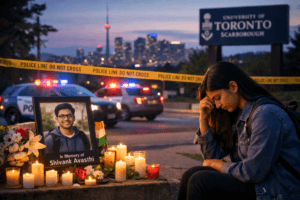
The Uncounted Cost: Beyond the Headline of an Indian Student’s Death in Toronto
The news item is stark in its brevity: “Indian student shot dead near University of Toronto campus.” It is a headline that flashes across screens, a brief, tragic datum in the endless scroll of global news. For a moment, we register the name—Shivank Avasthi, 20, a doctoral student—feel a pang of sorrow, and then the digital tide pulls us onward. But to let it end there is to do a profound disservice. This is not just a crime report; it is a fissure in the foundation of a global dream, a story that exposes the layered vulnerabilities behind the booming narrative of overseas education, and a grim reminder of the human stakes in our interconnected world.
The Dream and Its Shadow
Shivank’s journey to the University of Toronto Scarborough campus would have been familiar to tens of thousands of Indian families. It is a path paved with immense sacrifice, soaring aspirations, and meticulous planning. It represents the pinnacle of academic ambition: to study at a world-class institution in a country synonymous with safety, diversity, and opportunity. Families mortgage land, spend lifetimes of savings, and invest not just money, but the weight of their hopes into this venture. The student carries the dual burden of personal ambition and familial expectation, stepping into a new world to build a future that justifies the cost.
Canada has been a prime destination in this journey. Its post-graduate work permit programs, pathways to permanent residency, and reputation for multicultural tolerance have made it a magnet. Universities, including U of T, have actively recruited international students, for whom higher tuition fees have become a critical financial lifeline for institutions. This ecosystem, however, has a shadow side. It can sometimes prioritize the transaction over the transition, leaving students to navigate a complex web of housing shortages, staggering living costs, social isolation, and often, inadequate on-the-ground support networks.
Shivank, pursuing a PhD, was at the apex of this academic pyramid. His death shatters the implicit contract of this dream: that supreme academic pursuit is a shield, that a university campus is a sanctuary.
The Geography of Fear: “Near Campus”
The phrase “near the University of Toronto Scarborough campus” is loaded with unspoken meaning. It draws an immediate, terrifying proximity between the ivory tower and the unpredictable realities of the city beyond its borders. Campuses are often perceived as bubbles—well-lit, patrolled, secure. But students, especially those grappling with Canada’s housing crisis, often live in more affordable neighbourhoods further afield. They commute on public transit, work late shifts in part-time jobs, and walk streets that may not share the campus’s curated safety.
Toronto Police are investigating Shivank’s death as a homicide. The specifics are under investigation, but the very nature of a shooting prompts agonizing questions. Was it random violence? A targeted act? A case of being in the wrong place at a tragically wrong time? For the community of over 300,000 Indian students in Canada, and for their families watching from home, the uncertainty is paralyzing. It transforms every “near campus” into a potential zone of anxiety, challenging the very notion of what safety means in a foreign land.
The Ripple Effect: A Community in Trauma
The impact of such a loss radiates far beyond the immediate crime scene.
- The Family in Agony: For Shivank’s family, the world has collapsed. Their investment was not financial, but existential—their son, their pride, their future. They now confront a nightmare of bureaucratic horror: navigating international consular services, police procedures in a foreign country, and the unimaginable task of repatriating their child’s body. Their grief is compounded by distance, helplessness, and the brutal severing of a story still being written.
- The Student Diaspora: For Indian students across Canada, this is a collective trauma. WhatsApp groups light up with warnings, safety tips, and fear. It reinforces a sense of permanent “otherness” and vulnerability. They are forced to recalibrate their behavior, their movements, their trust in their environment. The pressure to succeed, already immense, is now layered with a primal need to simply survive.
- The Institutional Reckoning: Universities must confront hard questions. While they cannot police entire cities, what is the extent of their duty of care? Is their support for international students—especially in crisis management, mental health, and integration—commensurate with the substantial fees they pay? This incident will inevitably lead to calls for better security escorts, improved lighting in periphery areas, more robust orientation programs that address practical safety, and deeper community engagement with local police.
- The Diplomatic Channel: High-profile tragedies like this become diplomatic focal points. The Indian government will press for a thorough investigation and justice. It may also scrutinize the broader framework of student safety, potentially influencing policy dialogues on how destination countries safeguard their international student populations.
Beyond Sensationalism: Seeking Context in a Violent World
It is crucial to avoid reactionary stereotypes. Toronto is not a “dangerous city” in a blanket sense; it remains one of the world’s safest large metropolitan areas. However, like any major urban center, it has neighborhoods and moments of violence. The tragedy lies in the cruel intersection of that statistical reality with an individual life of such promise.
This incident also forces a conversation often shrouded in silence: the mental and emotional toll on international students. The pressure to appear successful, to not worry parents back home, can lead to profound isolation. Students may hesitate to seek help or may venture into less-secure situations for work or housing, unseen by institutional safety nets.
A Call for Integrated Care
Honoring Shivank Avasthi’s memory requires more than thoughts and prayers. It demands systemic action:
- Holistic Pre-Departure Orientations: Preparation must go beyond visas and coursework to include practical, hard-hitting information on personal safety, housing realities, mental health resources, and consular support.
- University-Community Partnerships: Institutions must work with city police, transit authorities, and neighborhood associations to create safer corridors for students. “Campus safety” needs a broader geographical definition.
- Enhanced Consular Vigilance: Source countries should have proactive, visible support systems for their student diaspora, including emergency hotlines and rapid response protocols for crises.
- Destigmatizing Struggle: Creating cultures within student communities where admitting hardship, fear, or financial strain is not seen as failure, but as a legitimate part of the experience requiring support.
The murder of Shivank Avasthi is a singular, horrific event. But it is also a symptom of larger complexities in the global education ecosystem. It reminds us that behind the statistics of international enrollment and economic contribution are human beings navigating a perilous juncture of youth, ambition, and displacement.
His story is not just a crime headline. It is a cautionary tale about the gaps in a global dream. It is a plea to look beyond the glossy brochures and see the whole student—not just as a scholar in a library, but as a young adult walking home on a foreign street, carrying the weight of a world on their shoulders. The true measure of our response will be whether we can build a framework of care sturdy enough to ensure that pursuit of knowledge never again costs a life.
You must be logged in to post a comment.