
The Two-Tier Justice System: How Israel’s New Death Penalty Law Exposes the Fault Lines of Occupation
Israel’s new death penalty law mandates execution for Palestinians convicted in West Bank military courts of lethal “terrorist” acts—with a 96% conviction rate, no clemency, and a 90-day timeline—while Israeli citizens who kill Palestinians in the occupied territory face near-total impunity, with no indictments for such deaths since 2020. The legislation, celebrated by far-right minister Itamar Ben-Gvir with champagne and a noose pin, revives capital punishment for the first time since Adolf Eichmann’s 1962 execution and has been condemned by the UN as a potential war crime. Backed by Prime Minister Benjamin Netanyahu, who faces an ICC warrant, the law formalizes a two-tier system of justice that human rights groups say entrenches apartheid and annexation, exposing the gap between international condemnation and meaningful action.
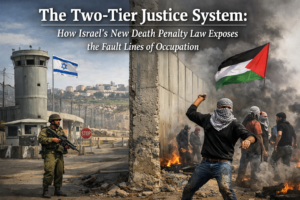
The Two-Tier Justice System: How Israel’s New Death Penalty Law Exposes the Fault Lines of Occupation
In the Knesset chamber on Monday, as lawmakers cast their final votes on legislation that would make capital punishment the default sentence for certain convictions, Itamar Ben-Gvir reportedly popped open a bottle of champagne. The far-right national security minister had been wearing a noose-shaped pin for weeks—a sartorial choice that seemed more suited to a dark political satire than the chambers of a democratic state. Yet the image of a government minister celebrating the expansion of state killing with celebratory bubbly captures something essential about what just passed into Israeli law: not a sober policy change, but a deliberate provocation wrapped in legislative language.
The law itself is a masterclass in bureaucratic cruelty. For Palestinians tried in West Bank military courts—where conviction rates hover around 96 percent—execution is no longer a punishment that prosecutors must seek or judges must carefully weigh. It is the default. Even if prosecutors don’t request it. Even if the evidence, as Amnesty International and other human rights organizations have documented, was obtained through torture or abuse. The old requirement for unanimous convictions has been stripped away. The possibility of pardon has been eliminated. And once sentenced, the condemned faces a 90-day countdown to execution.
For Palestinians, this is the law. For Israeli citizens who kill Palestinians in the West Bank, there is effectively no law at all.
The Numbers That Tell the Real Story
Since 2020, not a single Israeli citizen has been indicted for the death of a Palestinian in the West Bank. Not one. This statistic, confirmed by Guardian analysis, represents not a procedural oversight but a systemic reality. During this same period, settler violence has surged to record levels—first after October 7, 2023, and again more recently as regional conflict has expanded. But “surged” implies something that was once controlled and then broke loose. As Ziv Stahl of the Yesh Din NGO put it more accurately: settler violence is not spiraling out of control. It is operating exactly as designed.
What we’re witnessing is the formalization of a two-tier system of justice that has long existed in practice. In the West Bank, which remains under illegal occupation according to international law, there are two populations governed by two entirely separate legal regimes. Israeli settlers live under Israeli civilian law. Palestinians live under Israeli military law. And now, at the extreme end of that military law, Palestinians face the death penalty for acts that Israeli civilians committing lethal violence against Palestinians face no consequences for at all.
A History Abandoned
The cruelty of this new legislation is amplified by its historical context. Israel, like most democratic nations, had effectively abandoned capital punishment decades ago. The last execution carried out by Israeli authorities was Adolf Eichmann in 1962—a Nazi architect of the Holocaust whose hanging was understood as a singular response to crimes so monstrous they seemed to demand an exception to the rule. For sixty-three years, that exception held.
Now, the exception is becoming the rule, but for an entirely different population. The message being sent could hardly be clearer: Palestinian life does not command the same judicial protections, the same procedural safeguards, the same hesitation about state killing as Israeli life does.
Ben-Gvir’s champagne celebration wasn’t just triumphalism. It was the public face of a coalition that has made no secret of its views on Palestinians. The national security minister has long called for the death penalty for what he terms “terrorists”—a category that in practice encompasses Palestinians who commit violence against Israelis, regardless of context or circumstance. The noose pin was never subtle. It was a promise, and on Monday, that promise became law.
The Netanyahu Factor
Benjamin Netanyahu’s support for the legislation carries its own weight. The prime minister currently faces an International Criminal Court warrant for war crimes and crimes against humanity. His coalition partners, particularly Ben-Gvir and Bezalel Smotrich, have made clear that their continued support depends on advancing policies that entrench occupation and expand settlement. The death penalty law fits neatly into this dynamic: it delivers a symbolic victory to the far-right while establishing legal architecture that further entrenches the differential treatment of Palestinians and Israelis.
But there’s something else at play here. When a leader facing international prosecution for war crimes endorses legislation that the UN’s human rights chief explicitly warns would constitute a war crime, the message extends beyond policy. It signals a willingness to escalate, to push further, to see how much the international community will tolerate before meaningful consequences materialize.
What the International Community Has Done—And Hasn’t
Condemnations have arrived predictably. The UK, the European Union, and various human rights organizations have issued statements expressing concern. Volker Türk, the UN human rights chief, offered the kind of careful legal language that characterizes diplomatic responses to Israeli policies: “Its application to residents of the occupied Palestinian territory would constitute a war crime.”
But here’s the question that hovers over every such statement: after what the world witnessed in Gaza—after more than 46,000 Palestinian deaths, after the destruction of hospitals and universities and entire residential neighborhoods, after the International Court of Justice found plausible genocide—what does condemnation even mean anymore?
The shift in global public opinion that the Guardian’s editorial references represents something real. Across the world, from university campuses to union halls to the streets of European capitals, millions have demonstrated against the conduct of the war and the broader structure of Israeli occupation. But this shift in public sentiment has not translated into the kind of state-level action that might actually constrain Israeli policy. Weapons continue to flow. Diplomatic support continues largely unabated. And the government in Jerusalem faces no meaningful consequence for policies that the international community claims to oppose.
The Judiciary’s Impossible Position
Israel’s Supreme Court could theoretically strike down this law. The court has historically positioned itself as a check on Knesset excess, and there are multiple grounds on which to challenge this legislation: its discriminatory application, its elimination of procedural safeguards, its conflict with international law. But the court operates in a political environment that has made the judiciary a primary target of the current coalition.
The government has spent years attacking the court’s legitimacy, portraying it as an unelected body thwarting the will of the people. Any ruling against the death penalty law would be weaponized—presented not as a judicial check on legislative overreach but as further evidence that the court is hostile to Jewish security, to Israeli sovereignty, to the national interest. The justices know this. And that knowledge shapes what they are willing to do.
The Architecture of Annexation
There’s a reason the Guardian’s editorial describes this law as “annexationist.” The death penalty legislation applies to Palestinians in the West Bank precisely because the West Bank is governed under a legal framework that treats it as separate from Israel proper. But the effect of the law—creating harsher punishments for Palestinians while settlers face impunity—is to further entrench a system that functionally treats the territory as integrated into Israel when it serves Israeli interests, and as occupied when that framework allows for harsher treatment of Palestinians.
This is not a contradiction. It is the logic of the system. Israeli settlements expand, protected by the Israeli military, connected by Israeli-controlled roads, governed by Israeli law for Israeli citizens. Palestinians in the same territory live under military orders, face military courts, and now face the death penalty. The two-tier system has always been the system. The death penalty law simply makes explicit what was already implicit: that Palestinian life in the West Bank is subject to a legal regime fundamentally different from—and fundamentally more dangerous than—the one that protects Israeli settlers.
What Comes Next
The law’s implementation remains uncertain. International pressure could mount. The Supreme Court could intervene. Even within Israel, there are voices—including former prime minister Ehud Olmert, who has urged the International Criminal Court to intervene—who recognize the danger this legislation represents. But the trajectory is clear.
When a government minister celebrates the return of capital punishment with champagne while wearing a noose pin, when a prime minister facing international prosecution embraces legislation his own military lawyers may struggle to defend, when a legal system has shown itself unwilling to hold citizens accountable for killing Palestinians, the death penalty law becomes not an aberration but a logical extension of what has been building for years.
The impunity that settlers enjoy for violence against Palestinians and the capital punishment now codified for Palestinians who commit violence against Israelis are two sides of the same coin. Both rest on a foundational assumption: that Israeli lives and Palestinian lives are not equal. That different legal standards are appropriate. That justice is not a universal principle to be applied equally, but a resource to be allocated according to identity.
This is what the death penalty law ultimately represents. Not just a punishment, but a statement. And the statement, stripped of all legal language and procedural complexity, is brutally simple: some lives matter enough to protect, some lives matter enough to execute, and the difference between them is written into law for anyone who cares to see.
You must be logged in to post a comment.