
The Two Faces of Doha: How Qatar’s Schoolbooks Teach What Its Diplomats Deny
A new report from IMPACT-se analyzing Qatar’s 2025-2026 national curriculum reveals that despite the country’s carefully cultivated image as a modern peace broker, its textbooks systematically teach children antisemitic stereotypes, deny Jewish historical ties to Jerusalem, erase Israel from maps entirely, and glorify violent jihad as the highest ideal—including praising mothers who raise sons “to love martyrdom.” For four consecutive years, this problematic content has remained unchanged, exposing a profound double standard: while Qatari diplomats host Western allies and pose as mediators, the nation’s classrooms continue to dehumanize Jews and frame Israel’s destruction as an Islamic duty, raising urgent questions about whether a state that educates for conflict can genuinely serve as a force for regional stability.
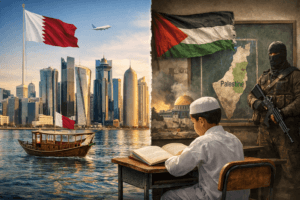
The Two Faces of Doha: How Qatar’s Schoolbooks Teach What Its Diplomats Deny
For a decade, Qatar has paid millions to project an image of tolerance—hosting Western universities, brokering ceasefires, and courting Jewish American donors. Yet a new analysis of the 2025-2026 national curriculum reveals a country quietly doing the opposite: teaching its own children that Jews are greedy, that Israel has no right to exist, and that dying for Palestine is the highest measure of a good Muslim mother’s success.
Doha, Qatar – February 2026
There is a particular passage in the sixth-grade Islamic education textbook that deserves our full attention, not because it is the most shocking—by the standards of the new IMPACT-se report, it is merely representative—but because it reveals something essential about how nations shape the moral imagination of children.
The passage praises Nusaybah bint Ka‘b, a woman who fought alongside the Prophet Muhammad at the Battle of Uhud. This much is historically uncontroversial. What is striking is the pedagogical framing: students are taught that Nusaybah represents the “optimal” model of motherhood because she raised her children “to love jihad.” Her three sons later died as martyrs. The textbook presents this not as a historical curiosity but as an aspirational standard.
Consider what an 11-year-old child absorbs from this lesson. Not that mothers love their children. Not that mothers protect their children. But that the greatest mother is the one who prepares her children for death in sacred struggle—and celebrates when that death arrives.
This is not religious education. This is eschatological conditioning.
The Curriculum as a National Mirror
The IMPACT-se report, which examined 75 Qatari textbooks across all grade levels for the 2025-2026 academic year, found that the problem is not new but entrenched. For four consecutive years, problematic content has remained “unchanged.” This is not negligence. This is policy.
When a sovereign state consistently teaches that “the Jews” are deceitful, materialistic, and hostile to Islam; when twelfth graders are shown maps labeling the Sea of Galilee as Palestinian territory and erasing Israel entirely; when students are instructed that Palestine must be “liberated” without conceding “any part” of the land—this is not the accidental persistence of outdated materials. It is the deliberate reproduction of a worldview.
Qatar’s curriculum is not merely anti-Israel. It is systematically anti-Jewish in ways that extend far beyond the political conflict. The Grade 12 history lesson on Jerusalem lists “the Jews” as colonizers alongside Romans and Crusaders. Jewish sacred attachment to Jerusalem—three thousand years of continuous presence, the Western Wall, the Hebrew Bible’s thousand references to Zion—is simply erased. Students learn that Jerusalem is holy to “Muslims and Christians alone.”
This is not politics. This is theology deployed as erasure.
The Strategic Value of Ambiguity
To understand why Qatar persists in this curriculum, one must understand what Qatar gets from its double game.
On the world stage, Qatar is indispensable. It hosts Al Udeid, the largest American military base in the region. It mediated the Afghanistan withdrawal. It funnels hundreds of millions in aid to Gaza while hosting Hamas’s political leadership. It is, by any measure, a master of regional hedging.
But domestically, Qatar faces a legitimacy problem that its Gulf neighbors do not. It is fabulously wealthy but demographically fragile—its citizenry vastly outnumbered by expatriates. It is historically Wahhabi but strategically independent from Saudi religious establishments. It is governed by a modernizing emir who courts Western investors while preserving conservative social structures.
The curriculum resolves this tension. It tells Qatari citizens: you are not merely rich; you are righteous. You are not merely powerful; you are the vanguard of Palestine. Your children may study at Georgetown and Northwestern in Education City, but they will not be confused about who the enemy is.
This is nationalism as theology. It is also politically useful.
What the Textbooks Actually Say
The IMPACT-se report catalogs dozens of examples. A few merit sustained attention:
Grade 11 Islamic Education, page 146: Israel is consistently referred to as the “Occupation State,” the “Zionist State,” and the “Israeli Entity.” The terminological distinction matters. An “entity” is not a nation. It is a temporary phenomenon, a political mistake awaiting correction. Students are not asked to make peace with Israel. They are asked to outwait it.
Grade 12 History, page 74: The Second Intifada is taught as a period when Palestinians “resorted to military operations to face the Occupation’s crimes.” This is the language of inevitability. Not: Palestinians chose suicide bombings. Not: Palestinians murdered civilians in pizza shops and Passover seders. But: they resorted to these methods, as if violence were a natural resource extracted under duress. The textbooks do not mention the 1,000 Israelis killed in that period. They do not name the children blown apart on buses. They present terror as a reasonable response.
Grade 8 Arabic Language, pages 127–132: A poem by Ali Mahmoud Taha calls on readers to “draw swords” and sacrifice their lives. The poem explicitly references Jerusalem’s “churches and mosques” while omitting synagogues. This is not an oversight. It is a ritual cleansing of Jewish presence from the landscape of sanctity.
Grade 12 Geography, page 180: Israel does not appear on a regional map. Its territory is labeled “Palestine.” This is cartographic erasure—the visual equivalent of the “entity” rhetoric. You cannot negotiate with a country that your national maps do not acknowledge.
The Dehumanization Sequence
Scholars of genocide prevention have identified predictable stages in the journey from prejudice to mass violence. Classification. Symbolization. Dehumanization. Organization. Polarization. Preparation. Extermination.
The Qatari curriculum has not reached the final stages. But it has institutionalized the early ones with remarkable consistency.
Jews are classified as fundamentally different—not merely adherents of a different religion, but carriers of negative essences: materialism, arrogance, deceit, hostility to Islam. They are symbolically marked through consistent association with greed, colonialism, and global manipulation. They are dehumanized through the denial of their historical and religious ties to Jerusalem—a denial that functions as spiritual expulsion.
When a child learns, year after year, that Jews are untrustworthy schemers who colonized a land that was never theirs, that child is being prepared for something. Perhaps not for violence directly. But certainly for indifference to Jewish suffering. Certainly for the conviction that justice requires Jewish dispossession.
This is the quiet violence of curriculum: it does not need to incite riots to achieve its aims. It only needs to produce citizens who believe, with perfect sincerity, that they are morally superior to those they have never met.
The Question of Impact
Qatar’s defenders will offer predictable responses. They will note that textbooks in many Arab countries contain similar material—a whataboutism that concedes the indictment while protesting the prosecutor. They will argue that the curriculum reflects traditional religious education, not state policy. They will insist that Qatari leaders have hosted Jewish delegations and invested in interfaith dialogue.
These defenses miss the point. The question is not whether Qatar has made tactical gestures toward tolerance. It has. The question is what Qatar teaches its own children when no one is watching.
There is a profound distinction between diplomacy and education. Diplomacy is performance; it is conducted before audiences, calibrated for effect. Education is formation; it operates in the intimate space between teacher and student, shaping assumptions that will endure for decades. Qatar has invested heavily in the first while systematically undermining the second.
The result is a population educated for conflict. The same children who memorize verses about Jewish treachery will, as adults, encounter Jewish visitors at World Cup matches and academic conferences. They will be polite. They will be hospitable. They will not have revised their fundamental assumptions.
The Regional Context
It is true that Qatar is not alone. IMPACT-se has documented similar problems in Palestinian Authority textbooks, in Saudi materials (though recent reforms show improvement), and in other Arab educational systems. But this is not exculpatory. The question is not whether Qatar is uniquely bad but whether it is genuinely committed to the coexistence it professes.
And here the evidence is damning. Countries that have pursued peace with Israel—Egypt, Jordan, the UAE, Bahrain—have undertaken significant curriculum reforms. They have removed antisemitic passages. They have acknowledged Israel’s existence on maps. They have reframed jihad in spiritual rather than militant terms. However imperfect these reforms, they represent movement in a direction.
Qatar has not moved. For four years, by the report’s accounting, the problematic content has remained “unchanged.” This is not inertia. This is stasis chosen and maintained.
What Is at Stake
The usual framework for discussing textbook antisemitism is pedagogical: bad curriculum produces bad citizens, which produces bad policy, which perpetuates conflict. This is true but incomplete. The deeper harm is moral.
Children who are taught that Jews are greedy are being injured, not only in their capacity for accurate knowledge but in their capacity for empathy. They are being trained to see an entire people through a single distorting lens. They are being denied the intellectual tools to recognize complexity, to resist propaganda, to extend moral consideration across lines of difference.
This is a kind of theft. It steals from Qatari children the possibility of genuine encounter with Jewish civilization—its texts, its history, its diversity, its humanity. It replaces that possibility with a caricature. And it does so in the name of religious education, which should be about the cultivation of wisdom, not the inoculation of contempt.
There is a word for education that systematically dehumanizes an entire people. We should not be afraid to use it.
The Path Forward
Qatar could change this tomorrow. It has the resources, the institutional capacity, and the political autonomy to revise its curriculum. It has models to draw from—not only Western textbooks but reformed curricula in other Muslim-majority countries. It has religious authorities who could reframe the discussion of jihad and martyrdom in terms consistent with classical Islamic jurisprudence, which places strict limits on violence and prohibits the killing of civilians.
What Qatar lacks is the will. Its current approach is too politically convenient. The curriculum signals regional solidarity with Palestinian causes. It insulates the government from Islamist criticism. It requires no uncomfortable conversations with domestic constituencies who have internalized the textbook narratives over decades.
But convenience is not strategy. And the long-term costs of educational antisemitism are higher than Qatar appears to recognize. A citizenry educated for conflict will eventually demand conflict. A state that denies the legitimacy of its neighbor cannot be a credible peace broker. A society that teaches children to see Jews as subhuman will find it difficult to participate in the global economy, attract international talent, or sustain its image as a modern nation.
The American base at Al Udeid is not a permanent guarantee. The goodwill Qatar accumulated during the blockade years is not inexhaustible. The world is paying attention—not only to the gleaming skyline of Doha but to the textbooks stacked in Doha’s classrooms.
Conclusion
The IMPACT-se report is not an indictment of Islam or of Arab nationalism or of the Palestinian cause. It is an indictment of a specific educational system that has chosen, repeatedly and consistently, to teach hatred rather than knowledge, dehumanization rather than recognition, eschatological certainty rather than moral complexity.
Qatar will continue to host conferences. It will continue to receive American officials and European diplomats and Jewish philanthropists. It will continue to project an image of moderation and sophistication. These are not lies, exactly. They are performances.
The truth is in the textbooks. The truth is in the maps that erase Israel, the poems that glorify martyrdom, the lessons that reduce Jewish history to a footnote in the history of colonial greed. The truth is in the fourth consecutive year of unchanged content.
Qatar can keep its two faces. But it cannot expect the world to look only at the face it presents in conference rooms. We are looking at the textbooks now. And we will continue to look, year after year, until what Qatar teaches its children matches what its diplomats say in public.
That day has not yet arrived. But the report is written. The evidence is gathered. The choice remains in Doha.
You must be logged in to post a comment.