
The Trump-Modi Pivot: How a New US-India Trade Deal Could Reshape Global Alliances
In a significant announcement, former President Donald Trump has signaled that the United States and India are nearing a “much different” and “fair” trade deal, one that is strategically contingent on India substantially reducing its imports of Russian oil. Trump indicated that the high tariffs imposed on Indian goods—a penalty for its continued purchases of Russian crude—could be rolled back as a result, creating a direct quid pro quo that links trade to foreign policy. This potential pact represents a strategic pivot, moving beyond traditional bilateral disputes to forge a stronger alliance centered on countering Chinese influence in the Indo-Pacific.
While the deal leverages the personal rapport between Trump and Prime Minister Narendra Modi and acknowledges India’s economic rise, its finalization hinges on navigating complex details, including the specific terms of India’s energy diversification and resolving long-standing trade irritants, underscoring a broader effort to align the two democracies’ economic and security interests.
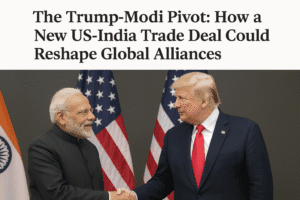
The Trump-Modi Pivot: How a New US-India Trade Deal Could Reshape Global Alliances
The air in the Oval Office carries the weight of history, but on this occasion, it was filled with the palpable energy of a potential geopolitical realignment. As President Donald Trump oversaw the swearing-in of his new ambassador to India, Sergio Gor, he didn’t just outline diplomatic pleasantries; he unveiled the contours of a “much different deal” with India—a pact that could fundamentally alter the economic and strategic calculus of both nations.
This isn’t merely a trade negotiation about tariff percentages and market access. It’s a high-stakes drama involving Russian oil, American penalties, China’s shadow, and the aspirations of the world’s largest democracy. At its heart lies a simple, transformative question: Can the United States and India forge a new compact that moves beyond historical grievances and aligns their interests for a new era?
Beyond “America First” and “Make in India”: The Anatomy of a “Different Deal”
When President Trump declares a deal to be “much different,” it’s a phrase laden with meaning. Historically, US-India trade talks have been protracted, often stalling over agricultural subsidies, intellectual property, and medical device prices. The new approach appears to be broader, more strategic, and crucially, linked to geopolitical concessions.
The “different” aspects likely include:
- A Shift from Bilateral Deficits to Strategic Gains: The previous administration focused heavily on reducing the US goods trade deficit with India. While this remains a talking point, the new framework seems to prioritize long-term strategic advantages—countering Chinese influence in the Indo-Pacific and integrating India into secure, US-friendly supply chains—over short-term balance sheets.
- Security-for-Trade Linkage: The most explicit connection is between trade and India’s energy imports from Russia. By openly stating that tariffs could drop if Indian purchases of Russian crude “substantially” decrease, Trump is creating a direct quid pro quo. This is a pragmatic, if unorthodox, fusion of foreign policy and economic negotiation.
- A Personal Touch: The repeated praise for Prime Minister Narendra Modi and the appointment of an ambassador tasked with being “friendly with him” underscores a reliance on personal diplomacy. This top-down approach can bypass bureaucratic inertia but also makes the deal highly dependent on the continuity of the current political leadership in both countries.
The Russian Oil Conundrum: India’s Strategic Dilemma
The centerpiece of this negotiation is India’s relationship with Russian oil. Following the Ukraine conflict, India astutely capitalized on discounted Russian crude, which soared to become its top source of imports. This provided immense economic relief, shielding Indian consumers from volatile global prices and helping to manage inflation.
However, this pragmatism came at a diplomatic cost. The US and its allies viewed these purchases as a financial lifeline to Moscow, undermining sanctions. The imposition of tariffs—reportedly as high as 50% on some Indian goods, with a specific 25% penalty tied to Russian oil—was Washington’s lever to force a change in behavior.
For India, this presents a classic strategic dilemma:
- The Economic Imperative: Cheap Russian oil is a direct boon to India’s economy. Abandoning it entirely would mean higher import bills, potential fuel price hikes, and strain on a developing economy supporting 1.4 billion people.
- The Strategic Imperative: Closer ties with the US offer unparalleled benefits: access to advanced technology, deeper defense cooperation, and a counterbalance to an increasingly assertive China on its border. Aligning more closely with Washington is a long-term strategic priority.
The path forward, as hinted by Trump’s comments, is not a full severance but a “substantial reduction.” This allows India to diversify its energy basket—perhaps by increasing imports from the US itself or other allies—while gradually weaning off its dependency on Russia, all without appearing to capitulate to external pressure.
The Bigger Picture: A Shared Rivalry with China
To understand why both nations are willing to navigate this complex dance, one must look east to China. For the United States, India is the indispensable counterweight in its Indo-Pacific strategy. A strong, economically vibrant, and strategically aligned India can help check Chinese expansionism.
For India, the threat from China is direct and territorial. The bloody clashes in Galwan Valley in 2020 were a stark reminder that its primary security challenge lies along its northern border. Closer integration with the US and its allies provides diplomatic support, intelligence sharing, and access to cutting-edge military hardware.
A successful US-India trade deal would be more than an economic agreement; it would be the economic pillar of a stronger security alliance. It signals to Beijing that the democratic world’s two largest nations are capable of setting aside differences to present a united front.
The Road Ahead: Challenges and Opportunities
While the optimism from the Oval Office is notable, the path to a signed deal is fraught with potential obstacles.
- The Devil in the Details: Agreeing on the principle of reducing Russian oil imports is one thing; agreeing on the baseline, the timeline, and the verification process is another. What constitutes “substantially reduced”?
- Unresolved Trade Irritants: Even with the oil issue settled, older points of friction—such as India’s price caps on medical devices like stents and knees, or its digital protectionism—will resurface and need resolution.
- Domestic Political Pressures: Both leaders face constituencies with competing interests. American farmers and manufacturers will demand significant concessions, while Modi must protect India’s vast agricultural and small-business sectors from being overwhelmed.
- The Risk of Unforced Errors: The article notes that Trump’s claim of an assurance from Modi on reducing Russian oil purchases has not been confirmed by Indian officials. This highlights the fragility of such talks, where a single misstatement can trigger diplomatic backlash and public posturing.
A Pivotal Moment
The prospect of a “much different” US-India deal represents a pivotal moment in 21st-century geopolitics. It is a recognition that the old rules of engagement are insufficient for the challenges of today. By creatively linking trade, energy, and security, the US and India are attempting to craft a partnership that is truly strategic.
For the United States, it’s an opportunity to solidify a democratic alliance that spans the Indo-Pacific. For India, it’s a chance to secure its economic future and its territorial integrity. And for the world, it’s a signal that the post-Cold War order is giving way to a new, more complex arrangement of alliances, where oil, tariffs, and shared rivalries are the currencies of power.
The success of this negotiation is not guaranteed, but the very fact that it is being pursued with such vigor reveals a profound truth: both Washington and New Delhi have concluded that they need each other more than they need to win any single argument. In the grand chessboard of global politics, that realization may be the most powerful deal of all.
You must be logged in to post a comment.