
The Tourist Trap: How an IDF Veteran’s Istanbul Vacation Became a Diplomatic Nightmare
An Israeli-Turkish dual national was arrested in Istanbul while visiting her parents after an anti-Israel activist group identified her past IDF service through social media and urged Turkish authorities to detain her under laws prohibiting foreign military service and alleging war crimes related to Gaza. The woman was held under house arrest for several days until diplomatic intervention by Israel’s Foreign Minister Gideon Sa’ar and pressure from the US administration secured her release, allowing her to travel to a third country and then return to Israel. The incident has alarmed Israeli officials amid tense relations with Turkey and follows a broader pattern of activist groups like the Hind Rajab Foundation targeting Israeli soldiers abroad, highlighting the growing vulnerability of dual nationals whose military service can now follow them across borders.
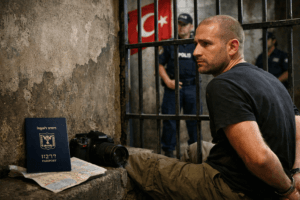
The Tourist Trap: How an IDF Veteran’s Istanbul Vacation Became a Diplomatic Nightmare
The call came late on a Tuesday evening. On the other end of the line, a young woman’s voice trembled with a mixture of fear and confusion that no twenty-something should ever have to experience while visiting their parents.
“Mom, they’re taking me to the police station. I don’t understand what’s happening.”
What followed would become one of the most delicate diplomatic tightrope walks between Jerusalem, Washington, and Ankara in recent memory—a case that has sent shockwaves through Israel’s dual-national community and fundamentally altered how thousands of Israeli citizens view vacation travel to Turkey.
A Family Visit Turns Into House Arrest
The woman, whose identity remains protected by Israeli media at the request of security officials, had done what countless Israeli-Turkish dual nationals do every year. She booked a flight to Istanbul to spend time with her parents, who maintain a residence in Turkey’s vibrant cultural capital. She packed light, looked forward to her mother’s cooking, and anticipated nothing more complicated than navigating the city’s notorious traffic.
She did not anticipate becoming a geopolitical bargaining chip.
According to Channel 12 News and confirmed by diplomatic sources, the former Israel Defense Forces soldier was apprehended last week under a Turkish law that prohibits citizens from serving in foreign militaries—legislation that has existed for decades but has rarely been enforced against Israelis until recently.
For several hours, she sat in police custody, confused and increasingly terrified as Turkish authorities processed her detention. When she was eventually released, it was not to freedom but to a different kind of confinement: house arrest at her parents’ home, her passport effectively confiscated, her ability to leave the country suspended indefinitely.
The Digital Hunters
How did Turkish authorities discover her military service? The answer lies in the shadowy intersection of social media activism and international lawfare.
An anti-Israel Turkish activist group, reportedly focusing specifically on female soldiers, had been systematically compiling a database of dual-national IDF veterans. Their method was disturbingly simple: scrape publicly available social media profiles, cross-reference military service mentions with location data indicating Turkish connections, and compile dossiers for submission to local prosecutors.
The group’s campaign gained momentum approximately ten days before the woman’s arrest, when Israeli news outlet Ynet published figures estimating that over 50,000 dual nationals currently serve in the IDF. For activists seeking to weaponize Turkish law against Israeli citizens, this statistic represented not just numbers but opportunities.
When the woman arrived in Istanbul, her details were already circulating in activist networks. The group urged Turkish authorities to arrest her not merely under the foreign military service statute but under laws relating to “genocide and crimes against humanity” in connection with the Gaza war—allegations that Israel vehemently denies.
The Diplomatic Tightrope
What happened next illustrates both the fragility of Israeli-Turkish relations and the complex web of international diplomacy that often operates far from public view.
Foreign Minister Gideon Sa’ar personally became involved in the case, according to reports. The diplomatic push involved multiple channels, multiple countries, and considerable urgency. Israeli officials understood that allowing this arrest to stand—or permitting a prosecution to move forward—would establish a dangerous precedent for the thousands of dual nationals who regularly travel to Turkey.
But Israel’s direct leverage with Turkey is limited. Relations between the two nations have deteriorated significantly since the October 7, 2023 Hamas attacks and the subsequent Gaza war. President Recep Tayyip Erdogan has been among Israel’s most vocal critics, and diplomatic back channels that once functioned with relative efficiency have grown cold.
This is where the United States entered the picture.
According to Hebrew media reports, Washington delivered a clear message to Turkish authorities: release the woman immediately. The nature of that message—whether diplomatic demarche, economic pressure, or private assurance—remains undisclosed. What matters is its effectiveness.
Within days, the woman was permitted to leave Turkey. Significantly, she did not fly directly to Israel. Instead, she traveled to a third country—reports suggest a European nation with functional diplomatic relations with both Israel and Turkey—where Israeli authorities could receive her safely before arranging her final flight home.
The Human Cost
Since her return, Foreign Minister Sa’ar has spoken with her directly. The content of that conversation remains private, but its very occurrence signals the seriousness with which Israeli officials view this incident.
For the woman herself, the psychological toll is immeasurable. What began as a routine family visit became an experience of detention, fear, and international incident. She now joins a small but growing group of Israelis who have discovered that their military service—something viewed domestically as patriotic duty—can become a liability abroad.
Her case raises uncomfortable questions for thousands of Israeli dual nationals. How many others are in similar databases? How many activist groups are compiling similar dossiers? And how many countries might prove receptive to these efforts?
The Hind Rajab Precedent
This Istanbul arrest follows a pattern established by the Hind Rajab Foundation, a Belgium-based legal group named after a six-year-old Gazan girl killed in January 2024. Since 2024, the foundation has filed dozens of criminal complaints against Israeli soldiers and officials traveling in Europe, using social media posts to locate and target them.
The foundation has claimed partial credit for forcing an Israeli soldier to flee Brazil amid fears of arrest. It has sparked European investigations and created a climate of anxiety among IDF veterans considering international travel.
Notably, however, the Hind Rajab Foundation has yet to secure a successful prosecution. No soldier targeted by the group has been convicted of war crimes or any other offenses related to Gaza service. Israeli officials maintain that this reflects the baseless nature of the allegations—that Israel’s military operations comply with international law and that allegations to the contrary stem from political animus rather than legal merit.
The Istanbul case differs in one crucial respect: it invokes Turkey’s foreign military service prohibition rather than war crimes allegations. This statutory basis may prove more difficult to challenge legally, even if its application in this case appears politically motivated.
A Warning for Travelers
Israeli legal, military, and political officials are alarmed, according to Channel 12. The current tensions with Turkey mean that similar incidents could recur, and the activist infrastructure for identifying potential targets continues to grow more sophisticated.
The IDF has already begun implementing new rules to protect troops’ privacy following the Hind Rajab Foundation’s activities. Soldiers are being advised to review social media presence, remove identifying details about military service, and exercise extreme caution when posting photos in uniform or discussing their units online.
But for dual nationals—citizens of both Israel and another country—the vulnerability is structural. Their very identity, split between nations, makes them subject to the laws and political winds of both. When those winds shift, as they have between Israel and Turkey, the danger becomes immediate.
The Geopolitical Context
Understanding this incident requires understanding the broader deterioration of Israeli-Turkish relations. Once regional partners with significant military and economic cooperation, the two nations have spent much of the past decade moving in opposite directions.
The Gaza war accelerated this divergence dramatically. Erdogan has positioned Turkey as a leading voice criticizing Israeli military operations, hosting Hamas leaders and accusing Israel of war crimes. Israeli officials, in turn, have condemned Turkey’s support for what they term a terrorist organization.
Into this poisoned atmosphere arrived a young woman who simply wanted to see her parents.
What Comes Next
For now, the immediate crisis has resolved. The woman is home, safe, and presumably processing an experience that will shape her relationship with her Turkish heritage for years to come.
But the underlying issues remain unaddressed. The activist groups continue compiling databases. Turkish law remains on the books. And thousands of dual nationals must now weigh every family visit against the possibility of detention.
Some will undoubtedly reconsider travel to Turkey altogether. Others will scrub their digital footprints, hoping to avoid detection. A few may even reconsider military service, recognizing that what their country views as obligation could elsewhere be grounds for arrest.
None of these outcomes serve anyone’s interests—not Israel’s, not Turkey’s, and certainly not the families divided between them. But in the current climate, individual interests often yield to geopolitical currents beyond anyone’s control.
The woman arrested in Istanbul learned this lesson in the most frightening way possible. She returned home with her freedom intact but with something else permanently altered: the assumption that family, heritage, and a parent’s home offer protection anywhere in the world.
They do not. Not anymore. Not in a world where military service follows you across borders, where activists compile dossiers from public posts, and where the simplest family visit can become an international incident requiring presidential intervention to resolve.
For the thousands of Israelis weighing vacation plans in the coming months, her story is not just news. It is a warning.
You must be logged in to post a comment.