
The Tightrope Walker: Decoding S. Jaishankar’s Balancing Act Between Israel and Iran
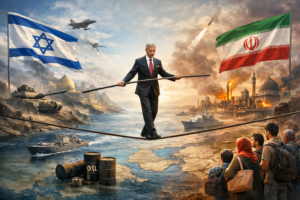
The Tightrope Walker: Decoding S. Jaishankar’s Balancing Act Between Israel and Iran
In the high-stakes world of diplomacy, what is said behind closed doors often matters more than the carefully curated press releases issued to the public. On Wednesday, India’s External Affairs Minister, Dr. S. Jaishankar, offered a rare glimpse into the pragmatic, often unspoken, calculus of New Delhi’s foreign policy during an all-party meeting. In a session meant to brief parliamentarians on global developments, Jaishankar did something unusual: he confirmed, albeit in an in camera setting, the long-suspected strategic depth of India’s relationship with Israel, while simultaneously making a robust case for the resilience of its ties with Iran.
For decades, India has played a delicate game in West Asia, maintaining a tightrope walk between rival powers. But with the region currently a powder keg—teetering on the edge of a direct confrontation between Iran and the US-Israel axis—Jaishankar’s remarks revealed not just India’s position, but the hard-nosed realism driving it.
The Israeli Connection: From Secret to Strategic Certainty
The most striking revelation from the meeting, attended by leaders from various political parties, was Jaishankar’s acknowledgment of Israeli military assistance during India’s past conflicts. While the minister reportedly did not specify which conflicts, the context pointed directly to the Kargil War of 1999 and the 1965 and 1971 wars with Pakistan.
For years, the India-Israel defense relationship was an open secret wrapped in political ambiguity. Due to India’s historical support for the Palestinian cause and the domestic political sensitivities surrounding the issue, successive governments often preferred to keep the military cooperation—which is now estimated to be worth billions of dollars—under the radar. Jaishankar’s assertion that Israel has been a “reliable source of defence technology” and a helper during “military conflicts” strips away that old ambiguity.
This is significant for two reasons. First, it signals a maturation of India’s political landscape, where the strategic necessity of the relationship now outweighs the electoral anxieties of the past. Second, it serves as a deterrent signal. By publicly (even within the parliamentary forum) acknowledging that Israel provided “speedy” assistance during confrontations with Pakistan, India is sending a quiet message to Islamabad about the reliability of its alternative supply chains.
During the Kargil War, for instance, Israel reportedly supplied laser-guided munitions and drones at a critical juncture when Western nations were reluctant to get involved. This is not merely transactional; it is a relationship built on interoperability, intelligence sharing, and counter-terrorism cooperation. In a multipolar world where supply chain resilience is as important as military might, Jaishankar’s statement reaffirms that Israel is not just a “technological ally” but a wartime insurance policy for India.
The Iran Equation: More Than Just a Condolence Book
If the comments on Israel were about strategic depth, the minister’s remarks on Iran were about diplomatic dexterity. The opposition’s query implied that India’s growing closeness to the US and Israel had come at the cost of its traditional friendship with Tehran. Jaishankar dismantled this narrative with a mix of procedural clarity and high-seas drama.
One of the key criticisms leveled against the government was the perceived delay in condemning the recent assassination of Iran’s Supreme Leader, Ayatollah Ali Khamenei, and the broader attack on Iranian sovereignty. Jaishankar’s response was a masterclass in bureaucratic diplomacy: he noted that Foreign Secretary Vikram Misri signed the condolence book the day it was opened. In diplomatic terms, timeliness is often more important than volume of rhetoric. By pointing this out, the minister suggested that the absence of a loud public outcry did not equate to a lack of diplomatic sensitivity.
However, the real insight came when Jaishankar explained the context behind India’s refusal to “condemn” the attack on Iran. Here, he introduced a factor often overlooked in the Western-centric analysis of the conflict: the Gulf Arab states.
He noted that the government had to consider the “outrage” in Saudi Arabia and the United Arab Emirates (UAE) over the damage caused by Iranian drones and missiles. This is a crucial piece of the puzzle. For India, the Gulf is not just a geopolitical region; it is an economic lifeline. With over 8 million Indian expatriates living and working in the UAE and Saudi Arabia—sending home billions in remittances and forming the backbone of India’s energy security—New Delhi cannot afford to take sides in a way that alienates the Gulf Arabs.
India’s silence on condemning Iran was, therefore, a form of strategic neutrality. It was a decision to prioritize the safety and economic well-being of its diaspora and the stability of its energy imports over performing a gesture of solidarity that would have inflamed the Arabian Gulf.
A Story of Safe Harbors and Hostile Waters
Perhaps the most cinematic—and telling—anecdote from Jaishankar’s briefing was the story of the IRIS Lavan and the IRIS Dena. In the shadowy waters of the Indian Ocean, a naval thriller unfolded that perfectly encapsulates India’s role as a net security provider.
According to the minister, when a US nuclear submarine was lurking in the region after sinking the IRIS Dena (an Iranian sister ship), India offered safe harbor to the IRIS Lavan, allowing it to anchor at Kochi port. The implication was clear: India provided a shield to the Iranian vessel, preventing it from suffering the same fate as its counterpart.
The moral of the story, as Jaishankar framed it, was that the IRIS Dena would have survived if it had accepted India’s earlier offer of a safe harbor. Instead, it drifted into international waters where it became a target. This narrative serves multiple purposes. It is a subtle flex of India’s naval power and its ability to project stability in the Indian Ocean Region (IOR). It is also a message to Tehran: India is a trusted player that can provide protection, but only if you play by the rules and remain within India’s sphere of influence.
This incident, more than any official statement, illustrates the level of trust that exists between the Indian and Iranian naval establishments. Despite the geopolitical turmoil, operational-level ties remain functional and, in some cases, protective.
The Strait of Hormuz: Where the Rubber Hits the Road
The final, and perhaps most tangible, proof of India’s successful balancing act lies in the Strait of Hormuz. Since the outbreak of the current war, Iran has flexed its muscles by disrupting or delaying traffic through this vital chokepoint, through which nearly 20% of the world’s oil passes.
Jaishankar revealed that despite the blockade and heightened tensions, Iran has allowed four Indian ships to pass through the strait, with five more on the way. He quoted Iran calling India a “trusted player” capable of mediating the crisis.
This is not a coincidence. It is the result of years of diplomatic investment. While India has deepened ties with Israel and the US, it has simultaneously worked to maintain a functioning relationship with Tehran. The development of the Chabahar Port—a project designed to bypass Pakistan and open a trade corridor to Afghanistan and Central Asia—has given India a strategic foothold in Iran that Tehran values, despite its disagreements with Washington.
India’s approach here is transactional but grounded in long-term vision. By securing passage for its ships through Hormuz, India is ensuring its energy security and trade continuity. By not condemning Iran publicly, it is preserving the goodwill needed to keep Chabahar operational. Simultaneously, by acknowledging Israel’s military help, it is keeping its defense options open.
Conclusion: The Art of Strategic Autonomy
What emerged from the all-party meeting was a portrait of India’s foreign policy that defies easy labels. The opposition’s question—whether India was tilting towards the US-Israel axis—was answered with a resounding “no” wrapped in a complex “yes.”
Jaishankar’s India is not choosing sides; it is leveraging contradictions. It accepts help from Israel to secure its borders while hosting Iranian warships to secure its diplomatic flank. It acknowledges the outrage of Saudi Arabia to protect 8 million citizens while using Iran’s territorial waters to move its commerce.
In a world increasingly divided into bipolar blocs, India is carving out a space where it can be both a security partner to Tel Aviv and a “trusted player” in Tehran. The remarks at the all-party meeting were not just a defense of the government’s policy; they were a declaration of intent. India is no longer a passive observer in West Asia, worried about its image. It is an active stakeholder, willing to make pragmatic—and sometimes contradictory—choices to protect its national interest.
For the Indian public, the takeaway is clear: in the complex web of Middle Eastern geopolitics, India is no longer just a bystander worried about oil prices. It has become an indispensable mediator, a safe harbor for warships, and a reliable partner for all sides—even when those sides are at war with each other. That is the ultimate definition of strategic autonomy in the 21st century.
You must be logged in to post a comment.