
The Tightrope Walk: How India Navigates the Minefield of the Strait of Hormuz
Amid escalating US-Israel-Iran tensions that have turned the Strait of Hormuz into a high-stakes geopolitical minefield, Iran has granted Indian-flagged vessels safe passage through the critical waterway—a diplomatic victory for New Delhi resulting from its delicate balancing act between maintaining ties with Tehran and its strategic partnership with the West. The exemption, however, comes with Iran’s stark warning that ships must seek prior approval or risk being targeted, leaving 778 Indian seafarers and the nation’s energy security precariously dependent on Tehran’s goodwill. While this temporary reprieve showcases India’s successful “strategic autonomy” in foreign policy, it underscores the fragility of global supply chains, as any sustained disruption to the strait—through which 20% of the world’s oil passes—would trigger economic shockwaves far beyond the immediate conflict zone.
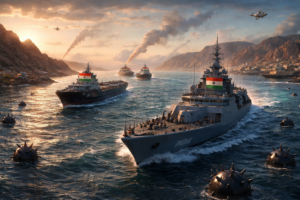
The Tightrope Walk: How India Navigates the Minefield of the Strait of Hormuz
In the treacherous waters of geopolitics, few chokepoints are as volatile and vital as the Strait of Hormuz. A narrow, 21-mile-wide passage connecting the Persian Gulf to the open ocean, it is the world’s most critical artery for crude oil. Recently, this waterway has transformed from a bustling maritime highway into a high-stakes geopolitical minefield. As the shadow of the US-Israel-Iran conflict lengthens, a recent development has offered a sliver of relief for one nation: India.
According to a report in The Economic Times, Iranian authorities have assured that Indian-flagged vessels will be allowed to pass through the Strait safely. This exemption, however, comes with a chilling caveat: seek permission from Tehran, or be targeted. This news offers a unique lens through which to examine India’s precarious diplomatic balancing act, the human cost of global conflict, and the fragility of the world’s energy supply chain.
A Permission Slip to Sail: The New Reality in Hormuz
The image is stark: the Islamic Revolutionary Guards Corps (IRGC), a formidable naval force, now scrutinizes every vessel attempting to traverse the Strait. Rear Admiral Alireza Tangsiri’s warning was not veiled in diplomatic language. It was a blunt declaration of control, punctuated by action. He claimed that two ships, the Express Rome and the Mayuree Naree, were struck on Wednesday after ignoring Iran’s warnings and trusting in “empty promises.”
While the nationalities of the crews on these vessels remain a point of contention, the message to the world—and specifically to India—is unmistakable. Even as Iran extends a “safe passage” pass to New Delhi, it is a reminder that this safety is contingent on acknowledging Tehran’s dominance in its own backyard. For India, it’s a stark illustration of how global supply chains can be held hostage to regional conflicts.
The exemption for Indian vessels isn’t an act of random benevolence. It is a calculated signal from Tehran to New Delhi, acknowledging India’s historically nuanced and independent foreign policy. Unlike the unequivocal condemnations from Washington or Brussels, India has long cultivated a relationship with Iran, rooted in centuries of cultural exchange and strategic necessity. This diplomatic channel, kept open even under US sanctions, is now paying a tangible dividend: the safe passage of 28 Indian-flagged vessels and the 778 seafarers aboard them, who were potentially trapped in a war zone.
India’s Delicate Dance: Between a Persian Promise and an American Alliance
For External Affairs Minister Dr. S. Jaishankar, ensuring the safety of these ships wasn’t just a logistical issue; it was a top-tier diplomatic priority. His late-night phone call with his Iranian counterpart, Abbas Araghchi, was their third interaction since the conflict’s escalation. This isn’t the diplomacy of public press releases, but the quiet, persistent work of maintaining communication lines when they are most needed.
This is the essence of India’s “strategic autonomy.” On one hand, India has deepened its security partnership with the United States and Israel—a key defense partner—to unprecedented levels through frameworks like the Quad and major defense deals. On the other, it maintains a robust, independent relationship with Iran, viewing it as a crucial neighbor and a gateway to Central Asia and Afghanistan via the Chabahar Port.
The Strait of Hormuz crisis throws this tightrope walk into sharp relief. India cannot afford to alienate the US, its largest export partner and a critical source of technology and defense. Yet, it also cannot ignore Iran, a nation that holds the keys to India’s energy security and the safety of its citizens in the region. The “safe passage” guarantee is a testament to the success of this delicate balancing act, but it also serves as a warning of how easily it could be upended. A single miscalculation, a single ship caught in the crossfire, could unravel years of diplomatic bridge-building.
The Human Cost: The 778 Reasons This Matters
Beyond the barrels of oil and geopolitical maneuvering, this story has a deeply human dimension. The Indian shipping ministry has identified 778 Indian seafarers currently in the line of fire. These are not abstract entities; they are officers and crew from maritime states like Kerala, Mumbai, and Gujarat. They are engineers, cooks, and captains who went to sea to support their families, now finding themselves as unwitting pawns in a high-stakes international conflict.
Imagine being aboard a tanker, hearing reports that the waterway you need to cross has been mined, and that your nation has secured a promise of safe passage—but only if you ask permission from a military force that has just struck other ships. The psychological toll on these sailors and their families back home is immense. A 24-hour control room has been set up in India’s shipping ministry, a reassuring but ultimately limited comfort for those watching the horizon from the bridge of a ship, unsure if the next blip on the radar is a friend or foe.
Their situation highlights a grim reality of modern warfare: civilians, often from nations not directly party to the conflict, become the first and most vulnerable casualties. They are the “collateral” in a conflict fought with long-range missiles and naval mines, their lives hanging on the outcome of frantic phone calls between distant foreign ministries.
The Economic Domino Effect: From the Gulf to Your Fuel Tank
The turmoil in the Strait of Hormuz is not just a Middle Eastern problem; it is an immediate, tangible threat to the global economy. With over 20 million barrels of crude oil—roughly 20% of global consumption—passing through its waters daily, any sustained disruption sends shockwaves across the planet.
The fear of supply disruptions has already pushed oil prices higher. In response, the US Department of Energy’s announcement to release a massive 172 million barrels from its Strategic Petroleum Reserve is akin to a fire department dousing a house that isn’t fully ablaze yet. It’s a preventative measure, designed to calm jittery markets and assure consumers that the US has the firepower to weather a potential storm.
For India, the world’s third-largest oil importer and consumer, the stakes are astronomical. A sustained spike in oil prices would widen its trade deficit, weaken its currency, and fuel domestic inflation, impacting everything from the price of cooking gas for a household in Delhi to the viability of a trucking company in Chennai. India’s energy security is directly tied to the tranquility of this narrow stretch of water. While the current “safe passage” for its flagged ships is a relief, it does nothing to shield India from the broader market volatility that the mere threat of a closure creates.
The Warning Shot: What the Attack on Ships Really Means
Rear Admiral Tangsiri’s statement is a masterclass in psychological warfare. By naming the ships that were “caught,” he isn’t just boasting; he is creating a powerful deterrent. The message to the global shipping industry is clear: the old rules of maritime law no longer apply here. The freedom of navigation, a principle upheld for centuries, has been replaced by a system of prior permission from a regional power.
This sets a dangerous precedent. If a nation can unilaterally decide to police a major international waterway, demanding allegiance tests from commercial vessels, it fundamentally challenges the global order. The ambiguity of the targets—why were Express Rome and Mayuree Naree singled out?—adds to the terror. It fosters an environment of paranoia where shipping companies must constantly weigh commercial interests against existential risk.
For now, India has navigated this treacherous moment with skill, securing a guarantee for its vessels and its people. But the core issue remains unresolved. The Strait of Hormuz is no longer just a shipping lane; it is a fuse box for the entire world. As long as the conflict between Iran, the US, and Israel continues to simmer, the safety of every vessel, including those with an Indian flag, will depend less on international law and more on the precarious goodwill of the powers that control the guns on the shore. The “safe passage” granted to India is a testament to its diplomacy, but in the volatile landscape of West Asia, such assurances are written in sand, not stone.
You must be logged in to post a comment.