
The Tightrope in Tel Aviv: Modi’s Gaza War-Era Visit Puts India’s Delicate Balancing Act to the Test
Prime Minister Narendra Modi’s two-day visit to Israel, his first since the Gaza war began, represents a high-stakes test of India’s ability to balance its deep strategic partnership with Israel against its broader interests in the Middle East, including ties with Iran and Arab nations. While the visit underscores the flourishing defense, technology, and trade ties between the two countries—a relationship Modi has championed since 2014—it is shadowed by regional tensions, domestic political controversies in both nations, and the moral weight of civilian casualties in Gaza, with Modi’s schedule including a Knesset address but no meeting with Palestinian leaders, highlighting India’s delicate diplomatic tightrope.
The Tightrope in Tel Aviv: Modi’s Gaza War-Era Visit Puts India’s Delicate Balancing Act to the Test
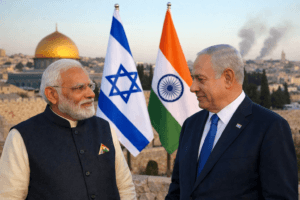
As the facade of the Knesset in Jerusalem glowed with the saffron, white, and green of the Indian flag, the image was a powerful symbol of a transformed relationship. For Indian Prime Minister Narendra Modi, touching down in Tel Aviv for a two-day visit, it was a moment of profound personal and political significance. Yet, beneath the warm hues of the welcome, the geopolitical reality is far more complex. This is not the same region Modi visited in 2017. This is Israel in the throes of a prolonged and devastating war, and Modi’s visit is a high-stakes test of New Delhi’s ability to walk a diplomatic tightrope.
This trip, the first by the Indian premier since the Gaza war began, is being framed by both nations as a celebration of a three-decade-old partnership that has blossomed into a strategic alliance. But the timing and the context force a more nuanced examination. It’s a visit that underscores India’s rise as a major power willing to engage with multiple, often conflicting, partners in a volatile region, while also exposing the domestic and international fault lines such a strategy creates.
From Hostility to Embrace: The Long Road to Jerusalem
To understand the weight of this moment, one must look back at the journey of India-Israel relations. For over four decades after its independence in 1947, India was a staunch supporter of the Palestinian cause and a vocal critic of Israel. It was a position born of anti-colonial solidarity, a large domestic Muslim population, and a foreign policy that aligned closely with the Non-Aligned Movement and the Arab world. India voted against the UN partition plan in 1947 and only established full diplomatic relations in 1992.
The real inflection point, however, came with Narendra Modi’s ascent to power in 2014. His government decoupled the relationship from the Palestinian issue, treating Israel as a partner in its own right. The 2017 visit, where Modi became the first Indian Prime Minister to travel to Israel, was a landmark event. It de-hyphenated the relationship, signaling that India could engage deeply with Israel without abandoning its principled support for a two-state solution with the Palestinians.
That de-hyphenation is now being put to its most severe test. The current war, ignited by the horrific Hamas attacks on October 7, has re-cast the region in blood and fire. India’s response has been characteristically calibrated: a swift and unambiguous condemnation of terrorism, alongside consistent calls for protection of civilians, adherence to international law, and a return to the path of dialogue for a two-state solution.
This balancing act is the central theme of Modi’s visit. His schedule is telling. He will address the Knesset, a platform from which he is expected to praise the “shared vision” and “unbreakable bond” between the two nations. He will meet with Prime Minister Benjamin Netanyahu, a leader whose domestic and international standing has been profoundly impacted by the war. Yet, conspicuously absent from the itinerary is a stop in Ramallah to meet with Palestinian leaders—a gesture that had become customary in previous high-level visits to maintain a semblance of balance.
A Strategic Alliance on Display
The core of the visit is undeniably strategic. India and Israel share a convergence of interests that transcends the current conflict. Both nations see themselves as frontline states in the global fight against terrorism. They are partners in innovation, with a bilateral agreement on industrial R&D and technological innovation. Israel is a top supplier of defense hardware to India, ranging from missiles and drones to radars and border surveillance systems. This defense partnership is no longer a simple buyer-seller dynamic; it has evolved into co-development and joint production, a key pillar of India’s “Make in India” initiative in the defense sector.
Beyond defense, the relationship is powered by a robust partnership in agriculture, water management, and cybersecurity. Israeli drip irrigation techniques have transformed farms in Haryana and Maharashtra. Collaborations on water desalination and recycling are helping Indian cities tackle acute water scarcity. It is this tangible, life-improving cooperation that Modi is likely to champion in his addresses, presenting Israel not just as a strategic partner in a time of war, but as a source of technological solutions for India’s developmental challenges.
Netanyahu, for his part, is keen to showcase this bond as a “powerful alliance between two global leaders” and an “axis of nations committed to stability and progress.” For an Israeli leader facing immense international pressure over the conduct and human cost of the war in Gaza, a high-profile visit from the leader of the world’s most populous country is a significant diplomatic victory. It is a message to the world that Israel is not isolated.
The Spectre of a Wider War
But the visit unfolds under the long shadow of a potential regional conflagration. The backdrop is not just the war in Gaza, but also the escalating rhetoric and military posturing involving Iran. The report mentions former US President Donald Trump’s threat of military action against Iran, which has led to one of the largest US military buildups in the region in decades. For India, this is a nightmare scenario.
India’s relationship with Iran is deep and historic, encompassing energy ties and the strategic development of the Chabahar Port, which gives New Delhi a crucial trade and connectivity route to Afghanistan and Central Asia, bypassing Pakistan. A war with Iran would put India in an impossible position. While Modi and Netanyahu will undoubtedly discuss these regional threats, analysts suggest the discussions will be held behind closed doors. Publicly, the focus will remain on bilateral ties. New Delhi’s message is likely to be one of restraint, urging de-escalation, but its leverage is limited. The visit is a reminder that while India partners with Israel, its interests in the Middle East are far broader and include maintaining strong ties with Iran, Saudi Arabia, and the UAE.
Domestic Controversies and Political Theatre
The high diplomacy of the visit is also being undercut by political theatre on both sides, offering a dose of human reality to the otherwise grand narrative.
In Israel, the carefully choreographed visit has been thrown into disarray by domestic political strife. The opposition has threatened to boycott Modi’s landmark address to the Knesset. Their grievance is the reported exclusion of Supreme Court President Isaac Amit from the state dinner and other events. This snub is seen as part of the ongoing and deeply divisive battle over the government’s contentious judicial overhaul. The opposition’s potential boycott would be a major embarrassment, robbing Modi of the unified and respectful audience such an occasion demands. The Speaker of the Knesset is reportedly scrambling to invite former lawmakers to fill the empty seats, a logistical fix that highlights the deep dysfunction at the heart of Israeli politics.
Meanwhile, back in India, opposition parties have also seized on the visit. Jairam Ramesh, a spokesperson for the Congress party, condemned the trip, accusing the Modi government of abandoning the Palestinian cause. This criticism resonates with a significant segment of India’s population and its traditional foreign policy establishment. For them, Modi’s embrace of Netanyahu, especially during a war that has seen a staggering number of civilian casualties in Gaza, represents a moral failure and a betrayal of India’s anti-colonial legacy. This domestic pushback serves as a constant reminder to the government that its foreign policy choices are watched and debated at home, and that the balancing act is not just international, but internal as well.
The Human Cost and the Diplomatic Silence
Perhaps the most profound insight missing from the official itinerary is the human one. The report mentions India’s “concern over civilian casualties.” But standing in Jerusalem, looking out towards Gaza, the scale of that tragedy feels abstract. For many around the world, and for a portion of India’s own citizens, the optics of a lavish reception and glowing speeches in the Knesset, while a humanitarian catastrophe unfolds just 70 kilometers away, are deeply jarring.
Modi’s speech, stripped of any direct mention of the Palestinian suffering, will be scrutinized for its moral tone. Can he praise Israel’s commitment to “peace and progress” without acknowledging the pain and devastation that has gripped Gaza? His careful avoidance of a meeting with Palestinian leaders, while strategically logical for maintaining the “de-hyphenation” policy, risks being perceived as a deafening silence.
This is the tightrope’s sharpest edge. India wants to be a friend to Israel and a partner to the Arab world, all while maintaining its traditional support for the Palestinian people. It is a policy of strategic autonomy, of keeping all options open. But in the zero-sum atmosphere of a brutal war, such nuance is often lost. Every handshake in Jerusalem is seen as a slight in Ramallah.
Conclusion: A Visit of Strategic Affirmation and Moral Ambiguity
As Modi’s motorcade winds its way through the streets of Jerusalem, it carries the weight of history and the burden of the present. This visit is a powerful affirmation of a transformed and deepening India-Israel relationship. It showcases a partnership built on shared strategic interests, technological collaboration, and a common approach to security challenges. For India, it is a marker of its arrival as a global power that can engage with key players on its own terms.
Yet, it is also a visit steeped in moral and political ambiguity. It highlights the immense difficulty of maintaining a truly independent foreign policy in an interconnected and conflict-ridden world. Modi’s ability to champion the India-Israel friendship while simultaneously assuaging concerns in the Arab world and navigating the domestic political crosscurrents will define the success of this trip. The illuminated Knesset is a beacon of a burgeoning alliance, but for India, the light must also illuminate a path through a regional landscape scarred by war, ensuring that in strengthening one partnership, it does not irrevocably damage others that are equally vital to its future.
You must be logged in to post a comment.