
The Thin Line Between Service and Knowledge: Decoding India’s Royalty Rulings on Cross-Border Payments
The Thin Line Between Service and Knowledge: Decoding India’s Royalty Rulings on Cross-Border Payments
In the complex world of international taxation, few concepts are as fiercely contested as the definition of a “royalty.” For multinational enterprises operating in India, the distinction between a payment for technical services and a payment for the use of “information concerning industrial, commercial, or scientific experience” can mean the difference between a 10% withholding tax liability and a 0% liability under a tax treaty.
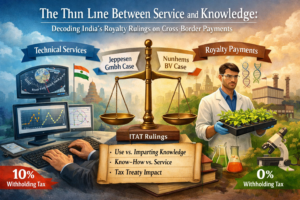
Two recent rulings by the Income Tax Appellate Tribunal (ITAT) in Mumbai and Delhi—Jeppesen GmbH v. Assistant Commissioner of Income Tax (2025) and Nunhems Netherlands BV v. Assistant Commissioner of Income Tax (2025)—have reignited this debate. While both cases involved the transfer of specialized knowledge, their outcomes were diametrically opposite. These rulings offer a masterclass in the fact-driven nature of royalty classification and provide a roadmap for structuring cross-border transactions to avoid costly tax traps.
The Core Dilemma: When Does “Use” Become “Imparting”?
The foundational challenge lies in the wording of Article 12 of the Income-tax Act, 1961, and most double taxation avoidance agreements (DTAAs). Royalty includes payments for the “imparting of any information concerning technical, industrial, commercial or scientific knowledge, experience or skill.”
At first glance, this seems broad enough to cover any payment for expertise. However, the judiciary has consistently drawn a line between a provider using its own skill to deliver a result and the provider transferring that skill so the recipient can use it independently.
The landmark 2007 Bombay High Court ruling in Diamond Services International v. Union of India set the benchmark. In that case, a Singapore-based company provided grading reports for diamonds. The court held that the reports were merely statements of fact based on the provider’s expertise, not a transfer of the expertise itself. The recipient could not take the provider’s gemological knowledge and apply it to its own diamonds independently. Consequently, the payment was not a royalty.
This logic, rooted in the OECD Model Tax Convention’s Commentary on Article 12, distinguishes between “know-how contracts” (royalties) and “service contracts” (business income or fees for technical services). The commentary explicitly states that the provision of services where the provider uses its customary knowledge to execute work for a client does not fall under the royalty definition—even if the provider utilizes special skills.
Case Study 1: Jeppesen GmbH (Mumbai ITAT) – The Output Approach
The Mumbai ITAT’s decision in Jeppesen is a textbook application of the Diamond Services principles. The taxpayer, a German non-resident, supplied flight information and navigational data to Indian airlines and aviation companies.
The tax authorities argued that the data supplied was the product of the company’s specialized know-how—its ability to compile, process, and standardize complex flight routes, weather patterns, and navigational charts. Therefore, the payments should be treated as royalties for “information concerning industrial, commercial or scientific experience.”
The tribunal, however, rejected this argument by applying a two-part test:
- Existence of Specialized Know-How: The tribunal acknowledged that the German company possessed significant expertise and proprietary methodologies for compiling navigational data.
- Impartment of Such Know-How: This was where the case failed. The ITAT found that the company did not transfer its proprietary methodology, algorithms, or internal processes to the Indian customers. Instead, it applied its expertise to create a standardized, final output (the flight information). The Indian customers received only the results of the service. They were not given the tools, formulas, or technical processes to generate this information themselves. Furthermore, the license restrictions prohibited duplication, resale, or alteration, reinforcing that the recipient was a consumer of the output, not a licensee of the underlying knowledge.
The ruling clarified a critical point: the mere possession of technical skill does not transform a service fee into a royalty. If the provider retains the secret sauce and only serves the final dish, the payment remains a service fee, potentially taxable only in the provider’s home country if no permanent establishment exists in India.
Case Study 2: Nunhems Netherlands (Delhi ITAT) – The Know-How Transfer
The Delhi ITAT’s decision in Nunhems stands in stark contrast, demonstrating how a slight shift in facts can lead to the opposite conclusion. In this case, a Dutch parent company provided specialized marker testing and double haploid (DH) services to its Indian subsidiary in the agricultural sector.
The services involved two key processes:
- Marker Testing: Examining seeds and leaves sent by the Indian entity and sharing results that would influence the Indian entity’s future breeding programs.
- DH Services: The Indian entity sent seeds to the Netherlands, where the parent used its proprietary processes to convert them into “double haploid” seeds with enhanced properties. These enhanced seeds were then returned to India for commercial exploitation.
The ITAT held that these payments constituted royalties. The tribunal distinguished Diamond Services by focusing on what was actually transferred.
Unlike the standardized reports in Jeppesen, the ITAT found that the test reports in Nunhems “encapsulated all the scientific experience and knowledge” of the parent company regarding seed conversion. More critically, the transfer of physical property—the enhanced hybrid seeds—carried with it the imbedded know-how. By sending back the converted seeds, the parent was not merely providing a service; it was imparting the result of its proprietary process that the Indian entity could use directly for commercial gain.
The tribunal’s reasoning suggests that when the result of the service is a product that the recipient can commercially exploit—and that product inherently contains the provider’s proprietary technology—the payment may cross the line into royalty territory. The Indian entity did not just receive a report; it received a biological product that would generate future revenue, derived entirely from the Dutch parent’s secretive, specialized process.
A Nuanced Analysis: Where Is the Line?
At the heart of these conflicting rulings lies a fundamental question: is the payment for the application of knowledge or the transfer of knowledge?
In Jeppesen, the navigational data was consumed by the airlines. It helped them fly efficiently, but they did not learn how to build the navigation system themselves. Their internal capabilities did not improve; they merely purchased a tool.
In Nunhems, the Indian subsidiary arguably gained a capability. By receiving the enhanced seeds, it bypassed years of research and development. While the Dutch parent did not teach a classroom course on DH conversion, it provided the embodiment of that knowledge in a form that the Indian entity could use independently—and indefinitely—to generate profit.
This distinction aligns with the OECD Commentary’s caution against classifying payments for “new information” obtained as a result of performing services as royalties. If the Dutch parent had simply tested seeds and said, “This seed has good yield potential,” it would be a service. But by converting the seeds and handing them back, it arguably transferred a piece of its intellectual property.
Practical Implications for Multinational Enterprises
For tax directors and CFOs, these rulings are not just academic exercises. They carry real-world implications for structuring intercompany agreements and transfer pricing policies. Based on the current judicial landscape, here are the key takeaways:
- The Contract is King, But Substance Reigns Supreme
The wording of the service agreement is the starting point. Tribunals will scrutinize whether the contract uses language implying a “transfer” of “knowledge” or a “provision” of “services.” However, labels are not binding. In Nunhems, despite the service-like description, the actual flow of enhanced seeds dictated the outcome.
- The “Independent Application” Test
This is the most critical litmus test. If, after receiving the payment, the Indian entity can perform the same task or generate the same outcome without further input from the foreign provider, the payment is likely a royalty. If the foreign provider must remain involved to ensure the output is useful (like updating navigational data), it is likely a service.
- Protection of Output vs. Transfer of Process
If the provider imposes strict restrictions on the use of the output—prohibiting the recipient from altering, copying, or sharing the product—it strengthens the argument that the provider is merely selling a service. Conversely, if the recipient gains unrestricted commercial rights to the output (especially if the output can be replicated or used as a base for further development), it suggests a royalty.
- The FTS Overlap
As noted by the authors Vasudevan, Bhardwaj, and Pandey, many Indian treaties also contain a “Fees for Technical Services” (FTS) clause. Under the India–US treaty, for instance, FTS is defined separately and often provides a backstop for taxation if the payment isn’t a royalty. Practitioners must analyze both the royalty and FTS definitions simultaneously, particularly the “make available” condition present in treaties like those with the UK, Singapore, and the Netherlands. A payment that fails the royalty test may still be taxable as FTS if it “makes available” technical knowledge.
- The Sectoral Sensitivity
The Nunhems ruling is particularly significant for the life sciences, agriculture, and technology sectors. Where the deliverable is a biological entity (seeds), chemical compound, or software code that embeds proprietary know-how, tax authorities are more likely to argue for royalty classification. The Jeppesen ruling offers a safer harbor for information services (SaaS, data feeds, analytics) where the deliverable is ephemeral or standardized.
Conclusion: The Case-by-Case Reality
The 2025 rulings from the Mumbai and Delhi ITATs serve as a stark reminder that in tax law, context is everything. There is no bright-line rule for “information concerning knowledge, experience or skill.”
The Jeppesen decision offers comfort to businesses that rely on providing standardized data services or application-based outputs without transferring underlying intellectual property. It reinforces the principle that simply being skilled at what you do does not turn your service fees into royalties.
Conversely, the Nunhems decision warns that when cross-border transactions involve the transfer of physical goods that are the direct result of proprietary processes—and when those goods enable the Indian recipient to generate future revenue without further provider involvement—tax authorities will aggressively classify those payments as royalties.
As India continues to assert its taxing rights and refine its jurisprudence, multinational corporations must move beyond simplistic classifications. The key to tax certainty lies in meticulous documentation, careful structuring of contractual rights, and a clear understanding of whether the transaction truly involves the imparting of knowledge or merely the skilled application of it. In this high-stakes environment, form must follow substance, or the tax liability will follow the fact.
You must be logged in to post a comment.